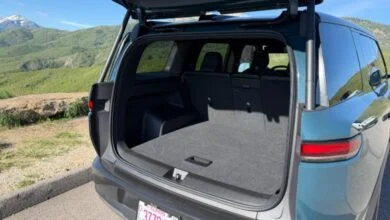
2026 Chevrolet Suburban High Country Review: The $100K King of Excess
Chevrolet's flagship three-row SUV is a masterclass in space and presence, but a few head-scratching details mar its six-figure ambitions.

There comes a point where an SUV gets so large that discussing it like a normal vehicle feels ridiculous. The 2026 Chevrolet Suburban crossed that line years ago. At 226.3 inches (5,748 mm) long, it’s closer to a small bus than most family vehicles. It dwarfs crossovers, overshadows parking spaces, and somehow manages to make full-size pickup trucks look reasonably sized. Yet despite all of that, people keep buying them in huge numbers.
After spending significant time with Chevrolet’s flagship three-row SUV, it is easy to understand why. It is a peerless road-trip weapon, but it also leaves us wondering why some of its strangest engineering and ergonomic decisions made it through development. The High Country tested here carried a sticker price of $100,985 before taxes and a $2,795 delivery fee, powered by GM’s familiar 6.2-liter V8 producing 420 hp (313 kW) and 460 lb-ft (624 Nm) of torque. The question is simple: is this enormous, six-figure SUV actually worth it?

Styling: A Majestic Whale
Let’s address the obvious fact first. The Suburban is objectively enormous. It’s also surprisingly handsome for something this large. The updated front fascia gives it a commanding presence without looking cartoonish. The body sides remain refreshingly simple. There aren’t endless creases, fake vents, or unnecessary styling tricks. It’s just a giant box executed reasonably well.
The rear end might actually be the strongest angle. The taillights look clean, the proportions work, and the dual exhaust outlets add a touch of visual flair that’s appropriate for a vehicle wearing a High Country badge. The 24-inch wheels deserve special mention.
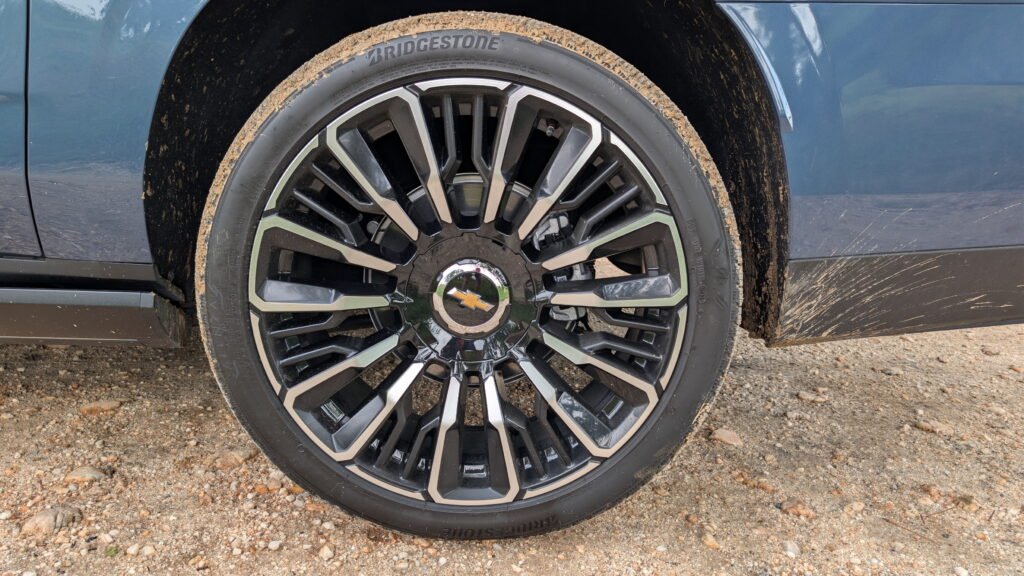
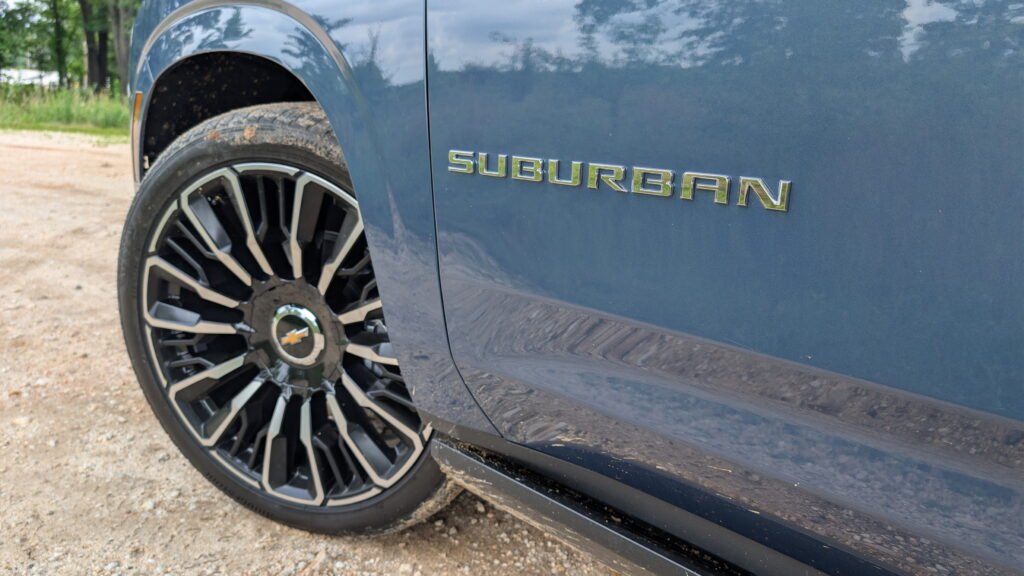
Normally, wheels this large look absurd. Here, they somehow look appropriate. If anything, they reinforce just how massive the Suburban really is. That said, replacing one or having to remove it for suspension or brake work is bound to induce some anxiety. They’re gigantic. Overall, Chevrolet has done a solid job making a vehicle this large feel expensive enough to justify a six-figure price tag. It’s commanding, upscale, and even a little glitzy—exactly what buyers in this segment want.
Interior: Premium Materials Meet Questionable Decisions
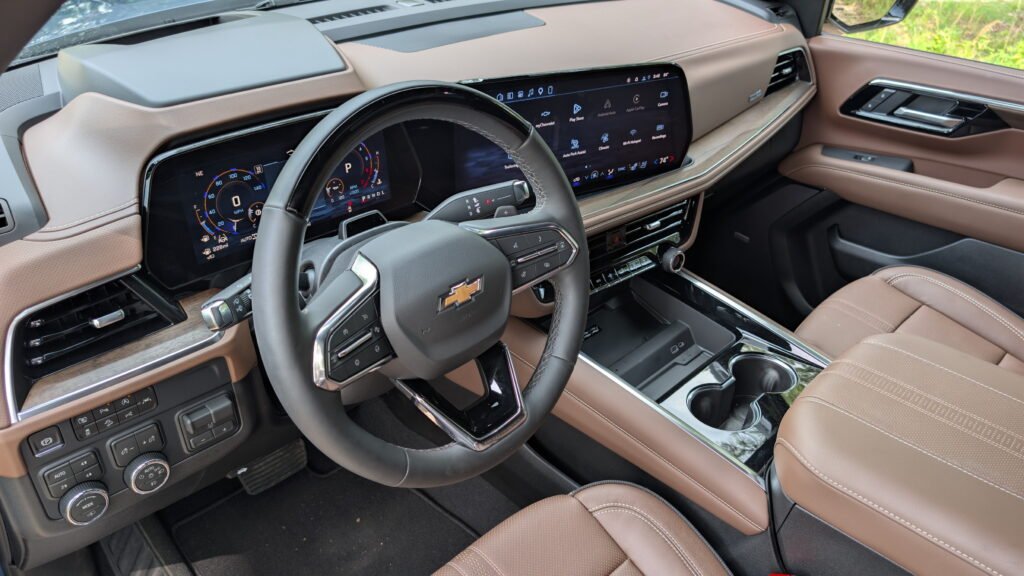
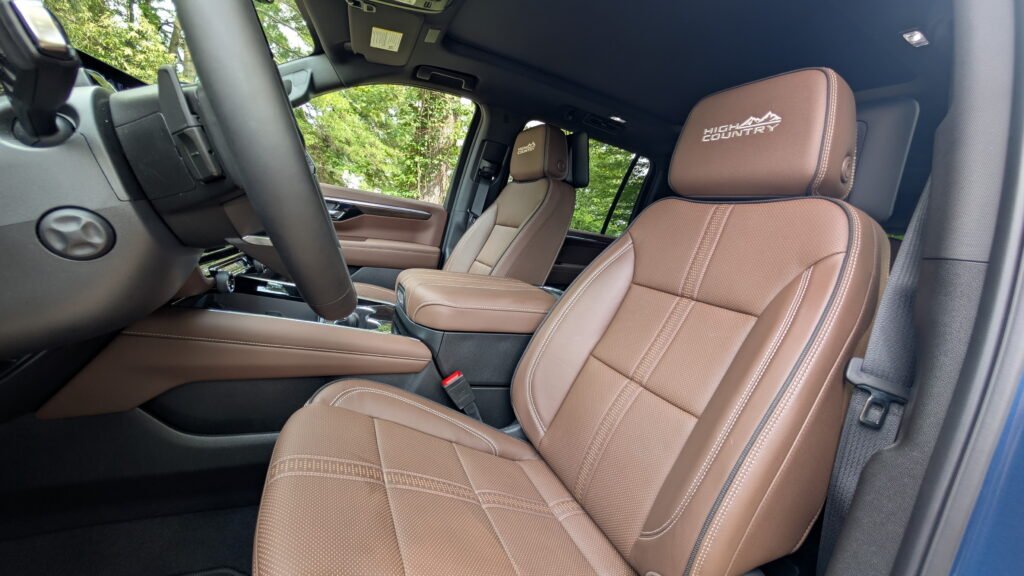
The cabin is where things get complicated. On one hand, there are genuinely premium touches throughout. The real wood trim is excellent, the leather feels rich, and the stitching is impressive. Material quality is largely worthy of the asking price. On the other hand, some decisions make absolutely no sense.
The biggest disappointment? The lack of massaging front seats. In a vehicle costing roughly $100,000, that’s difficult to excuse. The seats are heated, ventilated, comfortable, and supportive, but they’re not special. Competitors at this price point increasingly offer massage functions, and their absence here is highly noticeable.
Even the first moment of interacting with the vehicle—sliding your hand into the exterior door handle—starts to expose some cost-cutting. The Suburban doesn’t sense your hand to automatically unlock the doors. When a nearly 20-year-old 2008 BMW features proximity-sensing door handles, it is baffling how this six-figure “luxury” SUV lacks them today.
The infotainment system is another mixed bag. The screen itself is excellent, with sharp graphics, quick response times, and an intuitive interface. However, Chevrolet’s driver-focused layout goes a little too far. The display is angled toward the driver, which isn’t inherently a problem, but the only physical volume knob sits on the far upper-left corner of that screen.
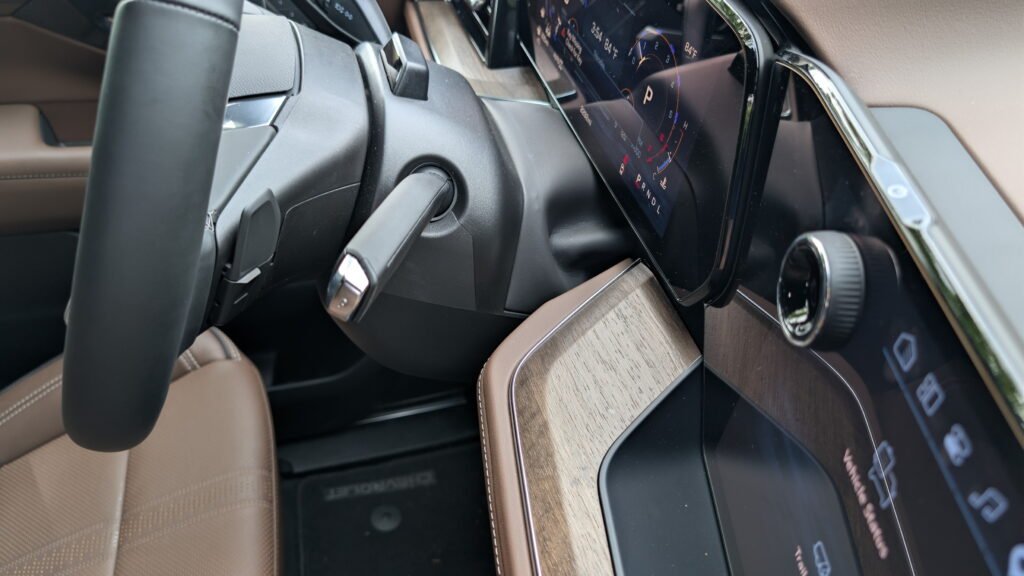
For the driver, that’s fine. For the front passenger, it’s comical. The passenger essentially has to reach across a football-field-sized center console to access it. Meanwhile, the driver has a second volume control located on the steering wheel just inches away from the main knob. One person gets two volume controls, while the other gets to do some stretching.
The digital instrument cluster also takes some getting used to. Unlike some rivals that allow extensive customization, Chevrolet limits drivers to a handful of pre-configured layouts. Certain information, including fuel economy data, only appears in specific views and only if you go to the center screen first to add it to the driver display. It works, but it feels restrictive compared to competitors.
Storage, meanwhile, borders on excessive. There are console-side pockets, phone storage trays, door bins, cupholders, and a traditional center-console compartment. Then things get weird. Hidden beneath the main console is another larger storage compartment that can only be accessed using a button mounted in the ceiling. Once opened, it reveals a slide-out drawer and a deeper storage area. It’s clever, but it’s also baffling. Why does a center console need an electric motor? Why is the switch overhead? Why couldn’t this simply be manual? It is easy to spend days with the vehicle before even discovering it exists.
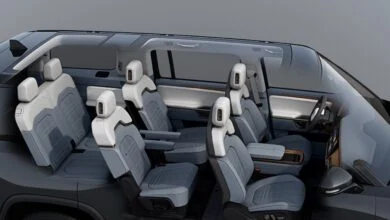
If you’re going anywhere in this vehicle, the second row is where you want to sit—especially on a road trip. The heated captain’s chairs are incredibly comfortable, and passengers get their own climate controls, HDMI inputs, USB-C ports, and a pair of bright, responsive rear infotainment screens complete with wireless headphones. The system allows multiple occupants to enjoy different media simultaneously without interrupting each other. For families, it’s genuinely excellent.
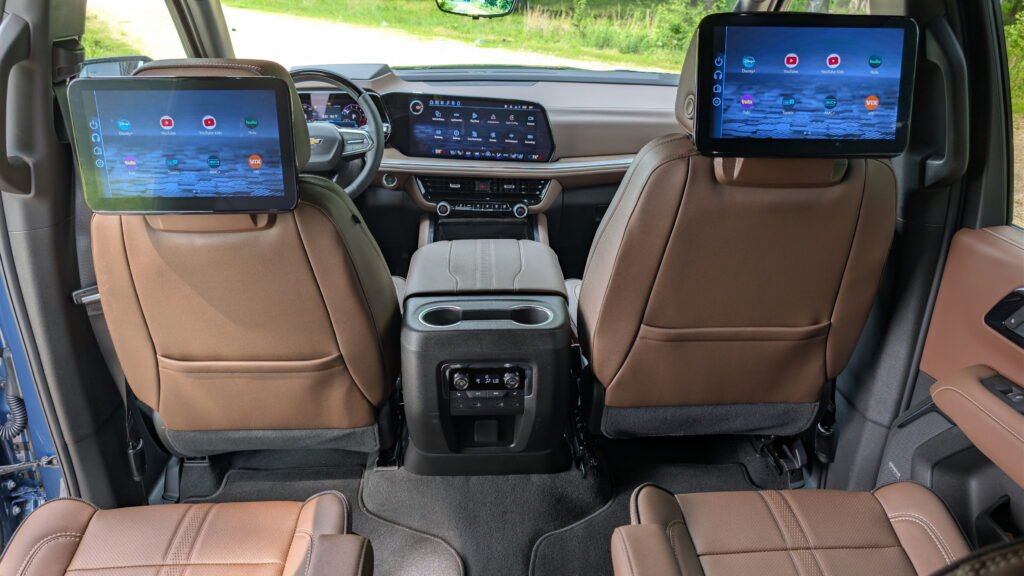
The third row is similarly impressive. Space is outstanding, with no headroom concerns whatsoever, and legroom remains genuinely adult-friendly. Third-row passengers also receive cupholders, storage cubbies, and USB-C charging ports. However, the seat-folding controls are a bit of a letdown. Like the Escalade IQ, the buttons require you to continuously hold them instead of offering convenient one-touch operation. Presumably that’s a safety decision, but it feels unnecessarily old-fashioned.
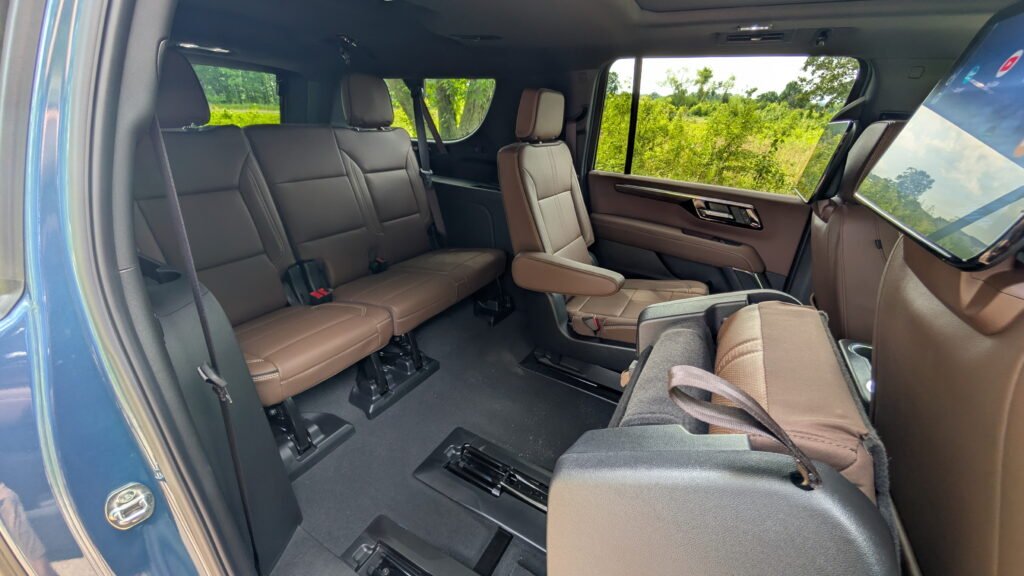
An interesting comparison emerges here. Many buyers dismiss minivans while simultaneously praising the Suburban’s spaciousness. Yet vehicles like the Kia Carnival offer remarkably similar passenger accommodations while often being easier to access and live with daily. The difference lies in cargo space behind the third row, heavy-duty towing capability, and available four-wheel drive. That’s where the Suburban earns its reputation.
Driving Impressions: Exactly As Big As It Looks
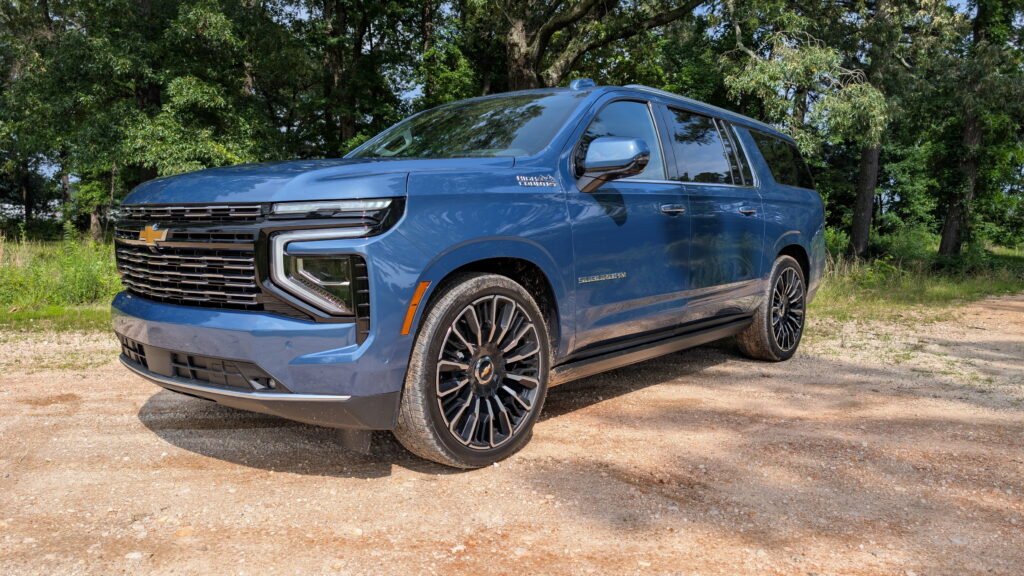
The Suburban feels huge because it is huge. No amount of engineering can completely disguise that fact. The 6.2-liter V8 sounds great and delivers respectable performance, but there’s simply too much mass here for the SUV to feel genuinely quick. Acceleration is adequate rather than exciting. You’ll never complain about it, but you’ll also never brag about it.
For drivers who prefer smaller vehicles, the Suburban can feel like a chore. It requires constant awareness of curbs, tight parking lots, narrow roads, and surrounding traffic. It always feels like you’re operating something substantial. That said, most buyers in this segment won’t care; in fact, they’ll probably love the commanding view.
The suspension tuning is excellent. The Suburban absorbs broken pavement with remarkable ease and shrugs off speed bumps in a way that almost makes them irrelevant. Steering is competent if forgettable—neither especially communicative nor annoyingly numb. The brakes require slightly more pedal effort than expected at first, but that’s understandable given the vehicle’s size and weight.
Then there’s Super Cruise. It’s fantastic. GM’s hands-free driving system remains among the best on sale today. Automatic lane changes work smoothly, communication is clear, and the system does an excellent job explaining what it sees and when it needs driver intervention. For long highway stints, this is a road trip dream machine.
Fuel Economy
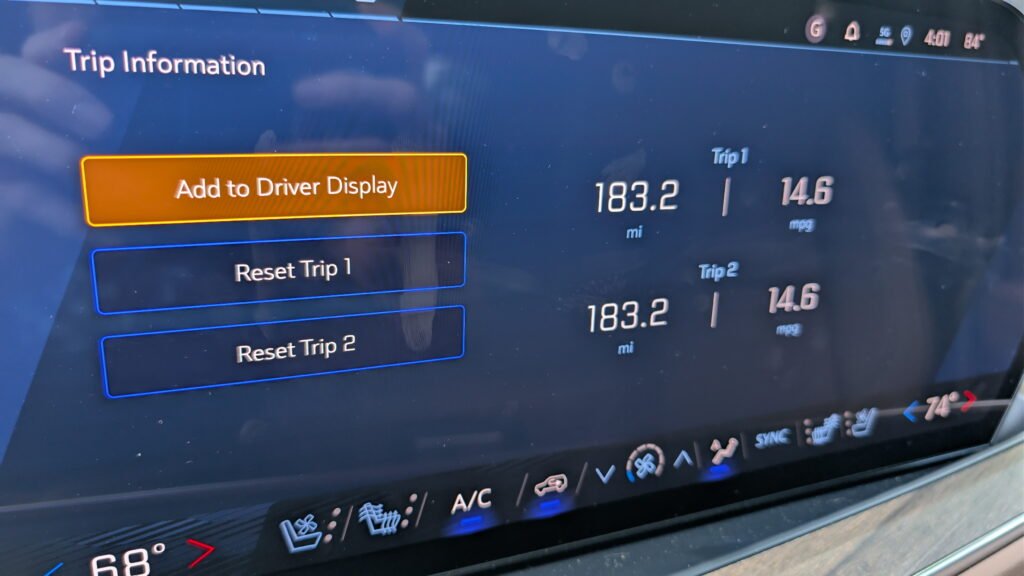
Over a mix of city and highway driving, the Suburban returned 14.6 mpg. That’s almost perfectly in line with its EPA combined rating of 16 mpg, which breaks down to 14 mpg city and 18 mpg highway. It’s also painful. There’s really no way around that, given the current prices of fuel and how many more miles buyers can get if they’re willing to look at the best competition for this vehicle.
The Big Minivan Problem
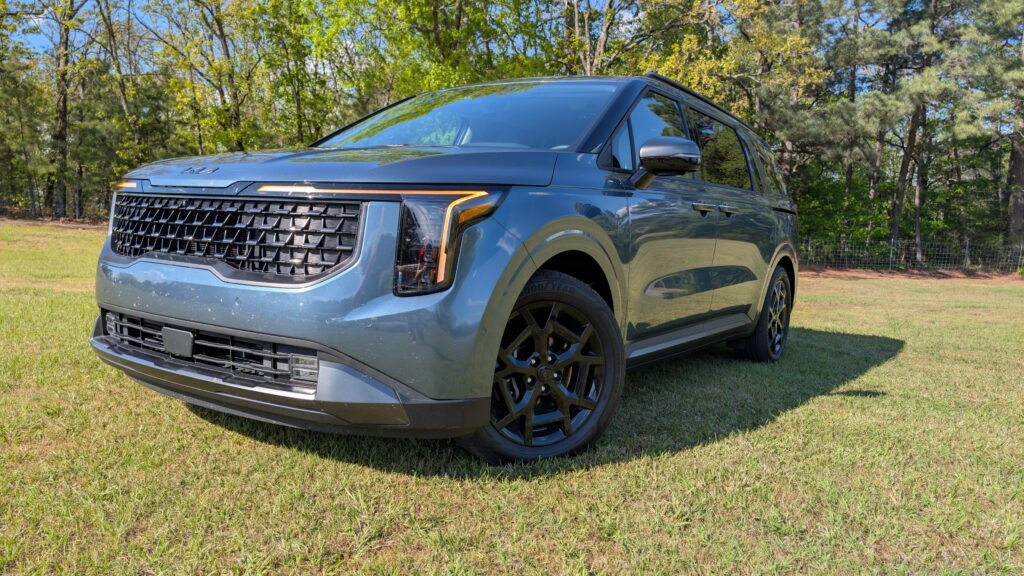
The biggest competitor to the Suburban may not be another SUV at all. It’s the humble minivan.
Vehicles like the Kia Carnival, Toyota Sienna, and Honda Odyssey deserve far more consideration than most shoppers give them. They offer superior fuel economy, easier maneuverability, easier access, and in many cases, packaging that’s every bit as family-friendly. However, if you genuinely need four-wheel drive, substantial towing capability, or simply refuse to drive a minivan, the Suburban makes more sense.
Among traditional SUV rivals, the GMC Yukon XL is its closest relative, while the Jeep Grand Wagoneer remains a compelling alternative. The Wagoneer deserves particular attention because it manages to feel noticeably smaller than it actually is from behind the wheel while offering more serious off-road hardware in certain configurations.
The Verdict
The 2026 Chevrolet Suburban High Country is simultaneously one of the easiest and hardest vehicles to recommend. It’s enormously practical, exceptionally spacious, comfortable on long trips, and packed with technology. Families who regularly haul seven or eight people plus cargo will struggle to find anything more capable.
At the same time, it costs over $100,000, drinks fuel at an alarming rate, omits features that should be standard at this price, and never lets you forget just how massive it is. Still, the Suburban remains successful because it delivers exactly what its buyers want: maximum space, maximum presence, and maximum capability. It’s a whale. But as whales go, it’s a pretty good one.