Robots Outrun Usain Bolt in Beijing as U.S. Crackdown Targets Chinese Tech
Chinese-built machines eclipse human running and jumping marks in Beijing amid expanding U.S. security bans.
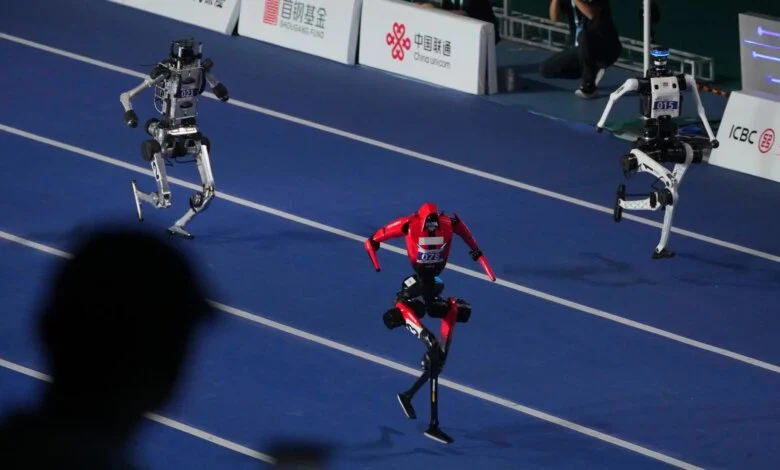
China showcased its rapidly advancing robotics capabilities in Beijing on Saturday, fielding hundreds of humanoid machines that shattered long-standing human athletic benchmarks. The opening of the second annual World Humanoid Robot Games comes at a moment when Beijing is using massive public demonstrations to assert technical leadership in advanced robotics. The five-day event is taking place at the National Speed Skating Oval, an arena originally constructed for the 2022 Winter Olympics.
During initial trial runs leading into the games, a humanoid robot developed by Chinese consumer electronics manufacturer Honor clocked a 100-meter sprint time of 9.32 seconds. Company officials reported that the machine reached a peak speed of 14.5 meters per second during the run. In official competition on Saturday, a separate humanoid built by Beijing-based X-Humanoid completed the 100-meter dash in 9.39 seconds. Both times surpassed the world record of 9.58 seconds set by Jamaican track star Usain Bolt in 2009.
X-Humanoid also claimed a record in the standing high jump event, where its robot reached a height of 2.88 meters. That mark exceeded the human high jump record of 2.45 meters established by Cuba’s Javier Sotomayor in 1993. It also represented a sharp technical leap from the inaugural 2025 games, where the top vertical jump by a humanoid reached 0.95 meters.
The athletic demonstrations coincide with escalating regulatory pressure from Washington aimed at curtailing China’s robotics industry. The U.S. Federal Communications Commission recently instituted a comprehensive ban on imports of newly manufactured foreign humanoid robots, citing potential national security threats posed by Chinese hardware and software architectures. Simultaneously, the U.S. Department of Defense expanded its list of Chinese military-linked firms to include Hangzhou-based Unitree Robotics, a leading manufacturer of quadruped and humanoid robots.
Beijing officials have criticized the American regulatory bans, emphasizing that domestic manufacturing currently supplies the majority of global humanoid robot demand. The robot games are running parallel to the 2026 World Robot Conference in the capital, where commercial vendors are displaying approximately 3,000 industrial and service automation products. Organizers stated that over 2,000 humanoid robots are participating across 51 distinct event categories, with international entrants representing 16 countries, including team submissions from Germany, Japan, and the United States.
Power density, dynamic balance control, and operational software reliability must improve before bipedal robots leave laboratories and pilot programs, industry analysts say, despite the high-speed athletic metrics on display. Widespread commercial deployment across industrial assembly lines and consumer homes awaits those breakthroughs. Spectators at the venue noted that seeing robots perform human athletic feats underscored the speed of AI system development.
The competition schedule spans more than 1,000 individual matches over five days. Beyond track and field trials, participating humanoids are slated to compete in technical head-to-head categories including weightlifting, table tennis, soccer matches, and tug of war.