Inside the Rivian R2: How Customer Feedback and Redesigned Tech Shape the New Electric SUV
Customer feedback drives key storage, space, and software upgrades in the upcoming electric SUV.
Rivian has unveiled the interior and technology specifications for its upcoming R2 SUV, showcasing a design that remains familiar to R1 owners while incorporating numerous adjustments driven by customer feedback and engineering experience.
To optimize cabin space, Rivian relocated the door speakers to the center console, a move that improves audio quality while freeing up door pockets to accommodate large water bottles. Storage options have been expanded to include two gloveboxes—one in the traditional passenger-side location and a second positioned directly beneath the center touchscreen. The center armrest features internal storage alongside two slide-out cupholders, complemented by an open floor area ahead of the console designed for bags.
Passenger Space and Cargo Capacity
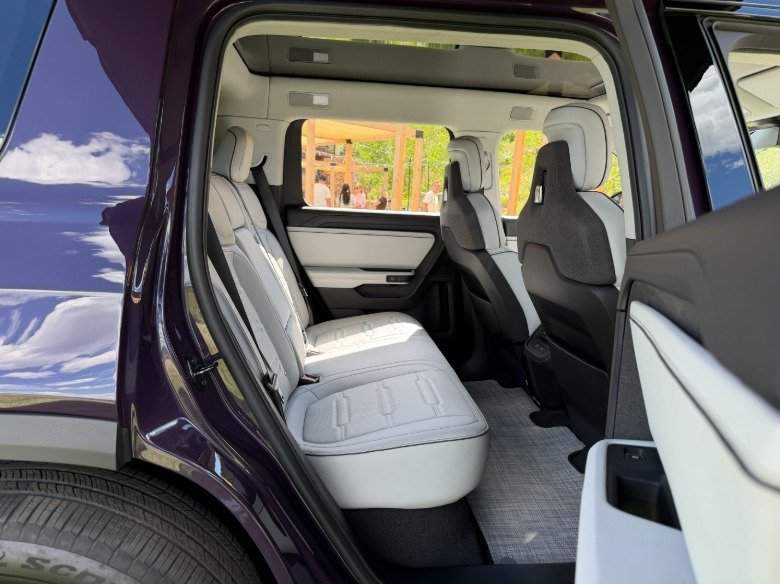
Despite its smaller exterior dimensions relative to the R1S, the R2 offers competitive interior space. The second row provides 40.4 inches of legroom and 40.4 inches of headroom, surpassing the rear-passenger dimensions of the larger R1S. A low, flat floor design prevents rear passengers’ knees from being sharply angled. For the driver, the R2 offers an assertive, SUV-style seating position with high visibility, aided by a hood design that clearly defines the vehicle’s front corners and wheel placement, alongside large side windows.
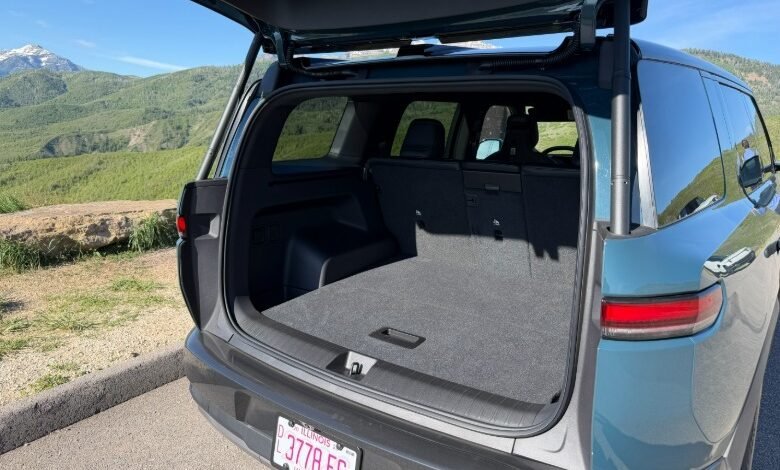
In terms of utility, the R2 offers 28.7 cubic feet of cargo volume behind the second row, which is 2.5 cubic feet larger than the Hyundai Ioniq 5. Folding the 40/20/40-split rear seats flat expands the cargo capacity to 79.4 cubic feet, outperforming the Hyundai competitor by 21 cubic feet. The R2 also includes an underfloor storage area large enough to fit a carry-on suitcase, while the power-opening, self-latching front trunk (frunk) provides an additional 5.2 cubic feet of space—enough for a carry-on bag and a backpack, or six grocery bags.
Daniel Golson/Jalopnik
Materials and Cabin Refinement
The cabin utilizes Rivian’s Adventex bio-based leather alternative, which features real accent stitching throughout the interior. Padded surfaces are applied to high-touch areas, including the door grab handles. The dashboard is accompanied by a large swath of birch wood trim, with a specialized textile applied to the door panels and seatbacks. Buyers looking for the off-white Ocean Coast interior package will need to wait until later this year.
Daniel Golson/Jalopnik
Infotainment and Software Updates
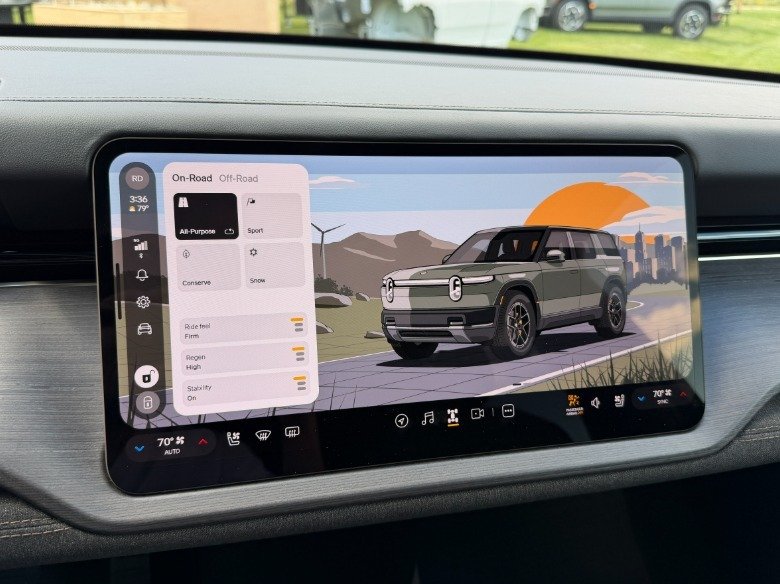
The R2 introduces a redesigned software interface with thinner screen bezels. The driver’s gauge screen measures 11.5 inches and is shorter and wider than the unit found in the R1. The primary 15.6-inch center touchscreen features updated menus, a left-side shortcut bar, and new gesture controls, such as swiping audio pop-up boxes across the display. The system retains Rivian’s signature cel-shaded graphic style.
Rivian continues to exclude Apple CarPlay and Android Auto from its vehicles. The infotainment system relies on built-in applications, including Apple Music, and a proprietary navigation system that utilizes Google Maps data for route planning.
Daniel Golson/Jalopnik
The vehicle also features the newly introduced Rivian Assistant, an in-house voice control system that is also being rolled out to existing R1 vehicles. The assistant operates offline to control infotainment settings, adjust drive modes, and answer vehicle-specific questions.
Background and Context
To help readers better understand the positioning of this vehicle, it is useful to look at Rivian’s broader product strategy and industry trends.
The Evolution of Rivian’s Vehicle Lineup
Founded in 2009, Rivian Automotive established its brand identity with the high-end R1T electric pickup truck and the R1S three-row SUV. Built on Rivian’s first-generation platform, these vehicles targeted the premium luxury segment. The R2 represents Rivian’s transition toward a more accessible, mid-size platform designed to compete directly in the highly active mid-size SUV market, where cargo efficiency and passenger space are primary selling points.
The Rise of Sustainable Cabin Materials
The use of materials like the Adventex bio-based leather alternative reflects a broader automotive industry shift. Many electric vehicle manufacturers are moving away from traditional animal-sourced leathers in favor of synthetic, plant-based, or recycled textiles. This transition helps manufacturers lower the overall lifecycle carbon footprint of their vehicles and appeals to environmentally conscious consumers.
The Proprietary Software Strategy
Rivian’s decision to exclude third-party smartphone mirroring software like Apple CarPlay and Android Auto is a strategic choice shared by a few other EV makers, most notably Tesla. By maintaining complete control over the infotainment ecosystem, manufacturers can deeply integrate vehicle functions—such as battery pre-conditioning, live charging-station routing, and over-the-air performance updates—directly into the native navigation and user interface.