Prussian Blue Nanoparticles Push Perovskite Solar Cells to 26.9%
Rigid nanoparticle frameworks trap mobile ions and repair crystal defects, enabling certified 22.9% efficiency on large-scale submodules.
A centuries-old pigment is solving one of the most stubborn engineering problems in next-generation photovoltaics. Researchers at the Chinese Academy of Sciences have used Prussian blue nanoparticles to stabilize perovskite solar cells, pushing inverted device efficiency to 26.9% while dramatically slowing the material degradation that has kept the technology out of mainstream power grids.
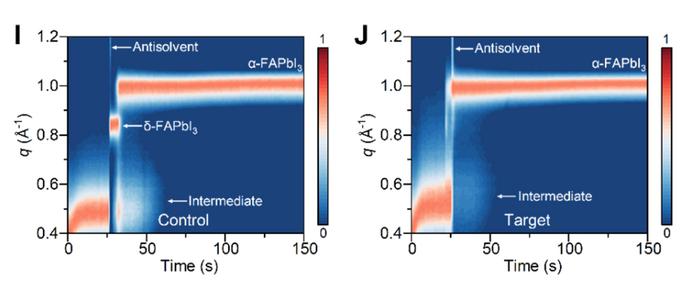
The findings, published in Science, address a critical bottleneck for formamidinium lead iodide (FAPbI3) perovskites. While FAPbI3 offers an ideal bandgap for converting sunlight into electricity, its photoactive alpha-phase is notoriously difficult to maintain. Without intervention, the crystal structure readily shifts into inactive phases and generates mobile ions that short-circuit the cell from within.
Prussian blue, a synthetic iron-based coordination polymer first discovered in the early 18th century, provides a rigid, open-framework scaffold that structurally matches the perovskite lattice. Rather than acting as a passive additive, the nanoparticles template the crystallization process during manufacturing, forcing the perovskite into its optimal alpha-phase alignment and reducing internal lattice strain.

Once the cell is operational, the framework actively repairs chemical damage. Mobile cesium ions and neutral lead or iodine defects—byproducts of electrical bias, heat, and light exposure—are chemically converted back into their functional ionic states and physically trapped by the Prussian blue matrix. The team measured this suppression directly: the activation energy required for ion migration jumped from 0.89 electron volts to 1.25 electron volts, a threshold high enough to lock the lattice in place under standard operating conditions.
This stabilization translated into immediate performance gains across both major solar cell architectures. Conventional n-i-p devices climbed from 24.2% to 26.1% power conversion efficiency. Inverted p-i-n cells, which are generally favored for commercial manufacturing because they operate at lower processing temperatures and integrate more easily with existing silicon production lines, reached 26.9%. An independent laboratory certified the inverted architecture at 26.2%.
Scaling laboratory efficiencies to commercial panel sizes typically triggers severe performance drops due to uneven film deposition and amplified defect densities over larger areas. The Prussian blue treatment mitigated these scaling losses. A 6 cm × 6 cm conventional minimodule achieved 23.4% efficiency, up from 20.1% in untreated reference panels. More significantly, a 30 cm × 30 cm inverted submodule covering a 756-square-centimeter aperture area secured a certified efficiency of 22.9%, maintaining 22.8% under stabilized measurement protocols.
Longevity remains the primary barrier separating perovskite research from commercial deployment. Silicon panels routinely carry 25-year warranties, whereas perovskites historically degrade within months under environmental stress. The CAS modules retained over 90% of their initial output after 2,500 hours in a damp-heat chamber set to 85 C and 85% relative humidity—an industry-standard torture test for photovoltaic qualification. Under continuous operation at 65 C and 50% relative humidity, the panels held above 80% efficiency for 2,200 hours.
Accelerated aging models project a T80 lifetime—the duration until a panel loses 20% of its original capacity—of approximately seven years at 35 C under constant illumination. The researchers cautioned that this figure relies on extrapolation from accelerated testing rather than real-time field data. However, a five-month outdoor deployment in Zhuhai, China, showed no measurable performance decline when compared side-by-side with a commercial silicon reference module.
The use of coordination polymers marks a departure from traditional organic passivation molecules, which often break down under ultraviolet light or thermal cycling. By leveraging an inorganic framework capable of dynamic ion exchange, the approach borrows chemistry more commonly associated with battery electrolytes and water purification systems than thin-film solar manufacturing.
Corresponding author Yu Chen indicated that the structural compatibility of the Prussian blue framework preserves electronic homogeneity under bias, a prerequisite for manufacturing reliable large-area modules. The research team continues to evaluate the long-term outdoor performance of the treated submodules following the Zhuhai deployment.