ArcActive Tests Bipolar Lead-Acid Battery at Deakin Microgrid
The Origin Zero-backed pilot leverages established lead-acid safety frameworks to reduce installation hurdles for industrial solar storage.
A New Zealand battery developer has energized a commercial-scale pilot using advanced lead-acid chemistry, betting that modernizing one of the world’s oldest rechargeable battery technologies can bypass the permitting and insurance bottlenecks slowing energy storage adoption at industrial sites.
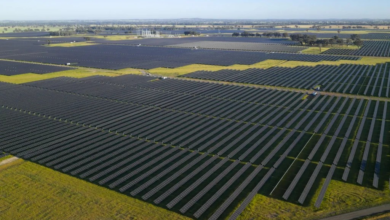
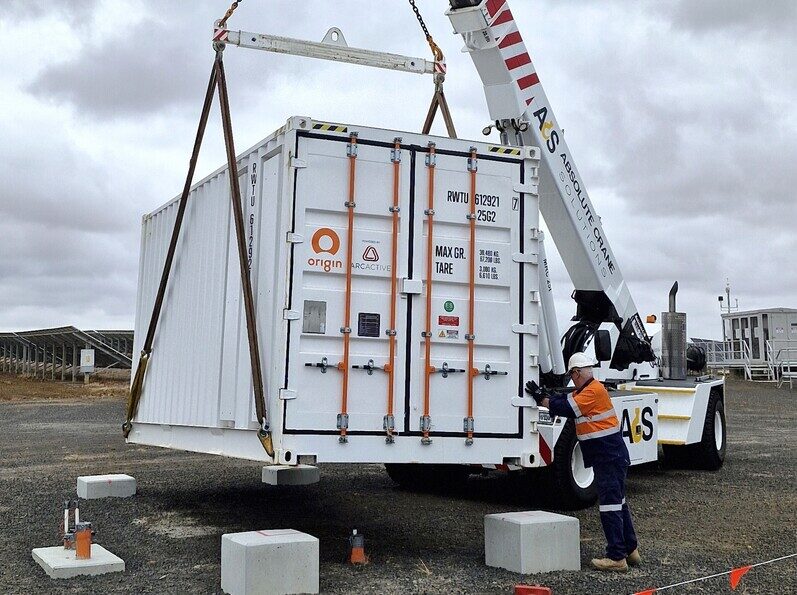
ArcActive activated its fabric-electrode bipolar lead-acid system this week inside the 7.25-megawatt microgrid testing facility at Deakin University’s Waurn Ponds campus in Victoria, Australia. The installation operates within the university’s renewable energy microgrid, which manages electricity generation and storage for daily campus operations.

The project targets factories, warehouses, and retail centers attempting to capture cheap daytime solar power for later use. While lithium-ion systems dominate grid-scale storage discussions, commercial property owners frequently abandon behind-the-meter battery projects because site-specific engineering, fire safety reviews, and insurance underwriting drive total installation costs far above the price of the cells themselves.
Lead-acid batteries have powered telecommunications networks, hospital backup systems, and data centers for decades. Because local fire authorities, building code officials, and commercial insurers already possess established frameworks for evaluating flooded and valve-regulated lead-acid installations, ArcActive Chief Executive Stuart McKenzie argues that deploying an updated version of the chemistry removes the regulatory uncertainty that stalls commercial investments.
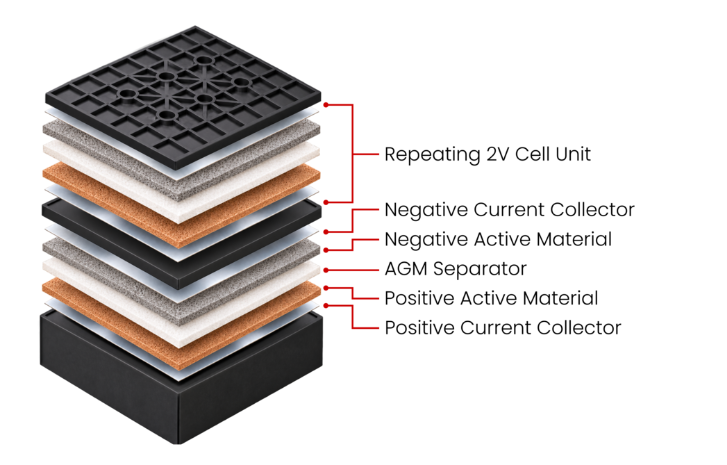
Unlike conventional lead-acid designs that wire individual cells together with external straps, ArcActive uses a bipolar architecture. Cells are stacked vertically in a compressed, layered structure where a single conductive plate serves as the positive terminal for one cell and the negative terminal for the adjacent cell. Current travels directly through the thickness of the stack rather than laterally across interconnecting hardware.
This vertical current path lowers internal electrical resistance and distributes power more evenly across the electrode surface. The uniform compression also stabilizes the positive electrode’s active material, reducing shedding — a primary cause of capacity fade in traditional lead-acid batteries over repeated charge cycles.
Compressing standard negative electrodes typically restricts electrolyte flow by collapsing pore structures, degrading performance. ArcActive addresses this physical limitation by substituting conventional grids with a proprietary fabric electrode material designed to maintain porosity and electrolyte access even under high mechanical pressure.

Bipolar lead-acid designs have been researched since the late 20th century but historically struggled with internal short circuits and sealing failures between stacked layers. Advances in composite bipolar plates and specialized separators have recently revived commercial interest in the topology as industries seek alternatives to lithium-ion supply chains heavily dependent on cobalt, nickel, and lithium processing concentrated in specific geographic regions. Lead-acid infrastructure, by contrast, relies on one of the most mature and successful closed-loop recycling ecosystems globally, routinely recovering over 99% of battery materials in North America and Europe.
Origin Energy’s commercial technology division, Origin Zero, supported the Deakin deployment. The battery system is also integrated into Origin’s virtual power plant network, allowing the utility to aggregate and dispatch the stored energy alongside other distributed assets to stabilize the broader grid.
Origin Group Manager for Customer Solution Development and Emerging Technology Bill Truscott said the trial provides operational data on how emerging storage formats perform under real commercial load profiles, helping utilities refine offerings for industrial customers managing volatile wholesale electricity prices.
The Waurn Ponds microgrid continues to log operational performance data from the ArcActive stack as it cycles through daily charge and discharge routines connected to the Origin virtual power plant.