Solar Shields Europe From 2026 Gas Crisis, But Night Prices Surge
Record solar output held midday power prices below gas-generation costs, while overnight rates spiked and negative pricing hours multiplied across Spain, Germany and Greece.
European electricity markets fractured into two distinct realities during the 2026 Iran conflict: midday hours insulated by a massive expansion in solar capacity, and evening hours battered by soaring natural gas costs. The divide exposes a grid that has solved half of its energy security problem while leaving consumers and industries fully exposed to fossil fuel volatility after sunset.
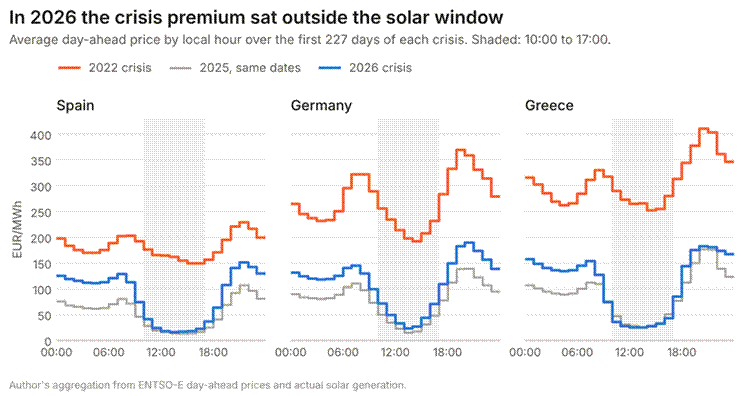
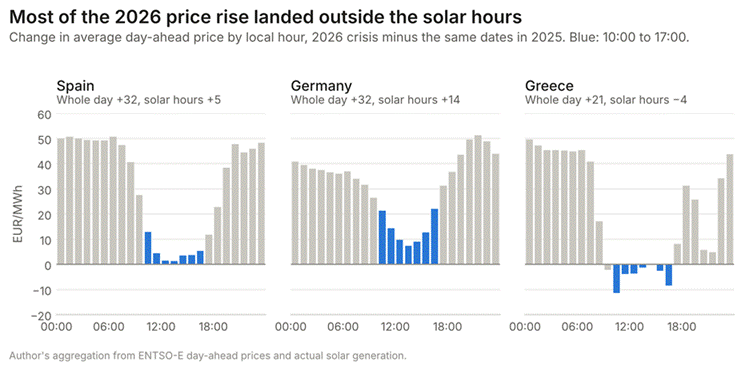
Between late February and mid-October 2026, day-ahead wholesale prices in Spain, Germany and Greece collapsed to between €16 and €25 per megawatt-hour during the cheapest daylight periods. Those rates sat far below the roughly €97/MWh required to operate a standard combined-cycle gas turbine at 55% efficiency, accounting for front-month Title Transfer Facility (TTF) gas futures that averaged approximately €54/MWh from March through September. Yet outside those sunlit windows, the same markets registered severe price spikes. Overnight electricity costs climbed €36 to €51/MWh compared with identical calendar dates in 2025, pushing evening averages into the €116 to €178/MWh range.
The structural difference between this shock and the 2022 crisis following Russia’s invasion of Ukraine lies entirely in the scale of renewable generation deployed over the intervening four years. When European gas markets seized in 2022, TTF futures averaged roughly €155/MWh during the spring and summer months. Solar capacity was insufficient to decouple any part of the day from those fuel costs, leaving the absolute cheapest hour of the average day at €149/MWh in Spain, €193/MWh in Germany and €252/MWh in Greece.

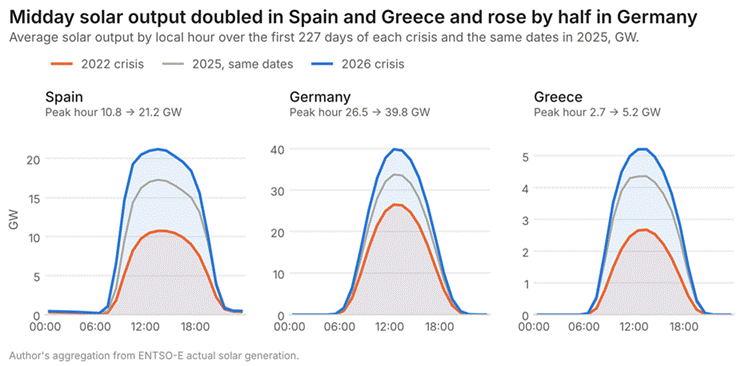
By the 227-day window spanning Feb. 28 to Oct. 12, 2026, peak solar output had doubled in Spain and Greece and risen by 50% in Germany. Spanish installations delivered 21.2 gigawatts during their highest-producing hour, up from 10.8 GW in 2022. German solar peaked at 39.8 GW against 26.5 GW previously, while Greek output reached 5.2 GW compared to 2.7 GW. Total reported solar generation logged by the European Network of Transmission System Operators for Electricity (ENTSO-E) surged from 23.8 terawatt-hours to 49.4 TWh in Spain, from 48.5 TWh to 74.7 TWh in Germany, and from 4.7 TWh to 10.0 TWh in Greece.
This concentrated daytime production effectively severed the link between global gas shocks and local electricity bills for roughly seven hours a day. In Spain, prices remained below €50/MWh from 10:00 to 18:00. Germany sustained that threshold from 11:00 to 16:00, and Greece from 10:00 to 17:00. The seven midday hours in Spain accounted for only 4% of the overall rise in the country’s baseload price compared to 2025, despite representing 29% of the day.
The oversupply during peak irradiance triggered an unprecedented volume of negative pricing. Across the 2026 event window, Spain recorded 547 hours of negative day-ahead prices, Germany logged 459 hours and Greece saw 476 hours. By comparison, the 2022 crisis produced zero negative-price hours in Spain or Greece and only 32 in Germany. Between 19% and 23% of all solar energy generated in each market during the 2026 window was produced while wholesale prices sat below zero.
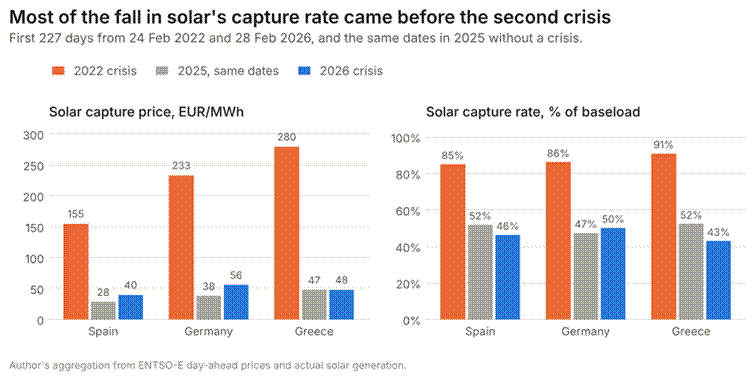
While negative pricing benefits consumers buying power on the spot market, it severely damages the economics of unsubsidized solar projects through a mechanism known as the cannibalization effect. Because solar farms generate simultaneously, they flood the grid precisely when demand is already being met, driving down the specific revenue they earn relative to the flat baseload average. During the 2026 crisis window, solar capture prices plummeted 74% in Spain, 76% in Germany and 83% in Greece compared to 2022 levels.
September 2026 illustrates this dynamic clearly. Spain’s monthly baseload average reached €143/MWh, nearly identical to the €141/MWh recorded in September 2022. However, Spanish solar generators earned just €66/MWh last month, down from €116/MWh four years earlier. Even when the broader market price remains elevated, the value captured by solar assets continues to erode as installed capacity grows. On a full-year basis, Spain’s solar capture rate fell from 90% in 2022 to 55% in 2025, Germany’s dropped from 94% to 51%, and Greece’s declined from 94% to 58%.
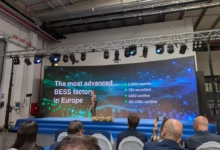
This widening gap between near-zero midday prices and triple-digit evening rates has fundamentally altered the investment case for utility-scale battery storage. Lithium-ion battery costs have fallen steadily since 2022, but the revenue potential for shifting energy has accelerated faster. During the 2026 window, a theoretical battery charging during Spain’s two cheapest consecutive hours and discharging during the two most expensive would have captured a spread of €131/MWh, up from €88/MWh during the same dates in 2025. In Germany, that arbitrage spread widened from €123/MWh to €161/MWh. Greece saw a smaller increase, moving from €150/MWh to €157/MWh, largely because evening prices were already elevated prior to the conflict.
Approximately 128 gigawatt-hours of solar energy per day across the three markets was generated during negative-price intervals. Shifting even a fraction of that volume into the evening peak would simultaneously eliminate the price-depressing oversupply at noon and reduce reliance on gas-fired peaker plants after dark. Current spreads are derived from averaged profiles and do not account for round-trip efficiency losses, which typically consume 10% to 15% of stored energy in commercial lithium-ion systems, nor do they reflect how deploying additional batteries will eventually compress the very arbitrage margins they seek to exploit.
Monthly TTF closes climbed from roughly €31/MWh in February 2026 to approximately €84/MWh by Oct. 12, tracking the escalation of hostilities. Baseload prices in all three markets remained more than 10% above their 2025 levels starting in May for Germany, July for Spain and August for Greece. Throughout this period, the share of each additional euro added to the baseload price that actually reached solar generators varied sharply: Spanish solar captured 37 cents, German solar 57 cents, and Greek solar captured almost nothing over the full window due to heavy negative pricing between March and June offsetting summer gains.