UV Down-Shifting Layers Could Turn Sunlight’s Most Damaging Rays Into Extra Power for TOPCon Solar Panels
Luminescent encapsulants convert cell-damaging UV photons into extra electricity, modeling shows 4%+ decade gain
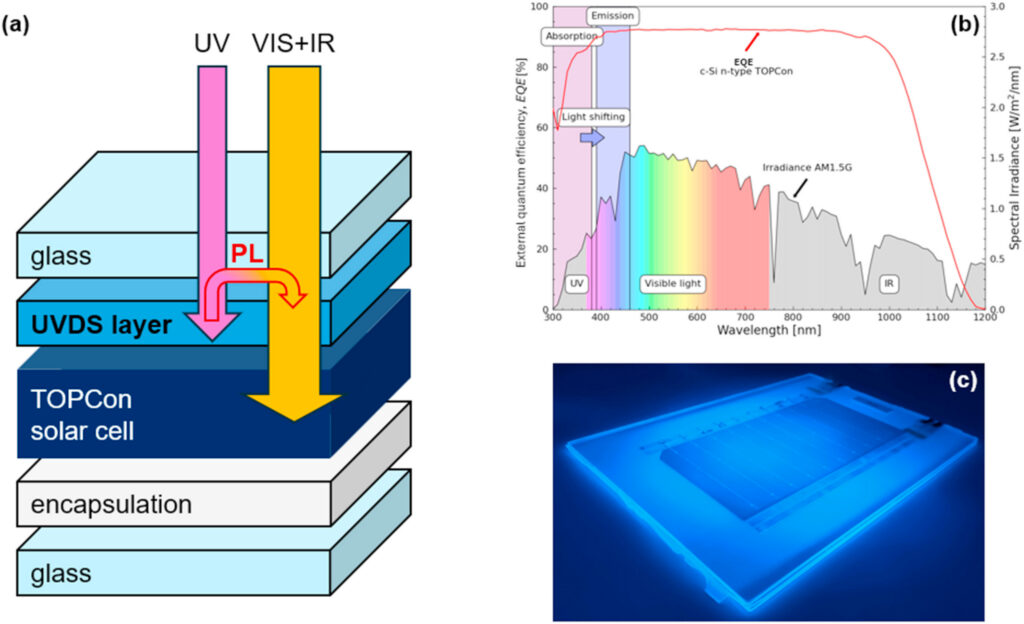
A research team at the University of Ljubljana has demonstrated that luminescent ultraviolet down-shifting (UVDS) layers integrated into solar module encapsulants can convert cell-damaging UV photons into usable visible light, potentially eliminating a key degradation pathway for high-efficiency TOPCon photovoltaics while delivering a net energy gain over a decade of operation.
Tunnel oxide passivating contact (TOPCon) cells have rapidly captured market share from older PERC designs because their rear-side passivation scheme pushes conversion efficiencies above 24% in volume production. But the same thin tunnel oxide layer that enables those gains also makes TOPCon devices unusually sensitive to ultraviolet-induced degradation — a phenomenon that can erode open-circuit voltage by several percent within the first few years of field exposure. Conventional encapsulants block UV with additives that simply dissipate the energy as heat, sacrificing those photons entirely.
The Slovenian group took a different approach. They dispersed organic photoluminescent dyes into a polyolefin elastomer (POE) matrix using a twin-screw cast extrusion process already common in encapsulant manufacturing, producing films roughly 400 micrometers thick. Optical characterization showed the dyes absorb more than 90% of incident UV photons and re-emit them at longer wavelengths with a photoluminescence quantum yield of approximately 95% — meaning nearly every absorbed UV photon emerges as a visible photon that the silicon cell can convert to electricity.
Optical modeling validated against mini-module measurements revealed the trade-offs. Without photoluminescence, a UVDS layer absorbing 90% of UV light would cut short-circuit current density by 1.77%. With the dye’s conversion active, that loss shrank to just 0.20%. Even the most heavily doped formulation limited current losses to 0.34% while still blocking the vast majority of damaging radiation. Compared against hypothetical UV blockers that lack photoluminescence, the UVDS approach recovered enough converted photons to yield a relative photocurrent gain exceeding 2%.
The economic case hinges on durability. The researchers simulated 10-year energy production in Minneapolis and Phoenix assuming unprotected TOPCon cells suffer a 6% voltage loss from UV degradation — a figure consistent with accelerated aging literature for n-type passivating contacts. If the UVDS layer fully prevents that degradation, an initial performance penalty of roughly 1% is outweighed by more than 4% additional cumulative energy harvest over the decade. In high-irradiance climates like Phoenix, the breakeven point arrives even earlier.
Several hurdles remain before commercial deployment. The dyes must withstand decades of thermal cycling, humidity, and intense UV flux without photobleaching or leaching from the POE matrix — a stability challenge that has stymied previous luminescent down-shifting efforts. Manufacturing integration also requires the extrusion process to maintain dye dispersion uniformity at gigawatt-scale throughput. Cost targets are stringent: encapsulant materials typically account for 3–5% of module bill-of-materials, leaving little margin for premium additives unless the energy-yield uplift is guaranteed.
The work, published in Solar Energy Materials and Solar Cells, provides a quantitative framework linking dye absorption spectra, emission profiles, quantum yield, and layer thickness to module-level energy yield under realistic spectra and operating temperatures. That framework is now being used to screen candidate dye chemistries for accelerated aging tests, the next step toward validating whether the modeled decade-long gains survive real-world exposure.