Maxxen Energy Ramps 5 GWh Battery Plant in Türkiye
Swiss-backed integrator leverages Hithium LFP cells and a Turkish factory to cut European utility storage delivery times to under two weeks.
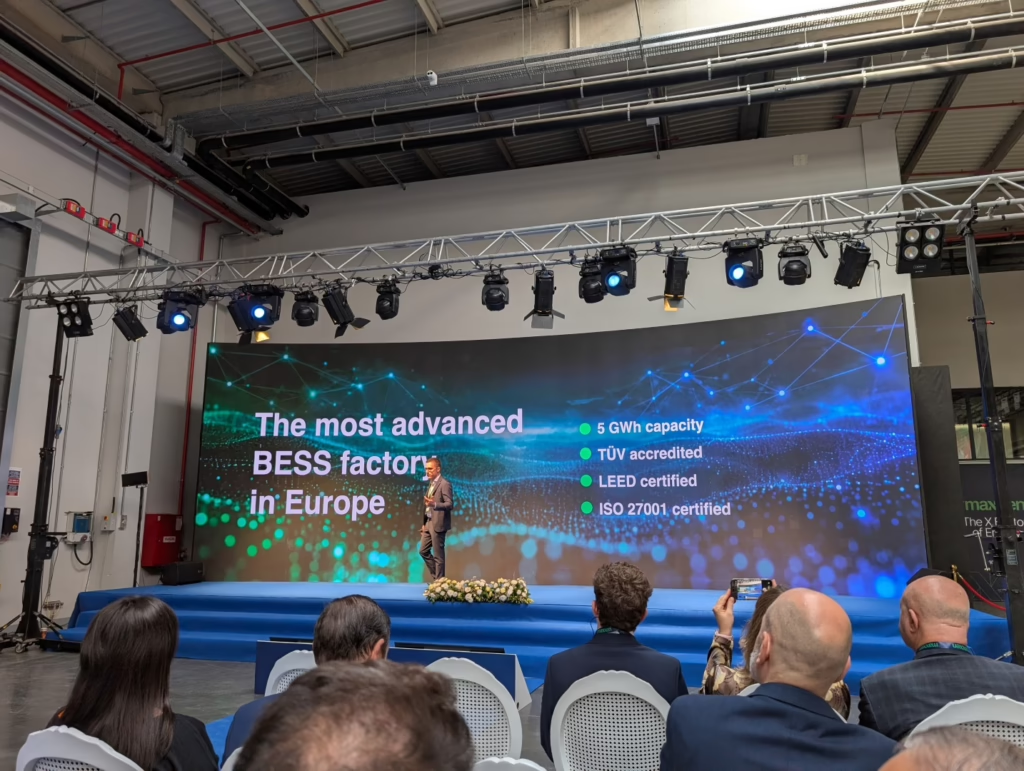
A Swiss-headquartered battery assembler is leveraging Turkish manufacturing infrastructure and Chinese lithium iron phosphate cells to undercut delivery timelines for European utility-scale energy storage projects. Maxxen Energy, a wholly owned subsidiary of Turkish engineering firm Kontek Energy, began operations at its $35 million facility in Aydın, Türkiye, earlier this year, positioning itself to bypass the extended maritime shipping routes that routinely delay Asian-manufactured battery deliveries to Europe.
The plant operates with a nameplate capacity of 5 GWh annually but currently runs at approximately 1.5 GWh as production ramps. Between January and September 2026, Maxxen delivered 664 MWh of battery energy storage systems across 21 global projects. Managing Director Ruben Valiente stated the company has secured letters of intent for an additional 4 GWh, with activation fees already signed for deployments scheduled over the next six to twelve months.
Maxxen’s commercial model relies on decoupling cell manufacturing from system integration. The company purchases 314 Ah prismatic LFP cells exclusively from Hithium, a Chinese manufacturer focused entirely on stationary energy storage rather than electric vehicles. Approximately 5,000 of these 3.2 V nominal cells are packed into each of Maxxen’s primary products: a 5 MWh DC Box container. An optional MV Box medium-voltage power station is also available, configured for 2.5 MW, 5.0 MW, or 10 MW outputs. The partnership involves no equity exchange; Hithium supplies the cells to specification while Maxxen handles all module assembly, thermal management, and containerization.

This division of labor reflects a broader trend in the European BESS market, where integrators avoid the massive capital expenditure required for gigafactory-level cell production while still claiming regional manufacturing credentials. Unlike competitors attempting to build full-cell supply chains within the European Union—a process hindered by high energy costs and raw material bottlenecks—Maxxen utilizes Türkiye’s customs union agreement with the EU to export finished containers tariff-free while benefiting from lower domestic operating costs.
To neutralize logistics risks, particularly the ongoing Red Sea maritime disruptions forcing cargo vessels to reroute around the Horn of Africa, the Aydın facility maintains a continuous buffer stock of 200 to 250 MWh worth of cells and raw materials. This inventory depth allows Maxxen to fulfill trucking orders to mainland Europe, including Germany, Spain, and Romania, within one to two weeks. Standard ocean freight from East Asia typically requires six to eight weeks under normal conditions, and significantly longer when avoiding the Suez Canal.
Inside the 20,000-square-meter plant, assembly follows four distinct stages heavily reliant on KUKA robotic arms for picking, packing, and welding. Incoming Hithium cells enter a sealed, positive-pressure clean room for automated open-circuit voltage testing and barcode scanning. Every cell undergoes controlled pre-charging to stabilize its chemistry before assembly. The energy consumed during this formation process is captured and recycled into the site’s own storage systems, offset by daytime solar generation to meet the facility’s LEED certification requirements. Fire safety protocols in the clean room can evacuate all oxygen within 100 seconds.
Following testing, robotic stackers arrange cells into 2P52S module configurations containing 104 cells each. After mechanical compression via steel belting and PET strapping, laser cleaning removes oxidation from pole surfaces before a flex-printed Cell Contact System is applied. Automated 3D CCD cameras inspect the subsequent laser welds prior to electrical safety testing. Each completed module weighs roughly 667 kg.
Thermal management relies on liquid cooling. Modules are bonded to cooling plates using structural thermal adhesive, followed by pressurized leak testing on all manifolds. Final container integration remains the most manual phase. Overhead cranes transfer modules onto Automated Guided Vehicles, which slide the racks into standard 20-foot enclosures. Power electronics, HVAC compartments, and fire suppression systems are integrated on parallel lines before full functional load testing.
The facility holds 27 safety certificates directly under the Maxxen name, alongside ISO 27001 and TÜV accreditations. For large-scale fire validation, the company utilizes Hithium’s UL 9540A burn test data rather than conducting independent container-level destructive testing. UL 9540A evaluates thermal runaway propagation at the cell, module, unit, and installation levels, serving as the baseline requirement for most North American and European grid interconnection approvals.
Maxxen plans to transition its assembly lines to larger 587 Ah cells by the end of 2027. The shift mirrors an industry-wide migration toward higher-capacity LFP formats, which reduce the total number of cells required per megawatt-hour, thereby lowering manufacturing complexity, connection points, and potential failure nodes within utility-scale enclosures.