China Solar Giants Propose Price Floors as Cell Costs Drop
Unconfirmed Hangzhou meeting targets minimum module and polysilicon costs while U.S. stockpiling restrictions and slowing Indian imports deepen the downturn.
Senior executives from China’s largest solar manufacturers proposed sweeping price floors and production curbs during an Oct. 11 meeting in Hangzhou, attempting to halt a collapse in photovoltaic component values that has pushed the industry into severe financial distress. The unconfirmed agreement targets minimum prices across polysilicon, modules, and cells for both domestic procurement and export sales.
Under the reported framework, participating companies agreed to treat polysilicon sales below CNY 43 ($6.38) per kilogram, including tax, as low-price dumping. The proposal also established module price floors of CNY 0.79 per watt for TOPCon technology and CNY 0.86 per watt for back-contact modules, translating to FOB equivalents of $0.117/W and $0.128/W respectively. For context, the proposed TOPCon floor sits approximately 9% above the current Chinese Module Marker benchmark assessed by OPIS at $0.107/W for panels below 645W.
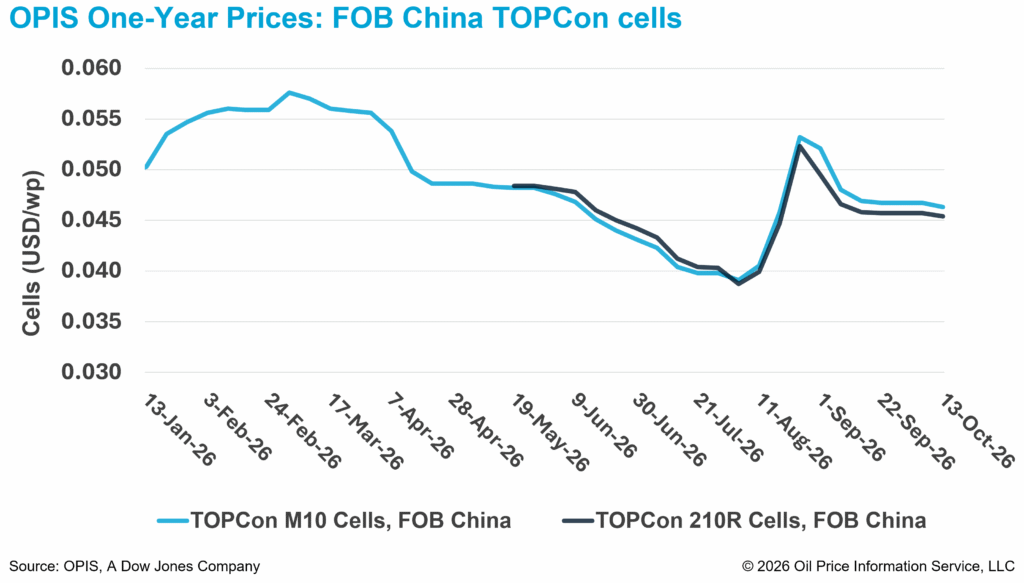
The intervention arrives as spot cell prices resume their downward trajectory. Following two weeks of stability, Free-On-Board China TOPCon M10 cell prices fell 0.86% week over week to $0.0463/W, while 210R format cells dropped 0.66% to $0.0454/W, according to the Oct. 13 OPIS Global Solar Markets Report. Both formats now trade roughly 13% below late-August peaks.
Overseas demand is simultaneously contracting under new regulatory pressure. A temporary U.S. rule restricting the stockpiling of polysilicon and its derivatives ahead of Section 232 tariffs taking effect on Dec. 4 has chilled purchasing activity. Buyers who previously accelerated orders to front-run anticipated trade barriers are now stepping back, removing a critical source of support for Chinese exporters.
India, historically a vital destination for Chinese solar components, is experiencing a similar deceleration. An extended exemption allowing commercial and industrial projects commissioned by Dec. 31, 2026, to bypass domestic content requirements initially triggered a buying rush. That momentum has faded. Indian manufacturers report that elevated baseline costs for Chinese cells combined with the approaching deadline have rendered further aggressive stockpiling commercially unviable.
Domestically, China faces a mathematical challenge to meet its own installation forecasts. The National Energy Administration recorded 97.19 GW of added solar capacity between January and August, representing a year-over-year decline exceeding 57%. To reach the 180 GW to 240 GW full-year range projected by the China Photovoltaic Industry Association in February, developers must install between 20.7 GW and 35.7 GW monthly through December. The actual pace from January through August averaged just 12.1 GW per month. While utility-scale procurement typically accelerates toward year-end to satisfy project commissioning deadlines, market participants remain skeptical that seasonal buying will bridge the gap or sustain a broader recovery.
On the supply side, October cell output is expected to contract as factories retool production lines. Manufacturers are racing to comply with mandatory minimum efficiency standards for modules and inverters taking effect Jan. 1, 2027, which will prohibit domestic sales of non-compliant equipment. This transition temporarily removes capacity from the market but does not address the structural oversupply that has defined the sector since late 2023.
The Hangzhou discussions also targeted state-owned enterprises, urging authorities to penalize SOEs that award procurement contracts based exclusively on lowest-bid tenders. Such practices have driven prices below manufacturing costs for over two years, forcing smaller producers into bankruptcy and triggering massive asset write-downs among tier-one manufacturers.
Enforcement remains the primary vulnerability of the proposed framework. Industry self-regulatory agreements lack legal standing under Chinese antitrust law, meaning actual transaction prices will continue to be dictated by physical supply and demand rather than boardroom consensus. Previous attempts at voluntary output restrictions in 2024 and early 2025 fractured quickly as individual manufacturers broke ranks to capture market share.
Global supply chain implications of these pricing dynamics will be examined during the “Decoding solar supply chains” session at the NetZero Milan Expo Summit on Oct. 21, where industry experts plan to assess how shifting trade regulations and manufacturing strategies affect procurement for solar and battery energy storage systems.