China Solar Crash Drives 11% Global Installation Drop in 2026
International residential and commercial rooftop deployments partially offset a massive contraction in Chinese utility-scale photovoltaic construction.
Global solar installations are contracting for the first time in years, dragged down by a steeper-than-anticipated collapse in the Chinese market that no amount of international growth can offset. Total deployment is now projected to reach 584 gigawatts in 2026, an 10.8% decline from the 655 gigawatts installed last year.
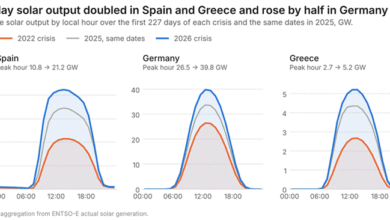
The contraction centers almost entirely on China, which deployed 383 gigawatts in 2025 but is expected to install just 271 gigawatts this year — a 29% reduction. First-half data confirms the severity of the pullback. Through June 2026, Chinese photovoltaic additions totaled roughly 71.8 gigawatts, compared with 212.2 gigawatts during the same period last year, representing a 66% plunge in the pace of construction.
Beijing’s latest five-year economic plan has deliberately shifted policy emphasis away from raw generation capacity toward grid stability and energy storage integration. After years of adding solar faster than transmission infrastructure could absorb it, curtailment rates in several provinces forced regulators to prioritize battery deployment over new panels. The pivot marks a structural change rather than a temporary pause, as authorities attempt to balance a power grid increasingly strained by variable renewable inputs.
Outside China, the trajectory remains upward. Installations across the rest of the world are tracking at 313 gigawatts for 2026, slightly exceeding earlier projections of 308 gigawatts and building on the 272 gigawatts deployed internationally in 2025.
That international expansion lacks a single dominant driver. “Honestly, none so far, a big theme has been no major booms,” said Jenny Chase, a clean tech analyst at BloombergNEF. “I don’t think it has anything to do with Chinese politics or pricing.”
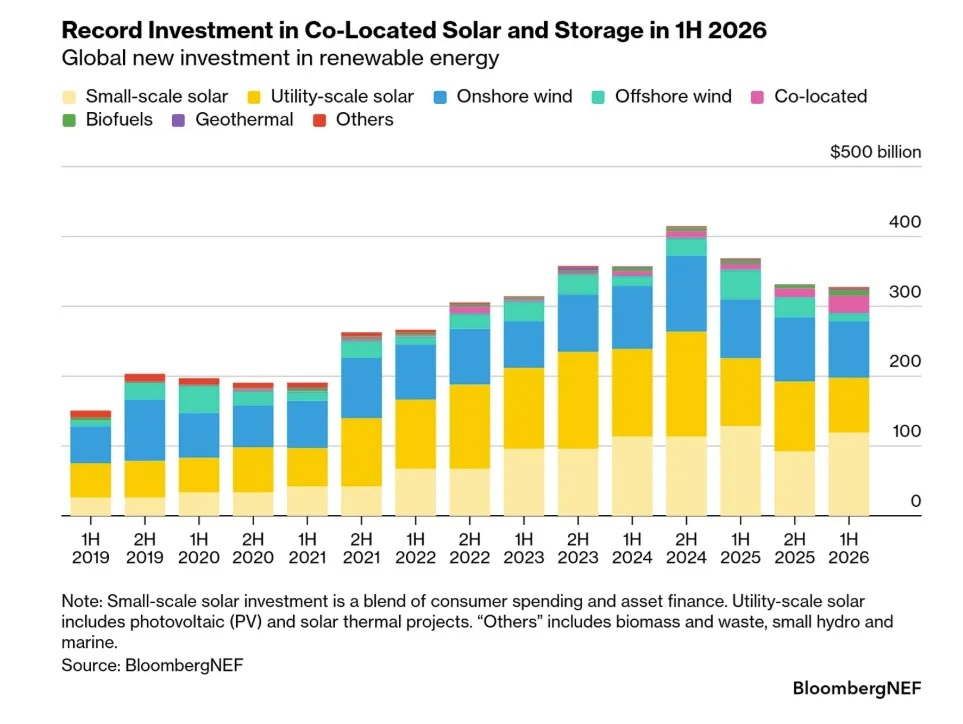
Instead of massive utility-scale tenders, distributed generation is fueling much of the non-Chinese activity. Residential and commercial rooftop systems are driving nearly all recent volume increases in Nigeria and the Philippines. India continues steady large-scale procurement, while Malaysia contributes consistent incremental gains. This shift has elevated non-utility solar past utility-scale projects as the largest sector of global renewable energy investment.
Forecast revisions over the past year illustrate how rapidly expectations have adjusted. In the first quarter of 2025, analysts anticipated 753 gigawatts of global installations for 2026. By December, that figure had fallen to 649 gigawatts before settling at the current 584-gigawatt estimate — a cumulative downward revision of roughly 22% from peak expectations.
Even aggressive electrification trends may not reverse the domestic slowdown in China. Electric vehicle adoption and stationary battery manufacturing consume significant electricity, yet they are insufficient to sustain previous installation rates. “We doubt that either batteries or EVs will halt this, they just slow it down a little,” Chase said.
For the broader industry, the 2026 contraction carries immediate supply chain consequences. Global polysilicon and module manufacturing capacity expanded continuously through 2024 and 2025 under the assumption that Chinese demand would remain insatiable. With top-tier manufacturers already operating below full utilization, a 112-gigawatt drop in annual installations intensifies margin pressure across the value chain, accelerating consolidation among smaller producers unable to compete on cost.
BloombergNEF estimates China installed 383 GW in 2025. It now expects 271 GW in 2026, a 29% decline. In the group’s 2025 Q4 projection, China had been forecast for 2026 was 341 GW.