Vivodyne Launches Automated San Francisco Bio-Data Center to Fix AI Drug Discovery’s Training Bottleneck
Automated facility leverages robotic HIVE units to generate causal tissue data for AI model training
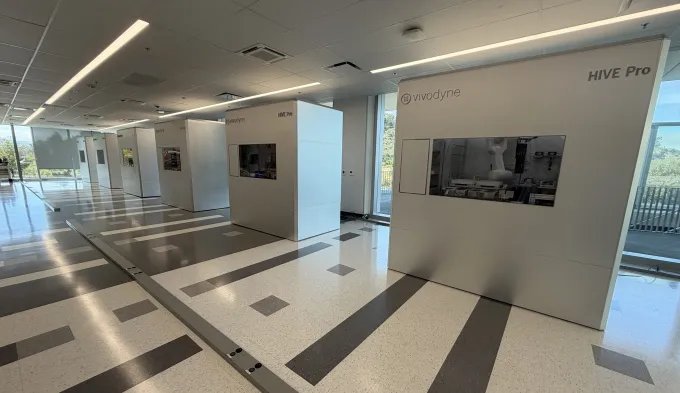
Biotech startup Vivodyne has established an automated biology facility near San Francisco to resolve a fundamental bottleneck in artificial intelligence drug discovery: the lack of dynamic human tissue data required to train predictive AI models.
Last week, the company, which has raised just under $80 million across two rounds led by Khosla Ventures, opened what it calls the world’s largest “human data center” just outside of San Francisco, and Georgescu says his team is already achieving twice the throughput of all the animal trials being held in the US.
HIVE, modular robotic labs built by the company, can grow 20 kinds of human tissue, then autonomously dose and monitor them, generating the kind of causal biological data that today’s AI models are missing — data that today mostly comes from animal testing, or studies of single cells or proteins, not living tissue.
Spun out of the University of Pennsylvania in 2021 by CEO Andrei Georgescu and co-founder Dan Tlozek following Georgescu’s bioengineering doctoral research, Vivodyne engineered its tissue platforms to replicate complex human organ interactions. Internal testing shows that its lab-grown liver tissue achieves 94% predictive accuracy in identifying drug toxicity compared to human clinical trial results, while its airway tissue replicates human physiological response at a 96% rate. In evaluating 20 chemotherapy drugs, the platform’s bone marrow tissue achieved 100% concordance with human clinical outcomes.
The pivot toward engineered human tissue aligns with federal regulatory shifts. In December 2022, President Joe Biden signed into law the FDA Modernization Act 2.0, which eliminated an 80-year-old statutory mandate requiring drug developers to conduct animal testing prior to advancing candidate compounds into human clinical trials. The law authorized the U.S. Food and Drug Administration to accept data from cell-based assays, microphysiological systems, and computer models to support Investigational New Drug applications.
This regulatory change comes as conventional pharmaceutical development faces severe efficacy drop-offs. Approximately 90% of drug candidates that prove safe and effective in animal testing subsequently fail during human clinical trials, primarily due to unexpected toxicity or a lack of therapeutic effect in humans. With individual Phase I and Phase II clinical trials frequently costing tens of millions of dollars, pharmaceutical developers incur major losses on molecules that fail late in testing.
To prevent clinical failures, Vivodyne has partnered with multiple major pharmaceutical companies to evaluate drug candidates prior to clinical submission. Georgescu compares the initiative to automotive crash testing, noting that while car manufacturers rely on standardized crash simulations to ensure vehicles pass federal safety requirements before production, drug developers currently enter human trials with minimal predictive certainty regarding FDA approval.
Beyond testing specific drug candidates, Vivodyne is positioning its automated labs to train generative AI systems on multi-step biological changes. Current generative models rely heavily on static single-cell sequencing snapshots, which capture static cellular states without revealing the biological drivers behind those changes. A study published in Nature Methods revealed that scaling training parameters across existing static cellular datasets fails to yield consistent performance improvements in generative AI models.
“All the training is done on static snapshots of these cells, and the models are not conditioned at all by the how a cell got to that state,” Georgescu told TechCrunch. “In other words, the model learns ‘this is cell state A,’ ‘this is cell state B,’ but never ‘cell state B is the effect of inflaming cell state A.’”
The commercial push for dynamic human data coincides with heavy investment across the AI drug discovery market. Google DeepMind spinout Isomorphic Labs signed multi-billion-dollar research partnerships with Eli Lilly and Novartis in early 2024 to design small-molecule therapeutics using AlphaFold architectures, yet expects its initial clinical trial candidates near the end of this year. Across the broader industry, only a small number of AI-designed molecules have advanced into Phase III human testing.
Vivodyne’s robotic HIVE units continuously track hundreds of thousands of individual experiments where diseased human tissue is exposed to chemical stimuli. By capturing how living tissue responds over time, the platform generates continuous causal data designed for reinforcement learning pipelines targeting complex, multi-pathway disease targets that require multi-drug combination therapies.