Record Heat Triggers Earliest Champagne Harvest in History
Extreme summer heat and frost cut yields across French vineyards, forcing growers into an unprecedented August harvest to save world-famous wine.
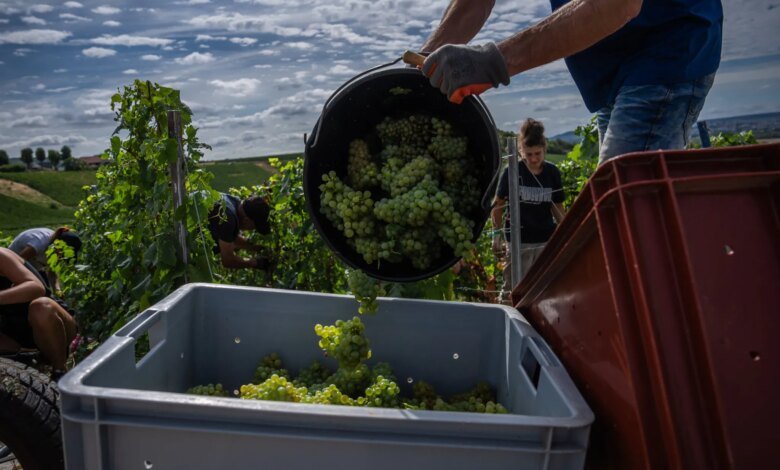
Unprecedented summer heat and severe drought across northeastern France have forced Champagne winemakers into the earliest harvest in the region’s recorded history, creating a high-stakes scramble to gather fruit before rising sugar levels ruin the wine’s delicate character.
Across the sloping vineyards of Hautvillers, crews of pickers begin manual harvesting at 6:30 a.m. among terraced vines designated as a UNESCO World Heritage site in 2015.
To Alexandre Gobillard, production director at the Gobillard & Fils Champagne house, bringing in the crop in mid-August was once virtually unimaginable.
“It’s historic in Champagne,” he said. “I’ve been working at the estate for 30 years, and when I started, my father used to tell me: ‘On Aug. 15, go on vacation.’ Today, it’s Aug. 18 and we’re in full harvest. We’ve never seen anything like it.”
At age 50, Gobillard represents the fourth generation of his family to cultivate these soils. Gobillard & Fils oversees 40 hectares (about 100 acres) of vineyards, yielding approximately 1.5 million bottles annually.
A changing climate brings an earlier harvest
Official picking for this year’s Champagne harvest commenced between Aug. 12 and Aug. 17, depending on specific sub-regions and grape varieties — nearly a month ahead of historical norms.
A late-March frost struck after unusually mild temperatures triggered premature budburst, cutting into potential crop volumes, which was subsequently followed by an unprecedented four distinct heat waves, Gobillard noted.
Sun-damaged grapes turned partially brown, a phenomenon Gobillard remarked he had seldom witnessed. He noted that a 10% crop reduction would trim overall volume without compromising wine quality.
Accelerated harvest calendars are becoming routine throughout Champagne and other French wine territories as average temperatures rise. In neighboring Italy, extreme heat has similarly pushed sparkling-wine makers toward earlier schedules and nighttime picking.
David Chatillon, president of the Union of Champagne Houses, confirmed that this year’s extreme weather will result in a sharp reduction in total output.
“But it’s not just because of the drought,” he said. “We lost 43% of the potential production to the spring frosts, and the drought has clearly made the problem of lower yields even worse.”
Chatillon explained that climate change has remained a core focus for the sector over the last 25 years, driving investment into research aimed at developing late-ripening, disease-resistant grape varieties suited for shifting climate conditions.
Adapting to these climatic shifts poses unique hurdles under Champagne’s strict legal appellation guidelines, which dictate permissible grape varieties, pruning techniques, and maximum yields per hectare. Introducing hybrid or late-ripening experimental varieties requires years of formal trial approvals from French agricultural regulators before commercial use is permitted.
Heat speeds grape ripening
Gobillard has tracked these changing agricultural realities across three generations of family winemaking.
“My grandfather’s generation harvested 100 days after flowering, my father’s 90 days, and today we’re down to 80,” he said. “We’re going to have to change our habits.”
Record heat during the summer months further compressed the growth timeline, with temperatures topping 40 degrees Celsius (104 degrees Fahrenheit) in parts of Champagne during June.
“The vine needs water to live,” Gobillard said. “The water was drawn out of the grapes to keep the vine alive, and as a result we had a much higher concentration of sugar. That’s why it happened so much faster.”
Watching the season’s initial grape juice flow from a press operated by his daughter, Gobillard felt a combination of anticipation and concern.
He immediately took a density reading to evaluate sugar content — a crucial metric determining potential alcohol levels and picking timing. “Champagne shouldn’t be too alcoholic. … We’re looking for delicacy,” he said.
An early harvest tests Champagne’s traditions
The accelerated calendar creates major operational hurdles in a region reliant on manual picking, coinciding with seasonal worker vacations and transit disruptions.
Gobillard aims to complete the estate’s picking within nine days, deploying roughly 120 seasonal workers hired primarily from France and Poland.
“It really changes how we look at Champagne’s traditional methods,” said Geoffrey Bonnet-Gobillard, 30, commercial director of the family Champagne house. “Hand harvesting comes with a lot of constraints — housing people, feeding them, recruiting them. It’s very difficult, especially with early harvests in August.”
These operational stresses could eventually pressure the industry to evaluate traditional practices as harvesting technology advances, he noted.
The family business distributes the bulk of its output to European markets like Britain, Belgium, Italy, and Spain, alongside West Africa, with smaller allocations sent to the United States and Asia, Bonnet-Gobillard added.
High stakes for a global industry
According to Comité Champagne’s 2026 industry report, 266.1 million bottles of Champagne were shipped in France and abroad last year, generating 5.7 billion euros ($6.6 billion) in sales. Exports accounted for 56.5% of shipments. Champagne represented about 8% of global sparkling wine consumption by volume but 31% by value.
To protect financial stability against volatile weather patterns, Champagne relies on an official reserve system known as the réserve individuelle. This mechanism permits growers to store still wines during high-yield seasons to blend into future vintages when frost or drought severely cuts output.
The sector supports around 30,000 direct jobs and requires roughly 100,000 seasonal workers for the harvest, according to Comité Champagne.
Despite the severe weather challenges encountered throughout the season, Gobillard found cause for optimism after inspecting harvested clusters.
“I’m very happy with what I’m seeing,” he said. “We were worried that the drought would leave us with very light bunches, but in these plots we’re really pleased. The quantity should be sufficient and the quality will be there.”
With high summer heat continuing to concentrate grape sugars, growers are left with no choice but to work rapidly through the remaining vineyards to lock in the precise balance required for global markets. “It’s time to cut them. We’re going to have to move quickly,” he said.