Evergrande Founder Sentenced to Life as Fines Exceed $2.3B in $300B Fraud Case
Shenzhen court convicts Hui Ka Yan and orders total asset forfeiture following multi-billion-dollar accounting manipulation.
Mercatus Center at George Mason University senior fellow Weifeng Zhong provides analysis regarding ongoing challenges at Tesla, Huawei and China’s Evergrande issues.
Five years after the collapse of China Evergrande Group sent shocks through the Chinese economy and international money markets, a Chinese judicial tribunal has sentenced the founder of the world’s most debt-laden real estate company to life imprisonment for bribery and financial fraud.
Hui Ka Yan, 67, received his conviction in a Shenzhen municipal court on Thursday, where judges also levied cumulative fines exceeding $2.3 billion against the corporate entities for financial offenses that included inflating company assets and hiding liabilities that eclipsed $300 billion.
“The amount involved is exceptionally large, the circumstances are particularly egregious, and extraordinarily heavy economic losses have been caused,” stated the court in its written ruling. “The harm to society is extremely serious. Therefore, severe punishment should be given in accordance with the law.”
Court findings established that Hui, who also uses the name Xu Jiayin, exploited his executive position to direct fraudulent schemes and misappropriate corporate assets.
COURT ORDERS CHINA’S BANKRUPT EVERGRANDE TO LIQUIDATE
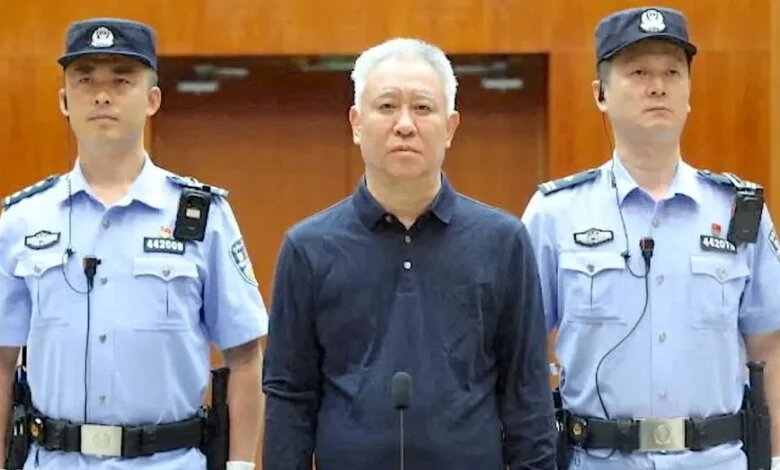
Hui Ka Yan, the founder of China’s Evergrande Group, was sentenced to life in prison for fraud and bribery in the Shenzhen Intermediate People’s Court, in Shenzhen, Guangdong province, China on August 20, 2026. (Shenzhen Intermediate People’s Court/Handout / Reuters Photos)
Fines assessed by the court included 8.82 billion yuan ($1.31 billion) against Evergrande group and 7 billion yuan ($1.04 billion) against Evergrande Real Estate Group.
According to China’s official Xinhua News Agency, Hui’s sons, Xu Tenghe and Xu Zhijian, were sentenced alongside high-ranking Evergrande executives and connected associates, with more than 50 individuals receiving prison terms spanning from 22 months to 18 years.
Court photographs displayed a gray-haired Hui clad in a navy collared shirt standing flanked by two officers as his punishment was declared, marking his first public appearance since Chinese authorities initially detained him in 2023.
The life sentence brings a dramatic conclusion to the career of a developer who rose from humble beginnings to construct one of China’s grandest real estate conglomerates. Born in 1958 into a rural Henan province family in central China, he gained employment in the steel sector during the 1980s before creating Evergrande, which surged during the nation’s real estate expansion, while also cultivating political standing as a delegate to the Chinese People’s Political Consultative Congress (CPPCC).
EMPTY BUILDINGS IN CHINA’S PROVINCIAL CITIES TESTIFY TO EVERGRANDE DEBACLE
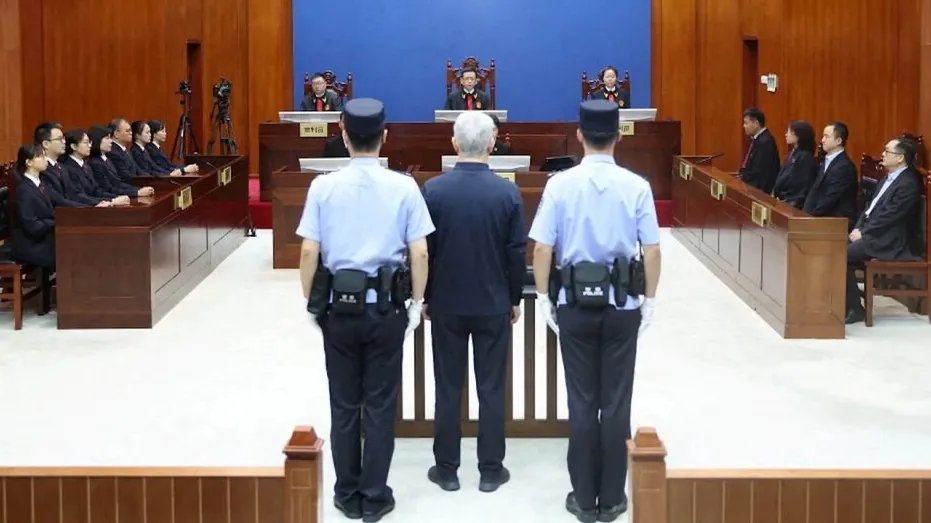
The Shenzhen Intermediate People’s Court, in Shenzhen, Guangdong province, China sentenced Hui Ka Yan, the founder of China’s Evergrande Group and once Asia’s richest man, to life in prison on August 20, 2026. (Shenzhen Intermediate People’s Court/Handout / Reuters Photos)
Judges at the Shenzhen Intermediate People’s Court ordered the asset forfeiture of Hui’s personal property after his April guilty plea to eight separate counts, including fundraising fraud, illegally taking public deposits, fraudulently issuing securities and bribery.
Chinese policymakers instituted strict limits on speculative corporate debt across the real estate sector in 2020, precipitating an industry-wide liquidity squeeze that led to a deep contraction in the property market.
The debt caps, widely referred to as the “three red lines” policy, required developers to keep debt ratio metrics strictly below official thresholds to access new bank credit. Because Evergrande had leveraged its balances past those safety margins, the capital dry-up triggered immediate cash-flow shortfalls across hundreds of active residential build sites.
Established by Hui in 1996, Evergrande expanded aggressively amid China’s multi-decade housing boom, utilizing heavy leverage to construct housing complexes nationwide. At the peak of its growth, it ranked as China’s largest developer by contracted sales, lifting Hui’s personal wealth to $45 billion in 2017 and naming him Asia’s richest individual, according to Forbes.
The firm’s eventual default sparked a widespread crisis across China’s broader property sector, where lingering home price declines, incomplete housing units, and developer bond defaults have suppressed economic growth and consumer sentiment for years.
CHINA’S EVERGRANDE: WHAT TO KNOW
Ticker Security Last Change Change % DHI D.R. HORTON INC. 151.86 +6.18 +4.24% LEN LENNAR CORP. 87.30 +2.36 +2.78% PHM PULTEGROUP INC. 130.68 +4.63 +3.67%
The economic impact spread directly to millions of retail investors and home purchasers across China. Protests erupted when Evergrande defaulted on its high-yield wealth-management products, wiping out individual savings and leaving contract buyers of unfinished apartments uncertain if their homes would ever be delivered.
Exchanges among Evergrande homeowners in online chat groups included statements such as: “All ordinary citizens have paid the cost,” “Imprisonment is meant to protect him. If he comes out, his life is in jeopardy,” and, “What about our money?”
Regulators in China confirmed that executive management artificially inflated corporate revenues by tens of billions of dollars during 2019 and 2020.
The criminal ruling follows prior administrative actions taken against Hui by market watchdogs. In 2024, China’s securities regulatory body levied a fine of approximately $6.5 million against him and imposed a lifetime ban from participating in domestic securities markets over fraudulent financial reporting and related systemic infractions.
The structural unwinding of Evergrande’s corporate empire proceeded in parallel with the state’s criminal prosecution of Hui.
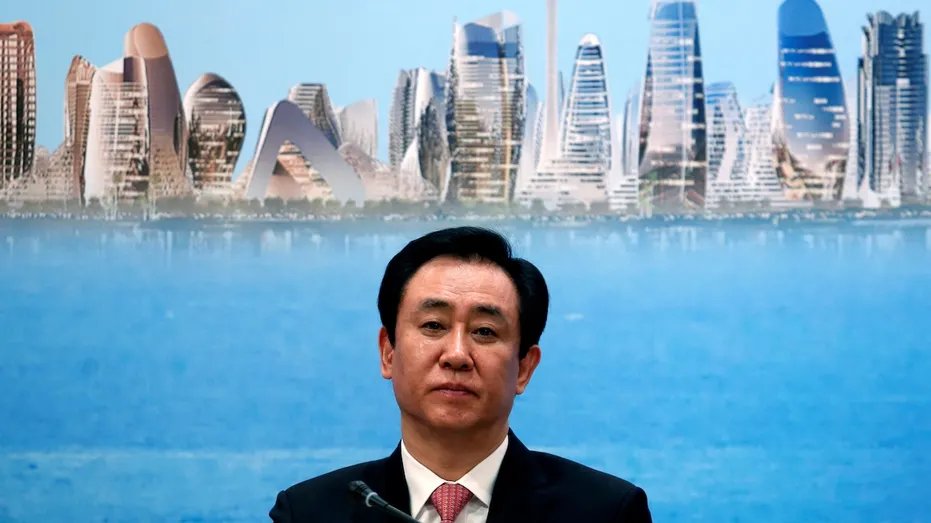
China Evergrande Group’s then-Chairman Hui Ka Yan attends a news conference on the property developer’s annual results in Hong Kong, China on March 28, 2017. (Bobby Yip/File Photo / Reuters Photos)
GET FOX BUSINESS ON THE GO BY CLICKING HERE
That corporate downfall reached its final legal milestone in 2024 when a Hong Kong judicial authority ordered the formal liquidation of the company, resulting in the permanent removal of its equity shares from the Hong Kong Stock Exchange.
Reuters and The Associated Press contributed to this report.