Tesla Drivers Shift Everyday Travel to Full Self-Driving Despite Legal Liability Rules
Drivers report up to 95% reliance as federal regulators investigate 2.4 million vehicles
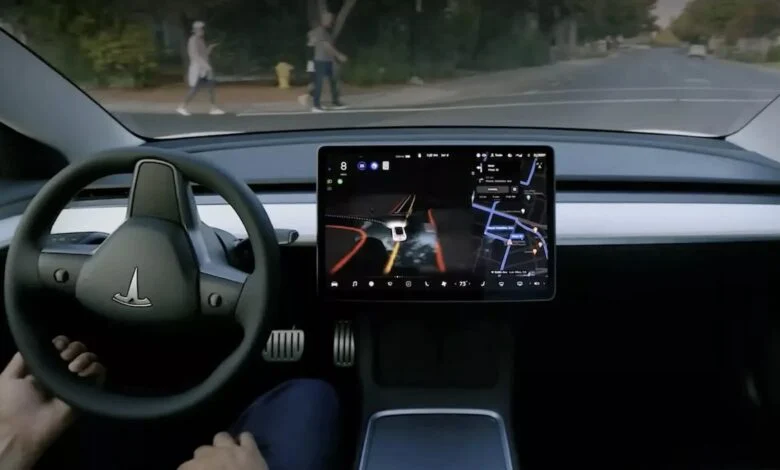
Drivers are increasingly turning over everyday driving tasks to Tesla’s Full Self-Driving software, using the system for up to 95% of their daily travel even as state laws and federal regulators class the technology as partial automation requiring human intervention.
Rohullah Hashimi, a full-time Uber driver operating a 2026 base Model Y in San Francisco, relies on the supervised system for nearly all of his commercial driving. Relying on nine onboard cameras and a central dashboard display, the vehicle navigated neighborhood streets, passed a construction zone on Geary Boulevard, climbed Twin Peaks, and parked at Christmas Tree Point while Hashimi remained behind the wheel. Hashimi reported that his Uber app driver performance rating, which tracks braking and acceleration, rose from 70% to 98% after he allowed the software to handle driving maneuvers, including stopping for two pedestrians he had not noticed himself.
Tesla’s Full Self-Driving (Supervised) remains a Level 2 driver-assistance system. The person behind the wheel is responsible for the vehicle at all times, even when the software is steering, braking, and controlling speed.
Under California vehicle regulations, advanced driver-assistance systems do not relieve motorists of legal liability or driving prohibitions, such as restrictions against texting while operating a vehicle. While the California Department of Motor Vehicles requires companies like Waymo to obtain full Autonomous Vehicle Deployment permits to operate without human safety drivers, Tesla continues to operate under a driver-assistance framework that mandates continuous human driver oversight.
“There’s an interesting choice that we have to come to terms with,” said Scott Moura, faculty director of California Partners for Advanced Transportation Technology at UC Berkeley. “All this automation of vehicles, is it for safety, or is it for convenience? Those two aren’t necessarily the same thing.” Moura, who has used FSD (Supervised) for about half of his driving over 16 months, noted that the software still makes choices an attentive driver might avoid, such as delaying lane changes before freeway exits.
Tesla has also changed how it monitors drivers. Joe Jefferson, president of Tesla Owners San Joaquin Valley and Tesla Owners Nor Cal-Reno, has used versions of FSD (Supervised) since 2020. Earlier versions required periodic steering-wheel input and issued escalating warnings when drivers kept their hands off the wheel. Tesla now relies on an interior camera to determine whether the driver is monitoring the road.
Federal safety oversight of the technology has intensified alongside increased driver reliance. The National Highway Traffic Safety Administration opened an investigation in October 2024 covering an estimated 2.4 million Tesla vehicles equipped with FSD (Supervised). The federal probe was launched after four reported collisions occurred in low-visibility conditions, including fog and sun glare, where vehicles running the software crashed, resulting in one fatality and an injury.
Tesla’s software updates have expanded driver customization by introducing five operational profiles that alter traffic behavior, including “Mad Max,” “Hurry,” standard, “chill,” and “sloth.” While these profiles modify how aggressively the car steers and changes lanes in traffic, state and federal safety standards dictate that human operators retain complete legal responsibility for any sudden evasive maneuvers or traffic violations committed by the software.