

Seven Black Candidates Target Governor Seats in Historic Bipartisan Election Wave
A record slate of Black candidates on November ballots could expand executive leadership across both major parties.
Over two and a half centuries of U.S. political history, only three Black individuals have ever been elected governor out of thousands who held the role—each of them a male Democrat, including sitting Maryland Gov. Wes Moore.
That narrow circle, however, may expand significantly by year’s end.
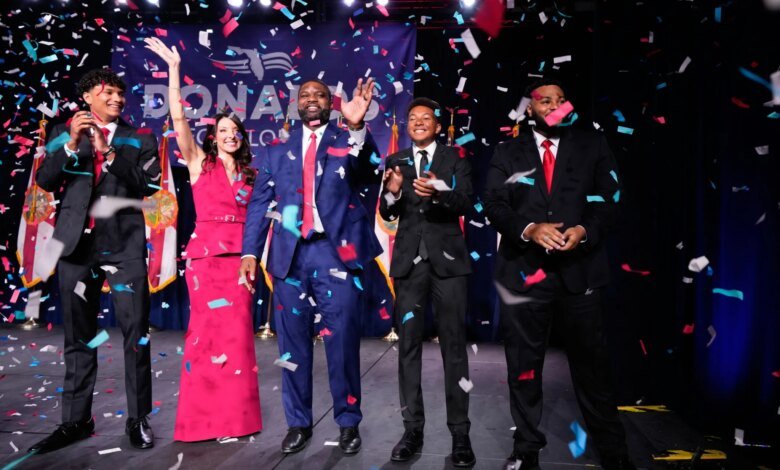
Following the nomination of U.S. Rep. Byron Donalds by Florida Republicans on Tuesday, seven Black major-party nominees—comprising both men and women across Republican and Democratic lines—will join Moore on statewide ballots this November.
“We do have a unique moment here,” observed Moore, who recently assumed leadership of the National Governors Association. He frequently notes that his milestone position is “not an applause line” but rather an indicator of systemic hurdles America continues to confront.
Rather than spotlighting the milestone, these Black nominees generally concentrate their campaigns on personal qualifications and specific policy frameworks.
“Florida is a great meritocracy in America,” Donalds stated to journalists Tuesday evening, having omitted any mention of his racial background during his election night speech. “I’ll let you guys write about that,” he remarked.
Nevertheless, numerous observers argue that representative leadership remains crucial in light of the nation’s historical legacy, stretching from slavery through Jim Crow to modern inequities.
“It’s not a secret that some issues in the African American community get ignored and don’t have a voice,” pointed out Aaron Ford, Nevada’s inaugural Black attorney general and current Democratic gubernatorial candidate. Ford emphasized that his platform prioritizes topics spanning civil and voting rights to economic stability.
Republican Lisa Demuth noted that she “has never led with any type of identity politics” during her tenure as Minnesota’s first Black speaker of the House and her current campaign as the GOP governor nominee. “But I recognize the historic state we are in right now,” she stated. Simultaneously, Michigan Republicans selected U.S. Rep. John James, who is also Black, as their nominee for governor.
Former New York Gov. David Paterson, a Democrat who assumed office following Eliot Spitzer’s 2008 resignation rather than through election, praised the bipartisan nature of the candidate field. “This is one day when maybe the Democrats and Republicans could stand in front of a statue of George Washington and let him know that we’re finally getting it right,” he remarked.
Democrats, for their part, underscored that their slate of Black candidates—which includes Keisha Lance Bottoms in Georgia, Jermaine Johnson in South Carolina, and David Crowley in Wisconsin—carries heightened urgency following U.S. Supreme Court rulings allowing states greater latitude to redraw majority and plurality minority voting districts. The urgency has been amplified by President Donald Trump’s criticisms of diversity programs and his efforts to reshape official narratives regarding American slavery and Jim Crow segregation.
“Governors, in many ways, are becoming the last lines of defense against what we’re seeing in Washington,” Moore asserted.
A challenge for Black politicians, even more so than reaching the US Senate
Democratic strategist Karen Finney, who advised Joe Biden’s campaign on selecting a Black female vice presidential nominee, noted that Black elected officials frequently serve as primary advocates for concerns heavily impacting Black communities. She and other analysts highlighted systemic health inequities, including maternal and infant mortality alongside sickle cell treatment, while Finney added that inflationary pressures disproportionately affect Black households, which maintain lower average income and net worth compared to the general population.
While legislative advocacy on these topics is critical, she stressed that executive power holds far greater transformational weight.
“These are people who have the power to shape our lives, and they shape the agenda,” Finney explained.
Reaching the governor’s mansion has proven exceptionally difficult for Black candidates, presenting a barrier even steeper than winning election to the U.S. Senate. Democrat Douglas Wilder of Virginia became the country’s first elected Black governor when he took office in 1990.
Historically, state executive positions have presented far higher barriers than legislative bodies. Across American history, 12 Black individuals have served in the U.S. Senate, whereas only three have ever won gubernatorial elections: Wilder, Massachusetts Gov. Deval Patrick in 2006, and Maryland’s Moore in 2022. (Louisiana’s P.B.S. Pinchback served briefly during Reconstruction after an impeachment, and New York’s Paterson assumed office following a resignation, though neither won an election to the governor’s office.)
“I didn’t become Maryland’s first Black governor because the Democratic Party said, ‘I think it’s time for us to put Wes Moore up in the seat’,” Moore stated. “I had to run against the party.”
“I don’t think that the party is doing enough,” Moore added, pointing specifically to what he characterized as “negligence” in Southern states where Black voters form the backbone of the Democratic coalition.
Former Georgia gubernatorial candidate Stacey Abrams, who mounted two statewide campaigns, recalled prominent white Democrats raising funds for her primary rival in 2018, though she clarified that explicit racial bias was not the driving factor.
“We do what we’ve done because it’s what we did,” she observed. “Black women have not been executives, and the absence of that proof point becomes a self-reinforcing philosophy.”
For the current election cycle, she pointed out, Bottoms enters the contest with executive credentialing gained as mayor of Atlanta.
Democrats and Republicans talk about ‘identity politics’ differently
Minnesota will reach a historic milestone in November when voters elect their first female governor, with Demuth facing off against Democratic U.S. Sen. Amy Klobuchar. Demuth expressed a desire for a future where demographic firsts no longer command headlines.
“One of the things that I really do look forward to is where it’s already done, where it no longer makes history,” she said. “So I think of young women, little girls that are looking at you, could I ever be governor of Minnesota? I hope when I win, they’re able to look at, point to that and say she’s already done it.”
Speaking to the National Association of Black Journalists last week, Bottoms said she avoids leaning into “the historical nature” of her bid. Nevertheless, she cited family roots in Georgia dating back “at least five generations through a plantation in Crawfordville” and recalled how her grandfather was forced to “walk through these back doors” upon arriving in Atlanta. While refraining from explicitly using terms like slavery or segregation, she noted her lineage “is always present with me.”
Abrams, who has been stumping for Bottoms and other Democratic candidates this season, offered a sharper assessment, contending that all political engagement touches on identity and arguing that conservative approaches simply use coded terms.
“When your Constitution specifically strips a race of its humanity, you cannot then later on say identity doesn’t matter and has no effect, and we’ve spent 250 years trying to reckon with that identity” through legislative, social, and judicial battles, she added. “So, it’s deeply disingenuous, if not woefully naive, to say that identity does not matter.”
Race shapes many decisions, but not all of them
Deval Patrick, whose time in office in Massachusetts overlapped with Paterson’s in New York, noted that his race carried distinct expectations among Black voters. The demands were “just different than the expectations of my predecessors,” he recounted, pointing to pushback he received when he didn’t immediately travel to a Boston neighborhood following the fatal shooting of a teenager.
“His mother was on the news grieving, and at some point she said while the cameras were rolling, where is Gov. Patrick?” he remembered. “Nobody had ever asked one of my predecessors to come to a crime scene in a neighborhood. Never.”
In Nevada, Ford emphasized that leading a state requires targeting fundamental concerns—such as employment, housing access, and medical care—that cut across all community demographics.
“It could be a white man, a Latino woman. It could be a person urban, suburban or rural Nevada. It could be someone from northern Nevada, southern Nevada. These are the issues that are important to them,” he explained.
Patrick, who maintains regular contact with both Ford and Moore, concurred that achieving executive power depends on building statewide appeal across all voter blocs rather than relying on limited constituencies.
“The successful candidates are the ones who present themselves as candidates for everyone,” he said, “and not candidates for just some.”
___
Sloan reported from Washington.








One Comment