OpenAI Shifts Strategy Toward Autonomous Agents with ChatGPT Work Launch
New GPT-5.6 model powers persistent multi-step workflows.
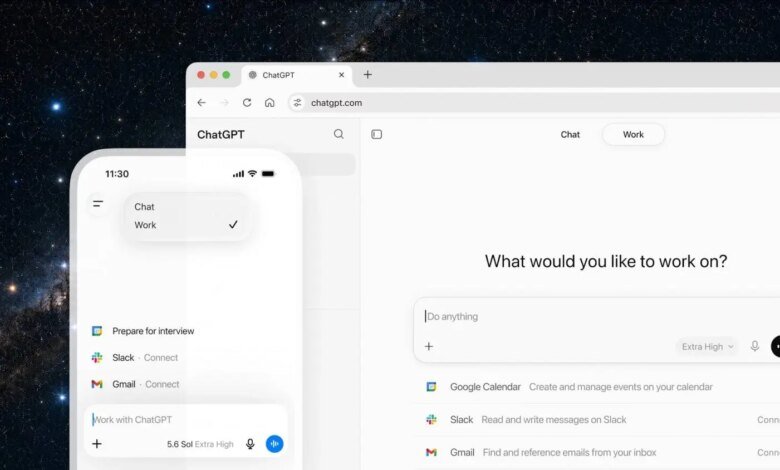
OpenAI has officially pivoted from conversational AI toward autonomous productivity with the release of ChatGPT Work, a new agentic system designed to execute complex, multi-hour projects without constant human supervision. The system, powered by the newly debuted GPT-5.6 model, marks a significant departure from the traditional prompt-and-response loop, allowing the AI to break down massive objectives into independent sub-tasks.
This evolution reflects a broader industry shift toward autonomous AI systems capable of operating across diverse software environments. While ChatGPT remains a dominant consumer brand, OpenAI is now positioning its technology as a persistent worker. The company revealed that ChatGPT Work was built on the technical foundation of Codex, its specialized programming agent. Internal data from OpenAI showed that 20% of Codex users were already utilizing the tool for non-development tasks, signaling a market demand for AI that acts rather than just speaks.
Unlike previous iterations, ChatGPT Work is built to handle end-to-end workflows. According to OpenAI, the agent can ingest customer research and independently transform it into a full campaign brief, subsequently generating marketing assets tailored for specific global markets. This capability is supported by a feature called Scheduled Tasks, which enables the AI to continue processing projects even when the user is offline or away from their device.
The launch is a direct response to the competitive pressure from Anthropic, whose Claude Cowork has recently gained traction in professional environments. To counter this, OpenAI is emphasizing deep integration. The ChatGPT Work desktop app can access local files and utilizes a built-in browser to merge web-based tools with local data.
Connectivity is managed through a system of plugins that link the AI to essential corporate tools including Slack, Teams, Google Drive, and SharePoint. OpenAI stated that the system automatically identifies which plugin to trigger based on the context of the user’s request.
Access to the new features begins today for users on Pro, Enterprise, and Edu plans. OpenAI confirmed that Plus and Business subscribers will receive access in the coming days. As part of this rollout, the standalone Codex application will be merged into the new ChatGPT desktop app, which will also benefit from the increased reasoning speeds provided by GPT-5.6.