Pangram Secures $9 Million Funding to Scale AI Content Detection Infrastructure
New York-based Pangram releases new text and image verification tools backed by Menlo Ventures.
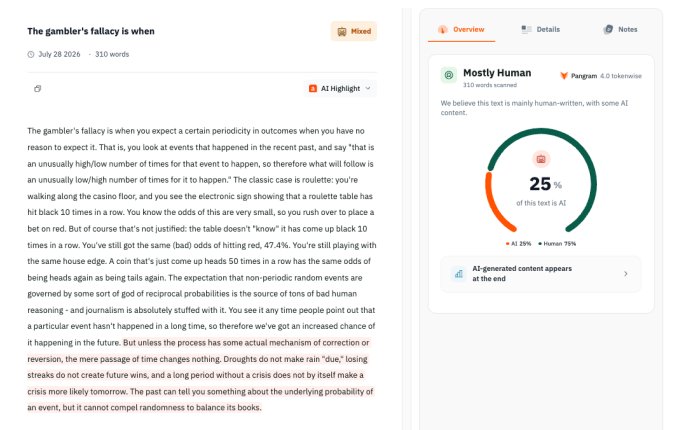
Pangram, a New York-based synthetic content verification startup, has raised $9 million in funding to expand its detection infrastructure as generative artificial intelligence models proliferate across digital platforms. The financing round was led by Menlo Ventures, with participation from venture firms Haystack, ScOp, Script Capital, and Cadenza.
Alongside the capital injection, the company unveiled Pangram 4, its latest text analysis engine, and introduced Pangram Image, a specialized model designed to detect computer-generated visual content currently available as a research preview prior to a broader commercial release.
The investment comes amid growing concerns over automated content generation on open network platforms, online publishing channels, and academic archives. Institutional responses to automated writing have tightened significantly over the past year. For instance, the open-access academic repository arXiv instituted policies establishing a one-year submission ban for researchers who submit papers containing unreviewed outputs from large language models, such as hallucinated citations or unedited conversational prompts.
Pangram’s commercial rollout targets both retail consumers and enterprise workflows. The platform is accessible through a $20 monthly subscription that includes a Chrome web extension capable of scanning feeds on X, LinkedIn, Substack, Reddit, and Medium. The browser tool calculates a real-time feed health score to quantify the ratio of synthetic versus human-authored content visible on screen. Substack has already integrated Pangram’s technology via API to flag newsletter authors using generative assistance, while enterprise clients including Quora, academic institutions, publishing agencies, and human resources recruiters utilize the API for automated verification.
Co-founded approximately two years ago by Stanford University artificial intelligence graduates Max Spero and Bradley Emi, Pangram was established following the launch of ChatGPT to mitigate platform manipulation, search engine optimization spam, and automated foreign influence operations on social networks.
Unlike digital watermarking techniques—such as metadata tagging or proprietary invisible markers used by developers like Google DeepMind—Pangram’s system evaluates underlying stylistic choices and structural patterns. The company built its detection engine by training machine learning models on tens of millions of verified human-authored documents paired with synthetic mirrors—copies generated by frontier language models matching the exact topic, length, and tonal style of the original human text.
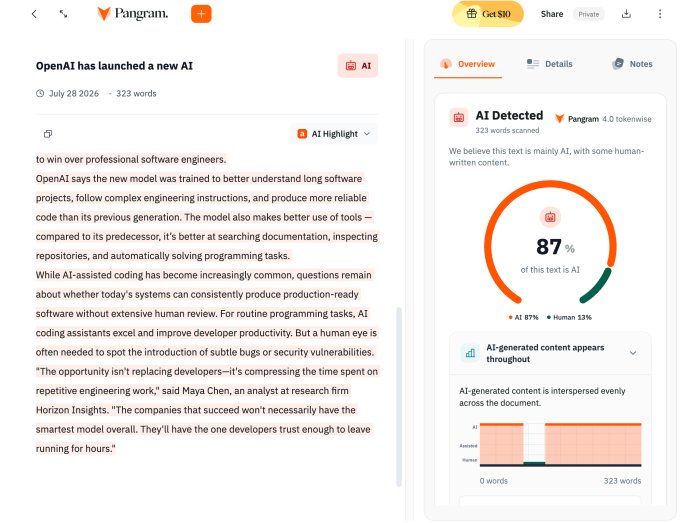
Pangram claims its fourth-generation text model achieves over 99% accuracy in identifying fully synthetic text, hybrid human-AI compositions, and outputs processed through specialized text humanizer software. According to Spero, the internal false-positive rate stands at approximately one misidentification for every 10,000 human-written documents processed.
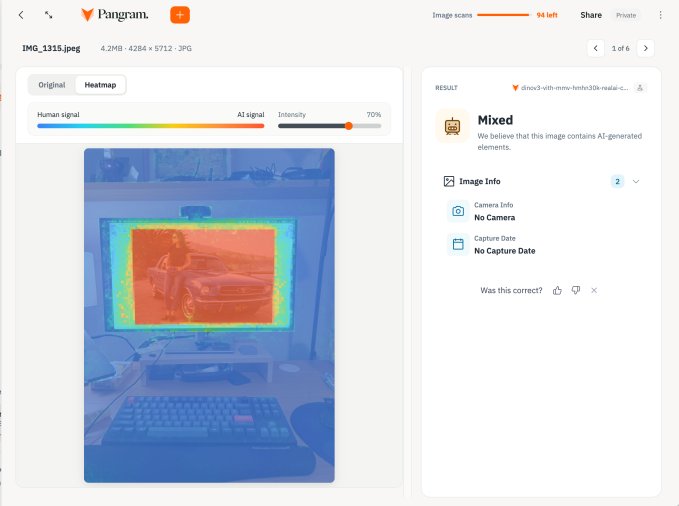
For visual media, Pangram Image operates on pixel-level distribution analysis, examining statistical deviations inherent in algorithmic generation rather than relying on embedded provenance data. The image detector is designed to identify synthetic elements across diverse model architectures, including nested synthetic images embedded within authentic photography.
Pangram competes in a growing market for automated integrity tools, facing rival detection vendors such as GPTZero, Originality.ai, Copyleaks, and Winston AI, as enterprises and legal systems face rising exposure to fabricated AI outputs in legal filings and administrative proceedings.