Australia Solar Generation Hits Record as Wind Output Slips
Solar curtailment rates improved year-over-year while wind output dropped 86 GWh across most states in September 2026.
utility-scale solar farms across Australia delivered unprecedented electricity volumes in September 2026, pushing the country’s total large-scale renewable generation to 5.44 terawatt-hours for the month and exposing a widening performance gap between photovoltaic and wind assets.
The milestone, tracked by global energy consultancy Rystad Energy, represents a 7% increase over September 2025 and surpasses the 4.99 TWh generated in August. The surge was driven almost entirely by solar facilities, which set individual state records in three major markets simultaneously while wind output contracted nationally.
Victoria anchored the national total, contributing 1,526 gigawatt-hours from its utility-scale fleet. The state’s solar installations alone produced a record 276 GWh, complemented by 1,250 GWh from wind turbines. New South Wales and Queensland also logged their highest monthly utility PV outputs on record, reaching 841 GWh and 645 GWh respectively.
Unlike rooftop solar, which dominates Australia’s distributed energy landscape, utility-scale PV projects feed directly into high-voltage transmission networks and are subject to wholesale market dynamics. The simultaneous record-setting across three states reflects both rapid capacity additions over the past two years and favorable spring irradiance conditions leading into the Southern Hemisphere’s peak solar season.
Despite the volume increases, grid operators continued to curtail significant amounts of available power. Roughly 22% of potential solar generation within the National Electricity Market was curtailed in September, meaning grid constraints or negative pricing forced operators to throttle back output. While substantial, this marks an improvement from the 26% curtailment rate recorded during the same month last year, suggesting incremental progress in grid management and transmission utilization even as installed capacity expands.
Wind generation told a different story. Total wind output fell by approximately 86 GWh compared to September 2025, with every state except Queensland recording flat or declining production. About 13% of available wind generation in the NEM faced curtailment. The divergence highlights a persistent challenge for Australia’s energy transition: solar capacity factors have improved alongside panel efficiency and scale, while wind generation remains highly susceptible to seasonal weather variability and localized grid bottlenecks.
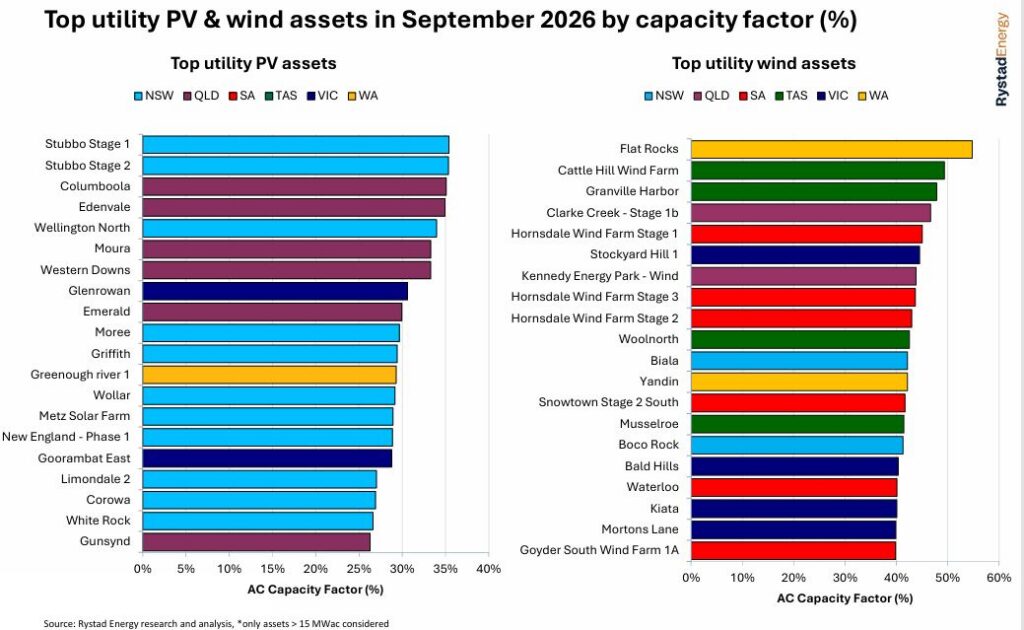
Western Australia’s Flat Rocks facility led all wind assets with a 55% capacity factor, followed by Tasmania’s Cattle Hill and Granville Harbor wind farms at 49% and 48%. Capacity factor measures actual output against maximum theoretical generation, making these figures notable given that onshore wind averages globally typically range between 25% and 45%.
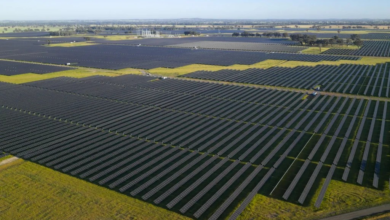
On the solar side, Acen Australia’s 400-megawatt Stubbo Solar Farm in central west NSW achieved a 35% AC capacity factor, tying it for top national honors with the 162 MW Columboola Solar Farm, backed by South Korea’s Hana Financial Investment, and the 204 MW Edenvale Solar Park, co-owned by Japanese firms Eneos and Sojitz. A 35% AC capacity factor for utility PV is exceptionally high, reflecting advanced tracking technology and optimal site selection.
Stubbo, which reached full commercial operations in late 2025, has introduced a dual-use operational model increasingly common in global renewable development but still maturing in Australia. Acen recently integrated a flock of 250 sheep into the facility to manage vegetation, reduce bushfire fuel loads, and maintain agricultural productivity beneath the panels. This practice, known internationally as agrivoltaics, addresses one of the primary sources of community opposition to large-scale solar: the removal of arable land from agricultural use.
The NEM, which connects Queensland, NSW, Victoria, South Australia, and Tasmania, operates independently from Western Australia’s Wholesale Electricity Market, where Flat Rocks is located. Managing curtailment across these distinct grids requires different infrastructure solutions. The Australian Energy Market Operator has been accelerating transmission projects, including the HumeLink and VNI West interconnectors, specifically designed to move excess renewable generation from concentrated solar zones to demand centers and reduce the need for curtailment.
Rystad senior analyst David Dixon confirmed Victoria’s position as the largest single contributor to the September totals. The firm’s data tracks only large-scale assets connected to the primary transmission grids, excluding the country’s massive distributed rooftop sector, which routinely supplies more than 15% of total national electricity demand during peak daylight hours.
Acen Australia confirmed the grazing program at Stubbo Solar Farm is fully operational, with the developer citing the integration as a functional template for future regional deployments rather than a pilot experiment.