Nathan Fielder’s New Elizabeth Holmes Documentary Tests Reality
Amanda Seyfried joins the A24 production to help Fielder reconstruct conversations with the imprisoned Theranos founder.
A life-size artificial intelligence avatar of Elizabeth Holmes sits at a dinner table while her children eat, projected onto a vertical screen wheeled into place by her husband, hotel heir Billy Evans. The scene is not science fiction. It is one of the most jarring sequences in a new documentary project spearheaded by comedian Nathan Fielder and director Lance Oppenheim, produced by A24, that attempts to dissect the psychological architecture of the convicted Theranos fraudster during her final weeks before entering federal prison in 2023.
Holmes and Evans initiated contact with A24 roughly a month before she was scheduled to surrender to begin an 11-year sentence for defrauding investors. Their objective was transparent: deploy a film crew to capture her remaining days of freedom and reshape a public narrative cemented by a devastating criminal trial. Instead of a sympathetic exoneration reel, they invited Fielder, a filmmaker whose entire career operates on weaponized awkwardness and the deliberate blurring of fact and performance.
The resulting film functions less as a traditional true-crime documentary and more as an interrogation of persona. Fielder built his reputation on “Nathan for You,” a Comedy Central series where he deployed absurd business strategies for struggling companies. His most famous stunt involved opening a legally protected parody coffee shop called “Dumb Starbucks,” exploiting intellectual property loopholes to generate viral marketing. That specific history makes him uniquely equipped to probe Holmes, who spent years cultivating a fabricated Silicon Valley visionary identity complete with an artificially deepened voice and black turtlenecks.


During filming, Fielder directly confronts this parallel. He suggests to Holmes that if she had simply framed Theranos as a comedy bit, she might have avoided prosecution entirely. Holmes responds flatly that the company was real. Fielder acknowledges the joke was in bad taste, but the exchange exposes the central tension of her defense: she maintains absolute certainty in her innocence despite overwhelming evidence to the contrary.
That evidence includes testimony from whistleblowers who flagged non-functional blood testing devices, patients who received inaccurate medical results, and investors stripped of hundreds of millions of dollars. Throughout her trial, Holmes never wavered. She continues to insist to Fielder that the world believes a false reality about her and that she committed no crime.
The documentary captures how aggressively Holmes and Evans manage media narratives. When The New York Times published a profile shortly before filming began — widely criticized for allowing Holmes to frame herself primarily as a mother separated from her children — the couple expressed fury over the coverage. They specifically contested a quote attributed to Holmes regarding actress Amanda Seyfried’s portrayal in Hulu’s 2022 miniseries “The Dropout.” Holmes allegedly told the reporter that Seyfried was playing “a character I created,” implying Holmes acknowledged manufacturing a fake CEO persona. Evans insists the quote was taken out of context and claims Holmes actually said the showrunners created the character. Fielder repeatedly asks Evans to produce evidence supporting this correction. Evans never provides it.
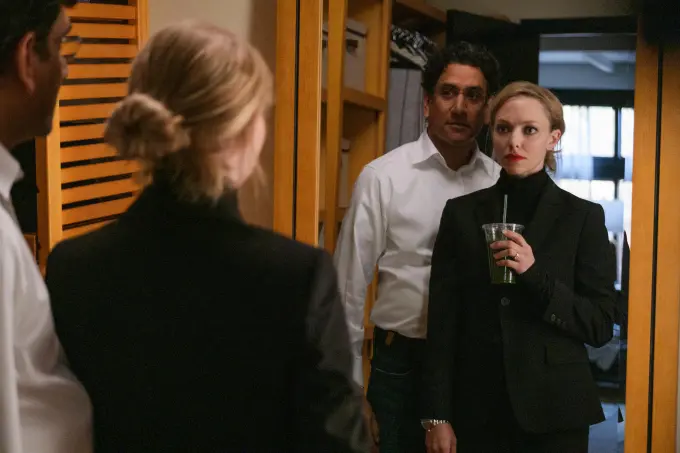
Unable to bring recording equipment into the federal facility once Holmes begins her sentence, Fielder resorts to reconstructing their conversations from memory, writing scripts based on his recollections of her exact phrasing. To test these reconstructions, he enlists an unlikely collaborator: Amanda Seyfried herself.
Seyfried, who earned widespread acclaim and award nominations for playing Holmes in “The Dropout,” joins Fielder to analyze the footage and workshop the reconstructed dialogue. In one sequence, Fielder shows Seyfried a clip of Holmes watching “The Dropout” alongside him. When a tense scene featuring former Theranos executive Sunny Balwani plays on screen, Holmes turns away and cries. Balwani, who controlled much of the company’s laboratory operations and was romantically involved with Holmes, is currently serving his own federal prison sentence for conspiracy and wire fraud.
The layers of mediation become dizzying. Seyfried watches Holmes react to Seyfried portraying Holmes. During script rehearsals, Seyfried reads lines written by Fielder based on things Holmes said, including complaints that inmates treat her worse because of how the Hulu series depicted her. Mid-read, Seyfried breaks character to state plainly that she did not do this to Holmes; Holmes did it to herself.
Evans emerges throughout the project as a deeply polarizing figure. His behavior is so abrasive that audiences are left questioning whether he is intentionally positioning himself as the villain to redirect sympathy toward his wife. This dynamic mirrors the strategy Holmes employed during her trial, where her defense leaned heavily on claims that Balwani abused and manipulated her into perpetuating the fraud. By making himself profoundly unlikable on camera, Evans inadvertently reinforces the image of Holmes as someone surrounded by controlling men, even as she simultaneously directs a high-stakes media campaign from behind the scenes.
The documentary arrives amid a broader cultural fatigue with tech-industry fraud narratives, yet distinguishes itself by abandoning the pretense of objective journalism. Where previous adaptations like Alex Gibney’s 2019 HBO documentary “The Inventor: Out for Blood in Silicon Valley” focused on the mechanics of the corporate deception, Fielder’s project isolates the psychology of denial.
Federal Bureau of Prisons records confirm Holmes remains incarcerated at FPC Bryan, a minimum-security facility in Texas, where she has been held since reporting in May 2023. Her projected release date, accounting for standard good-conduct time reductions, is currently listed as 2032.