US Robotics Firms Build Australian Factories to Automate Solar Farm Construction
ARENA commits $22.5M to Luminous and Built Robotics for Melbourne and Brisbane plants addressing labor shortages in utility-scale solar rollout
Two United States robotics companies are establishing manufacturing facilities in Australia with backing from the federal government’s renewable energy agency, betting that automation can solve the labor bottlenecks threatening the country’s aggressive solar deployment targets.
The Australian Renewable Energy Agency (ARENA) has committed up to AUD 32.3 million (approximately $22.5 million) to Luminous Robotics and Built Robotics for plants in Melbourne and Brisbane respectively. The funding comes through Round 2 of the Solar Sunshot program, designed to strengthen domestic solar supply chains.
Australia aims to reach 82% renewable electricity by 2030. The Australian Energy Market Operator projects this requires roughly 38 gigawatts of new solar and wind capacity within three years — including 20 gigawatts of utility-scale solar alone. That construction pace has collided with chronic skilled-labor shortages and rising costs.

“Installing foundations and placing panels are two of the most labour-intensive parts of solar farm construction,” ARENA Chief Executive Darren Miller said. “Australia needs to install large volumes of solar quickly and cost-effectively.”
Luminous Robotics will receive up to AUD 17.8 million toward a AUD 39.7 million Melbourne facility producing its LUMI robots, which autonomously lift and mount solar panels onto racking. The company says the machines install panels up to 3.5 times faster than manual crews and could reduce overall solar farm construction costs by about 6.2%. The project targets deployment of roughly 100 robots by 2029.
“We’ve proven LUMI on real solar farms in Australia, in the heat and dust, doing some of the hardest work on site,” said Tenzin Crouch, General Manager of Luminous Robotics Australia. “The next step is to turn that into scale.”
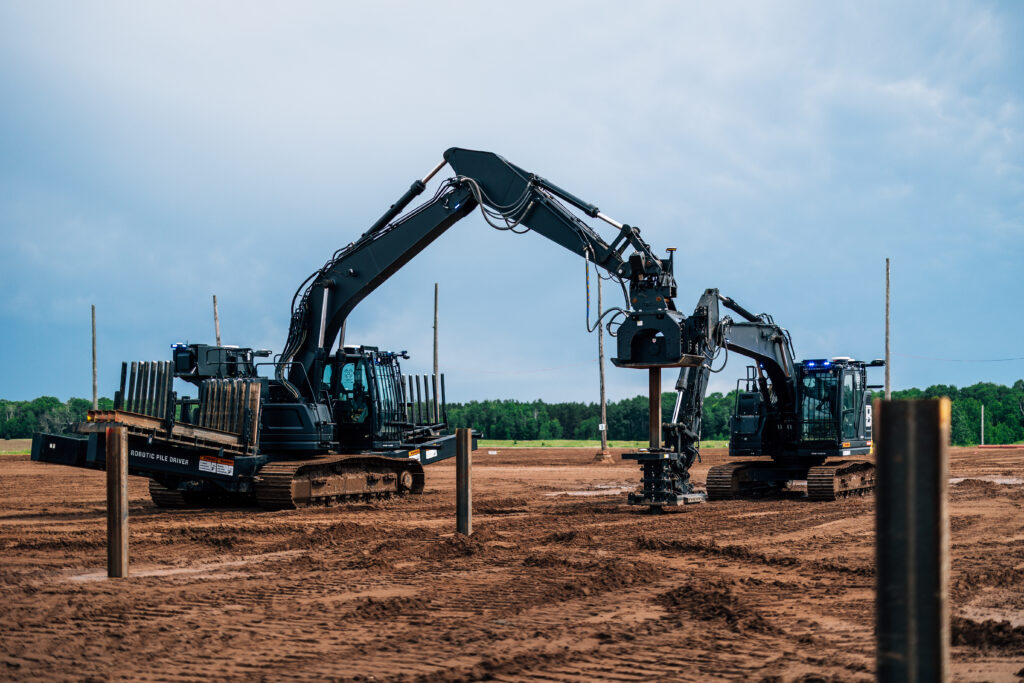
Built Robotics secures up to AUD 14.5 million for a Brisbane hub manufacturing autonomous piling systems. The company’s robots drive more than 300 foundation piles per day — work that traditionally requires large crews and weeks of scheduling. Built Robotics estimates its technology cuts piling time by roughly 82% and labor costs by 88%. The facility aims to produce 12 robotic pile-driving systems.
“Australia has shown the world that construction robotics and physical AI work in the field,” said Paul Kelly, Vice President of Business Development at Built Robotics. “Now we’re going to build that technology here.”
The investments reflect a broader shift: renewable energy developers globally are turning to construction automation to meet deployment timelines. In the United States, companies including Terabase Energy and AES have deployed similar robotic installation systems. Australia’s relatively high labor costs and vast project pipelines make it an early proving ground.
Local manufacturing also addresses supply-chain fragility exposed during the pandemic. Importing specialized construction equipment from overseas adds lead time and currency risk. Producing robots domestically creates a feedback loop — Australian engineers refine the machines for local conditions, then deploy them on Australian projects.
Both facilities are expected to generate skilled manufacturing and robotics jobs, aligning with the government’s “Future Made in Australia” industrial policy. The Solar Sunshot program has now allocated funding across multiple rounds for ingot, wafer, cell, and module production as well as balance-of-system components.
Construction on the Melbourne and Brisbane sites is slated to begin this year, with first commercial deployments anticipated in 2026.