

Nneka Ogwumike Prepares to Exit the WNBA After Shaping Its Labor Future
15-season veteran and players' union president set to announce retirement following historic labor negotiations.
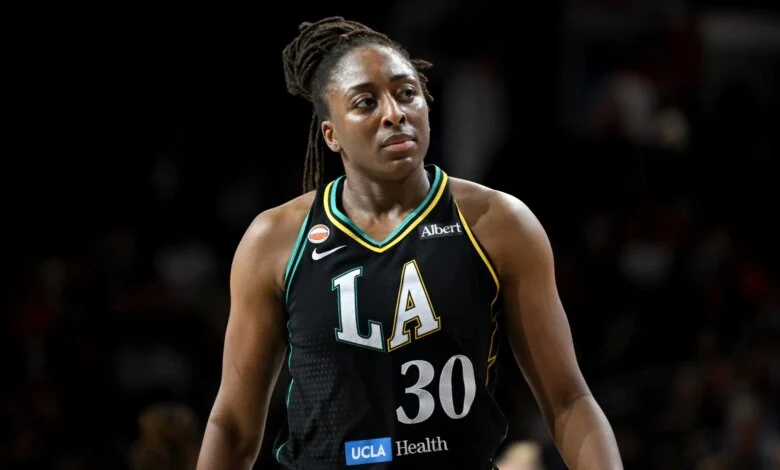
Sitting in a Boston hotel room ahead of a career-defining moment, Nneka Ogwumike connected via Zoom to prepare for what comes next: a public announcement two days away confirming her retirement from the WNBA.
“I feel good,” she said. “I don’t know if excited is the right word, but I feel good.”
The 36-year-old forward entered the league as its top overall draft choice in 2012 and is currently navigating her 15th professional campaign. Although her household profile beyond core basketball circles has not matched that of some younger personalities, her track record over the past decade-and-a-half stands among the game’s elite: an 11-time All-Star selection—the second-highest total in WNBA history—along with the 2016 Most Valuable Player award and a championship title with the Los Angeles Sparks. She belongs to a prominent basketball family; her sister Chiney Ogwumike also suited up for the Sparks before establishing a career as an ESPN broadcaster, while sisters Erica and Olivia competed at the collegiate level and represented Nigeria internationally.
Her lasting impact, however, extends well beyond her statistical achievements. Ogwumike assumed the presidency of the Women’s National Basketball Players Association (WNBPA) in 2016, directing the labor union through the landmark 2020 collective bargaining agreement that introduced pioneering protections like parental leave. Just four years later, she was called upon to guide the union through another pivotal labor negotiation.
The influx of a transformative 2024 draft class featuring Caitlin Clark and Angel Reese ignited unprecedented commercial growth across the league, yet player compensation lagged far behind that financial surge. Unprecedented attendance records and broadcast ratings clashed sharply with rising frustration among players and supporters regarding league pay scales, exemplified by Clark’s initial base salary of $76,000.
Ogwumike bore the responsibility of transforming that internal frustration into collective bargaining power. Serving as union president, she was tasked with aligning a diverse membership—spanning long-tenured veterans accustomed to five-figure incomes to 22-year-old rookies arriving as NIL millionaires—into a unified bargaining entity to confront the WNBA and the NBA, which retains major ownership in the women’s league. That solidarity faced severe tests, including a formal letter from superstars Breanna Stewart and Kelsey Plum expressing reservations over the union’s tactical approach during talks. Ultimately, the bargaining process yielded a labor contract with ramifications reaching far past women’s sports.
Backed by prominent advisers such as Nobel laureate economist Claudia Goldin, the players secured a 364% pay increase, marking the largest single salary jump in American professional sports history. Average player compensation rose to $564,000 for the current season, positioning WNBA athletes as the highest-compensated competitors in women’s team sports.
This financial overhaul represents a stark departure from the league’s previous economic model, where player salaries were capped far below comparable men’s professional leagues and revenue-sharing mechanisms were minimal. By tying compensation more directly to expanding media rights deals and franchise valuations, the 2024 negotiations established a baseline designed to narrow the long-standing gap between league revenues and player remuneration.
“It took a lot,” Ogwumike said while reflecting on the process. She was required to balance her duties as an active competitor with her responsibilities as a union leader. “I had to manage people not seeing me as president while I’m on the court.” The challenge was compounded by grueling moments during bargaining—such as a six-week stretch of silence from league management, or negotiating until the “wee hours of the morning” in New York that ended just hours before morning practice sessions.
Her decision to retire crystallized during this season’s training camp, which marked her return to the Sparks following a two-season tenure with the Seattle Storm. “I was just thinking about how much this league has grown and the demand on players as it continues to grow,” she recalled. Having persevered through periods of low visibility when games rarely aired on television and the league faced severe financial strains during the COVID-19 pandemic, she evaluated her future. “Even though I know I’m up for the challenge, I wasn’t sure I needed to do it for longer than another year.”
Widespread respect among the union membership occasionally prompted players to refer to Ogwumike informally as their own “commish” during moments of frustration with league executive leadership. She has previously indicated an interest in eventually joining the league’s corporate front office, advocating for greater representation of former players within executive management.
With that transition now approaching, Ogwumike’s immediate plans remain fluid. In the short term, she intends to divide her time between Houston and Los Angeles while taking control of her personal schedule for the first time in 15 years. She has committed to play in Project B, an upcoming international league designed to extend top athletes’ careers through global exhibition games. Regarding a potential executive role in the WNBA front office, she noted, “I don’t close doors.”
She remains realistic about the requirements for stepping into an executive role during an intense period of commercial expansion across women’s athletics. “I’m not assuming that it’s just going to be a role that is made available or that is given,” she said. “I don’t feel as though today I am completely qualified for any type of executive role.”
Yet observers of the intense collective bargaining sessions recognize the skill set developed during her tenure: managing complex constituency interests, understanding the intricacies of the WNBA’s financial operations, and executing high-stakes strategic negotiations.
Ogwumike noted that executive leadership becomes “a little less tumultuous” when leaders “provide an environment for everyone to share their thoughts.” As union president, she prioritized accessibility and open communication, striving to appreciate the varying backgrounds of the player body. “Everyone just has different lived experiences,” she explained.
The unpredictable flow of labor bargaining helped soften her rigid, detail-oriented tendencies. “Being adaptable is incredibly important,” she acknowledged regarding her key takeaway from the negotiations.
Her departure arrives amid a turbulent period for the WNBA. While attendance figures and broadcast viewership continue to set records, the season has faced distraction from broader political debates. Comments by Indiana Fever guard Sophie Cunningham opposing the participation of transgender women and girls in women’s sports sparked widespread media coverage, drawing national political commentary despite no active eligibility disputes within the league. Game arenas have seen spectators wearing apparel supporting transgender women alongside merchandise from the XX-XY brand, which advocates excluding transgender girls from female sports categories. “I think ultimately there’s too much good and too much excitement happening in the league for it to be swallowed up by the noise,” Ogwumike remarked.
Having spent countless hours locked in direct bargaining against top league officials, Ogwumike earned explicit recognition from WNBA Commissioner Cathy Engelbert for her pivotal role in reshaping the organization. “Nneka will retire at the end of this season,” Engelbert acknowledged, “leaving the WNBA much better than she found it.”








One Comment