Texas Federal Judge Strikes Down ATF Ghost Gun Restrictions as Unconstitutional
Court rules federal restrictions on unfinished firearm kits violate constitutional protections
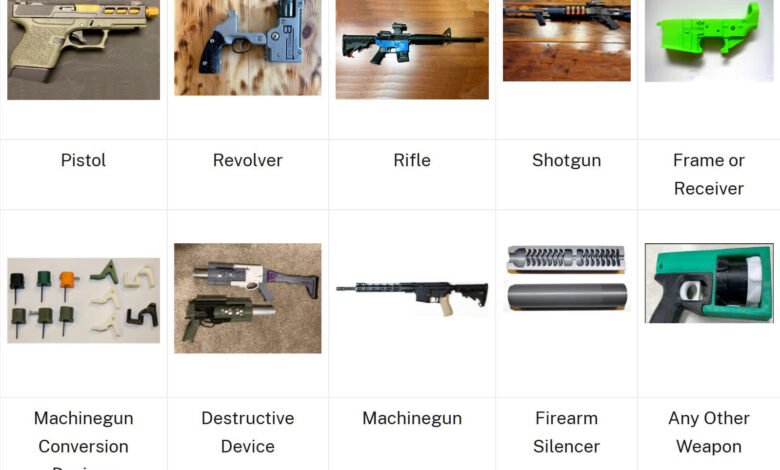
Federal requirements compelling gun kit sellers to hold licenses, run background checks, assign serial numbers, and maintain customer records have been struck down as unconstitutional by a federal judge in Texas. The ruling halts major elements of the Bureau of Alcohol, Tobacco, Firearms and Explosives’ 2022 regulation, which had broadened the legal definitions of “firearm” and “frame or receiver” to encompass partially completed components and weapon assembly kits.
Under the issued permanent injunction, federal authorities are barred from enforcing these provisions against Defense Distributed along with existing or future members of the Second Amendment Foundation. The protective order specifically applies to the firm’s G80 build kit, M1911 80% frames, grip module, and unfinished receiver.
This judicial determination carries significant consequences for 3D-printed firearm parts. Per the agency’s rule, a forged, printed, cast, extruded, or unmachined body is classified as a regulated receiver or frame the moment it becomes “clearly identifiable” as an incomplete gun component.
Judge Reed O’Connor relied on that specific threshold to anchor his Fifth Amendment ruling. To evaluate whether an item is “readily” convertible into a functioning firearm part, the ATF relies on eight nonexclusive criteria: required time, ease of assembly, necessary expertise, available equipment, financial expense, parts availability, operational scope, and overall feasibility.
O’Connor ruled that the regulation fails to define the exact point at which plastic or metal material transitions into a regulated firearm. By leaving individuals to speculate whether a machined or 3D-printed component triggers federal regulation while granting expansive enforcement authority to the ATF, the judge declared the definitions void for vagueness under the Fifth Amendment’s Due Process Clause.
The court further concluded that the restrictions infringe upon the Second Amendment by restricting access to essential parts used to construct or repair personal weapons. In defense of the rule, federal attorneys pointed to historical colonial statutes that mandated safety testing for gun barrels and regulated the storage and transport of gunpowder.
O’Connor dismissed those historical precedents, noting they targeted product defects and accidental explosions, whereas the ATF’s policy seeks to aid law enforcement in tracing firearms and keeping weapons away from prohibited individuals. The regulation “contradicts the actual historical tradition of personal gunsmithing,” O’Connor wrote, emphasizing that private firearm manufacturing was widespread in early American history.
While the U.S. Supreme Court upheld this regulation in a 7-2 decision last year, concluding that the Gun Control Act granted the ATF authority to regulate unfinished receivers and easily assembled kits, that decision focused strictly on statutory authorization rather than the constitutional claims evaluated by O’Connor.
The legal battle centers on the statutory framework established by the Gun Control Act of 1968, which grants federal authority over completed firearms and their core structural components. Historically, unfinished components requiring additional drilling or milling—commonly referred to as 80% frames—existed outside federal regulation, creating a distinct regulatory framework that the ATF attempted to update in response to advancements in manufacturing tools and desktop 3D printing.
Based on ATF guidance, individuals retain the right to fabricate detectable firearms for personal use using 3D printers or traditional equipment without serializing them, provided they are not engaging in commercial manufacturing. According to agency data, law enforcement recovered roughly 45,240 suspected privately made firearms from potential crime scenes between 2016 and 2021.
Defense Distributed has engaged in extended litigation over 3D-printed weapons for years. A 2018 settlement with the Department of Justice permitted the organization to share firearm CAD files online, though a federal judge subsequently invalidated that agreement in 2019. In recent years, forensic researchers have also examined whether unique toolmarks left by 3D printers could assist law enforcement in tracing home-built firearms.
While the injunction refrains from invalidating the ATF’s federal regulations nationwide, it establishes a targeted carve-out that shields Defense Distributed, the SAF, and all current or prospective SAF members from federal enforcement actions under the challenged provisions.