Beijing’s Strategic Oil Return: Restocking Without Rattling Global Markets
Beijing balances reserve replenishment with market stability.
China has initiated a significant return to Middle Eastern oil markets, securing at least 26mn barrels for mid-summer delivery as it moves to replenish domestic reserves depleted during recent regional instability.
The surge in activity follows a period of uncharacteristic restraint by Beijing, which had curtailed imports to prevent global prices from spiraling after the outbreak of the Iran war. According to the price-reporting agency Argus, the recent purchases—slated for July or August—were conducted through a mix of tenders and one-off deals with trading firms, involving suppliers from Qatar, Saudi Arabia, the United Arab Emirates, and Iraq.
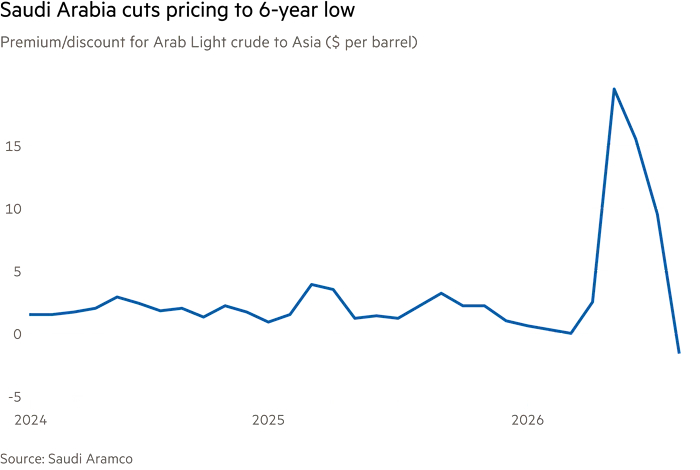
The timing coincides with a pivot by Saudi Aramco, which on Monday issued deep discounts on all its crude grades. The kingdom’s flagship Arab Light crude is now priced for Asian buyers at its most significant discount since the 2020 price war with Russia. This aggressive pricing follows the partial reopening of the Strait of Hormuz, a critical maritime artery that handled roughly a fifth of global oil shipments before the conflict.
For Beijing, the move is a necessary correction. Michal Meidan, head of China energy research at the Oxford Institute for Energy Studies, estimates that Chinese commercial stocks were likely drawn down by nearly 1mn b/d through May and June. While the Middle East traditionally accounts for half of China’s crude imports, data compiled by Kpler shows that flows hit a near decade-low in April.
However, the recovery remains tempered by internal policy. Beijing continues to maintain informal export controls on refined products like gasoline and jet fuel. Fabian Ng, head of Asia crude pricing at Argus, noted that a full-scale revival in crude demand is contingent on the lifting of these restrictions, which currently limit the volume of feedstock Chinese refiners can profitably process.
Market analysts suggest the current buying pattern reflects a “stealth” restocking strategy. Zhuwei Wang, a director of oil trading research at S&P, observed that China is wary of sending signals that could trigger a market rebound. Beijing is reportedly facing pressure from domestic oil majors to ease export caps, yet officials remain cautious about sparking a crude buying frenzy that could reverse recent price declines.