Logistics Giants Warn Against Abandoning Strait of Hormuz for Costly Land Routes
Kuehne+Nagel CEO cites $8,000 trucking costs and capacity limits as barriers to land-based trade alternatives.
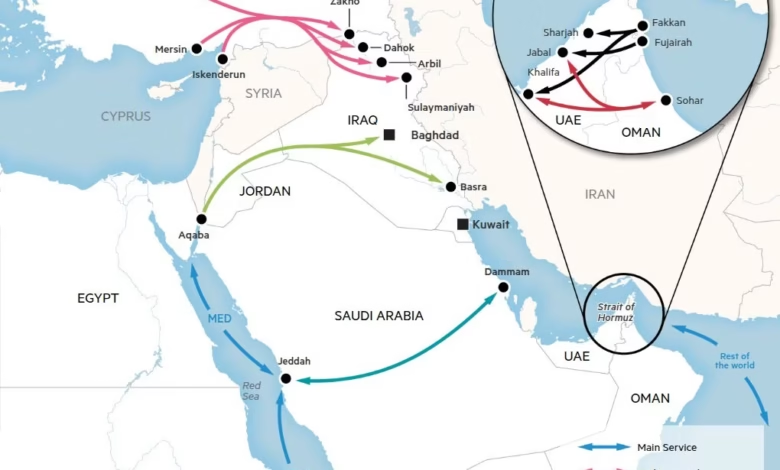
The global logistics industry is facing a reality check over the viability of land-based trade corridors in the Middle East, as the head of the world’s largest freight forwarder warns that trucking remains an unsustainable alternative to maritime passage.
Stefan Paul, chief executive of Kuehne+Nagel, told the Financial Times that the reliance on road transport to bypass the Strait of Hormuz cannot be maintained in the mid-to-long term. His assessment highlights a fundamental math problem in global trade: the massive capacity of container ships versus the limited scale of lorry fleets.
While the largest container ships can carry more than 20,000 containers, a single truck is limited to just two 20ft units. This disparity has led to severe congestion at border crossings, such as the transit point between Oman and the United Arab Emirates, where trucks have queued for miles.
The push for land routes intensified following a period of heightened regional conflict. After the US and Israel attacked Iran in late February, subsequent strikes on commercial vessels effectively closed the strait. This forced logistics groups to seek paths through Turkey and Jordan to reach Gulf markets.
The shift came with a significant price tag. Paul noted that demand for trucking drove hire costs to approximately $8,000 per month—a 25 per cent increase from pre-conflict levels.
Historically, the Strait of Hormuz has functioned as the world’s most sensitive energy and trade artery. According to the U.S. Energy Information Administration, the waterway accounts for the transit of nearly 21 million barrels of oil per day, making any prolonged closure a threat to global price stability that land routes are physically incapable of mitigating.
Despite the inefficiencies, some industry players are betting on a hybrid future. The French shipping line CMA-CGM recently announced a $400mn partnership with Oman’s Asyad Group to develop a logistics facility in Sohar. Similarly, work began last year on a railway project in Saudi Arabia designed to link the Red Sea port of Jeddah to Gulf terminals.
Peter Sand, chief analyst at the freight analytics company Xenata, suggested that shipping networks will not return to a “carbon copy” of their previous states. He argued that companies might accept longer transit times and multi-modal transport to insulate themselves from future geopolitical shocks.
However, the immediate impact of the disruption remains visible in global equipment shortages. Paul estimated that 350,000 containers are currently displaced, sitting in ports across the Gulf, India, or Africa. This has created a vacuum in Asia, where exporters are scrambling for “steel boxes” to meet a surge in demand ahead of new US tariffs.
Even with a 60-day ceasefire between the US and Iran allowing more vessels to pass, the recovery is slow. Bookings for the Gulf have improved but remain 50 per cent lower than they were before the conflict began.
Lars Jensen, chief executive of Vespucci Maritime, told the Financial Times that the industry is likely to revert to traditional maritime routes once stability is assured, citing the simple reality of cost-efficiency.