Hyundai Tucson Signals Shift Toward Premium Ambitions in Competitive SUV Market
The fourth-generation SUV pivots from affordability to premium refinement.
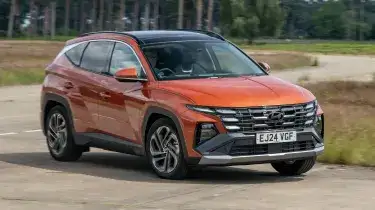
The fourth-generation Hyundai Tucson marks a definitive departure from the brand’s historical reliance on utility and affordability, repositioning the mid-size SUV as a premium competitor in a crowded European landscape. While previous iterations prioritized modest pricing and standard equipment to offset a lack of aesthetic flair, the current model targets a more affluent demographic through refined interior materials and advanced hybrid technology.
This strategic pivot comes as South Korean manufacturers increasingly challenge established European marques. According to reporting from Auto Express, the Tucson has already secured victories in real-world testing against prominent rivals including the Ford Kuga, Vauxhall Grandland, and the Renault Austral.
The Tucson’s market positioning is supported by a pricing structure that now reaches up to £43,690 for top-tier variants. However, entry-level models remain accessible at £30,255, with current market incentives potentially lowering that threshold to approximately £26,635. This pricing flexibility allows Hyundai to maintain its traditional customer base while simultaneously attracting buyers who previously favored luxury brands.
Central to the vehicle’s appeal is its integration of petrol-hybrid powertrains. The International Energy Agency has noted that hybrid adoption serves as a critical bridge for consumers transitioning away from internal combustion engines, and Hyundai’s implementation emphasizes smoothness over raw performance. The system utilizes a six-speed automatic transmission designed to shift early, keeping engine revolutions low to mitigate noise—a necessary calibration given that the engine can become thrashy under heavy load.
Inside, the cabin features a layout that rivals estate cars for total load space, a key metric for the family car segment. The shift toward a “premium-feeling cabin” and intuitive on-board tech reflects a broader industry trend where digital interfaces and material quality are now primary differentiators.
Driving dynamics remain focused on urban and motorway utility rather than engagement. While the vehicle includes a Sport driving mode, Auto Express notes the feature feels largely superfluous in a car designed for efficiency. Instead, the Eco drive mode is favored for maintaining the low-rev profile that complements the hybrid system’s refinement.