Mini Countryman SE ALL4 Review: Electric Power Meets Playful Design
The flagship electric crossover delivers strong performance and a highly digitized cabin, but faces range and charging trade-offs.

The third-generation Mini Countryman has evolved significantly since its debut 16 years ago, transitioning from a controversial five-door crossover into a modern, fully electric flagship. The latest dual-motor Countryman SE ALL4 attempts to balance the brand’s signature driving dynamics with the realities of electric mobility, presenting a unique but compromised package for premium EV buyers.
Pricing and Lineup
In Australia, the Countryman range spans four distinct configurations. The entry-level Countryman C, powered by a 1.5-liter turbocharged four-cylinder engine, starts at AU$56,700 ($39,700). Buyers looking for a single-motor electric variant can opt for the Countryman E starting at AU$75,526 ($52,900), while the combustion-powered JCW Countryman ALL4 features a 2.0-liter turbocharged engine starting at AU$78,652 ($55,100). The top-tier Countryman SE ALL4 starts at AU$80,737 ($56,600), with the premium Favored trim tested here priced at AU$83,862 ($60,600).
Powertrain and Performance
The Countryman SE ALL4 is equipped with a 64.6 kWh battery pack and dual electric motors. Together, they generate 230 kW (308 hp) and 494 Nm (365 lb-ft) of torque. While Mini claims a 0-100 km/h (62 mph) acceleration time of 5.6 seconds, real-world GPS testing achieved a quicker 5.3 seconds. Rolling acceleration from 60-120 km/h (37-75 mph) was clocked at 4.79 seconds, providing robust passing power.
Range and Charging Limitations
Despite its strong performance, the vehicle’s battery capacity limits its practical usability. The official driving range is rated at 432 km (268 miles), but real-world testing averaged a consumption rate of 17.2 kWh/100 km, indicating that drivers will struggle to exceed 400 km (248 miles) on a single charge. DC fast-charging is capped at a peak rate of 130 kW, requiring 29 minutes to charge from 10% to 80%.
Interior Design and Technology
Inside, the cabin centers around a digitized circular OLED infotainment display. This screen handles climate control settings, navigation, and media, while featuring interactive software that alters graphics and colors based on selected Experience Modes. Tactile toggles located below the screen control key functions, including the vehicle’s power switch, mimicking the physical keys of older Mini models.
The Favored trim adds premium features such as a panoramic glass roof, an interior camera, a massaging driver’s seat, and a 12-speaker Harmon Kardon audio system. Ambient lighting is projected directly onto the door panels and behind the central screen. Rear cargo space is rated at 460 liters (16.2 cubic feet), though second-row legroom and headroom remain tight for passengers over six feet tall.

Driving Dynamics and Safety
The vehicle’s suspension is on the firmer side, occasionally bouncing on uneven roads, but works in tandem with Pirelli P Zero tires to deliver high levels of grip. Engaging Go Kart Mode sharpens the throttle response, increases steering weight, and introduces a synthetic soundscape to the cabin.
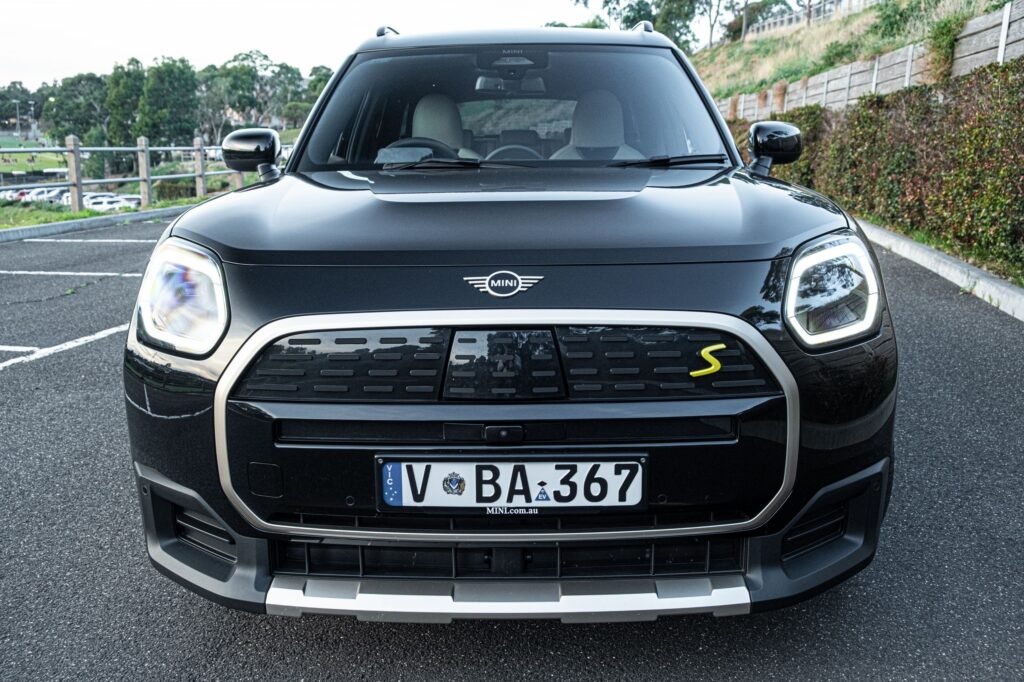
For daily driving, the gear selection toggle allows drivers to engage B mode for one-pedal driving, though standard regenerative braking adjustments are located deep within the infotainment menus. Standard safety systems include autonomous emergency braking, active cruise control with lane-centering, and an automatic parallel self-parking system.
Platform and Heritage
The Mini brand, owned by the BMW Group since 2000, has progressively scaled its vehicles to meet global consumer demand for larger utility vehicles. The original Countryman, launched in 2010, was Mini’s first modern crossover, designed to expand the brand’s appeal beyond compact hatchbacks. This third-generation model shares its underlying architecture with BMW’s compact front-wheel-drive and all-wheel-drive platforms, allowing it to utilize the same electric drivetrains found in other BMW Group compact electric vehicles. This shared engineering explains both its premium cabin refinement and the physical constraints of its battery pack, which must fit within a platform shared with internal combustion engine variants.