Toyota C-HR Real-World Tests Reveal Significant Gap in Hybrid Efficiency Claims
Laboratory WLTP figures clash with real-world road performance.
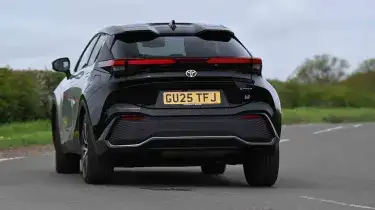
Toyota’s latest C-HR lineup demonstrates the persistent friction between laboratory-certified efficiency and the realities of daily driving. While the Japanese manufacturer’s hybrid technology remains a benchmark for urban fuel economy, recent performance evaluations highlight a notable discrepancy between official Worldwide Harmonised Light Vehicles Test Procedure (WLTP) ratings and actual road use.
The entry-level 1.8-litre Hybrid variant, which carries an official combined rating of 60.1mpg, returned a combined average of 54.6mpg during long-term fleet testing conducted by special contributor Paul Adam. Despite falling short of the manufacturer’s laboratory figures, the vehicle maintained significant efficiency in urban environments, frequently operating on electric power for over 70 per cent of short-duration trips without manual intervention.
The gap becomes more pronounced with the 2.0-litre Plug-in Hybrid (PHEV). Official data suggests a combined figure of 353.1mpg, a number predicated on the frequent use of its 13.6kWh battery. However, in scenarios where the vehicle operated without electrical assistance, the efficiency dropped to 51.8mpg. This “worst-case” figure, recorded during a comprehensive hybrid evaluation loop, underscores the reliance of PHEV technology on consistent charging infrastructure to meet environmental targets.
Infrastructure limitations remain a hurdle for the C-HR PHEV. The model does not support DC rapid charging, a feature increasingly common in modern electrified vehicles to reduce downtime at public stations. Instead, replenishing a depleted battery requires approximately 2.5 hours via a 7.4kW home wallbox.
Driving dynamics also reflect the compromises of the hybrid powertrain. The Continuously Variable Transmission (CVT), a staple of Toyota’s hybrid architecture designed to optimize engine RPMs for efficiency, produces a distinct engine drone under hard acceleration. Paul Adam noted that while the vehicle remains composed at cruising speeds, the powertrain struggles during overtaking maneuvers.
Insurance costs reflect the increasing complexity of these electrified systems. The 1.8-litre HEV sits in insurance group 20, while the more complex PHEV model rises to group 25. These classifications, alongside the 19g/km to 115g/km CO2 variance across the range, position the C-HR as a high-efficiency option that nevertheless requires specific driving habits to realize its advertised potential.