Ruf Asserts Manufacturing Autonomy with 1,000-Horsepower B8 Engine Reveal
The German manufacturer moves beyond its Porsche roots with a bespoke 1,000-hp V8.
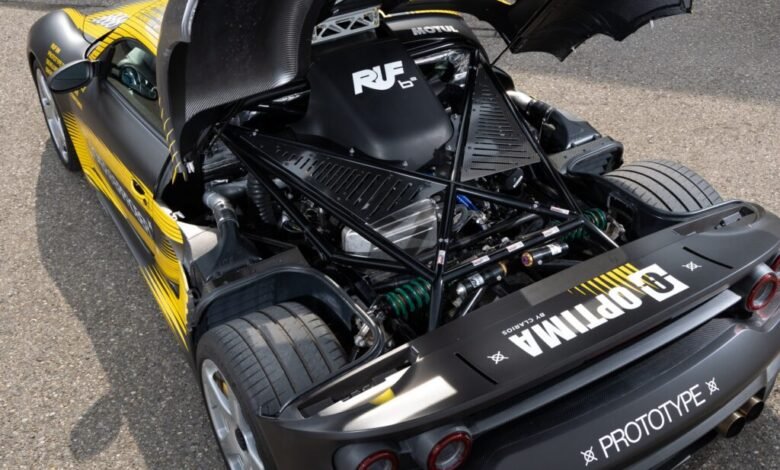
The Goodwood Festival of Speed served as the backdrop for Ruf’s most significant technical departure from its Porsche-adjacent heritage to date: the public debut of the B8 engine. Mounted within a lengthened CTR3 development mule nicknamed the “Erprober,” the new 4.8-liter powerplant represents a pivot toward bespoke engineering for the Pfaffenhausen-based firm.
While the company is often associated with modified 911 chassis, Ruf has operated as a recognized vehicle manufacturer under the Federal Motor Transport Authority in Germany since the early 1980s. This distinction began with the 1983 BTR, the first model to receive a proprietary Ruf vehicle identification number. The B8 engine, generating more than 1,000 hp and 737 lb-ft of torque, pushes that independence further by moving away from the traditional horizontally opposed six-cylinder configurations that have defined the brand’s previous high-performance offerings.
Lead engineer Marc Brunner and company head Alois Ruf Jr. oversaw the engine’s first public firing at the event. The B8 is currently being tested in a chassis that evolved from the 2007 CTR3, a mid-engined supercar that utilized a frame developed alongside Multimatic. Unlike the rear-engine layout of the Porsche 911, this configuration allows for the packaging of the larger V8 unit.
Professional driver Tanner Faust is tasked with piloting the “Erprober” during its demonstration runs. The move to a 1,000-hp V8 follows Ruf’s recent shift toward proprietary carbon fiber monocoque chassis, seen in the SCR and Rodeo models. While those vehicles maintained the aesthetic of the 964-era Porsche, the B8 signals a transition toward a new generation of cars where the internal architecture is as unique as the VIN.