UN Rebuilds Its Data Systems as AI Gets Global Facts Wrong
The UN is rebuilding its data infrastructure as AI-generated answers prove unreliable
NEW YORK — AI assistants are becoming a major route to public information even as their answers on global development remain unreliable. A forthcoming UNICEF working paper found that six leading models achieved an average accuracy score of only 21.2% when asked about indicators including maternal health, childhood nutrition, and literacy rates.
The study examined more than 133,000 queries involving global development data. The models were OpenAI’s GPT-4o and GPT-4o-mini, Anthropic’s Claude Sonnet 4.5 and Claude Haiku 4.5, and Google’s Gemini 2.5 Flash and Gemini 2.0 Flash. UNICEF chief statistician João Pedro Azevedo said the systems failed to provide a usable figure in approximately three out of five cases, often hedging to avoid an error.
The same model versions also produced unstable results. When researchers repeated identical queries 48 hours later, matching figures appeared only about half the time. UNICEF plans to publish the paper’s full methodology, dataset, and code with its peer-reviewed release.

AI-driven traffic to UNICEF’s main data website has nevertheless increased sharply. The site receives more than 6 million visits per month, and visits arriving through links in ChatGPT responses rose 67% year-over-year between January 1 and September 14. Those referrals accounted for 6.4% of all sessions, while UNICEF estimates that automated AI assistants generate roughly one in 10 visits overall.
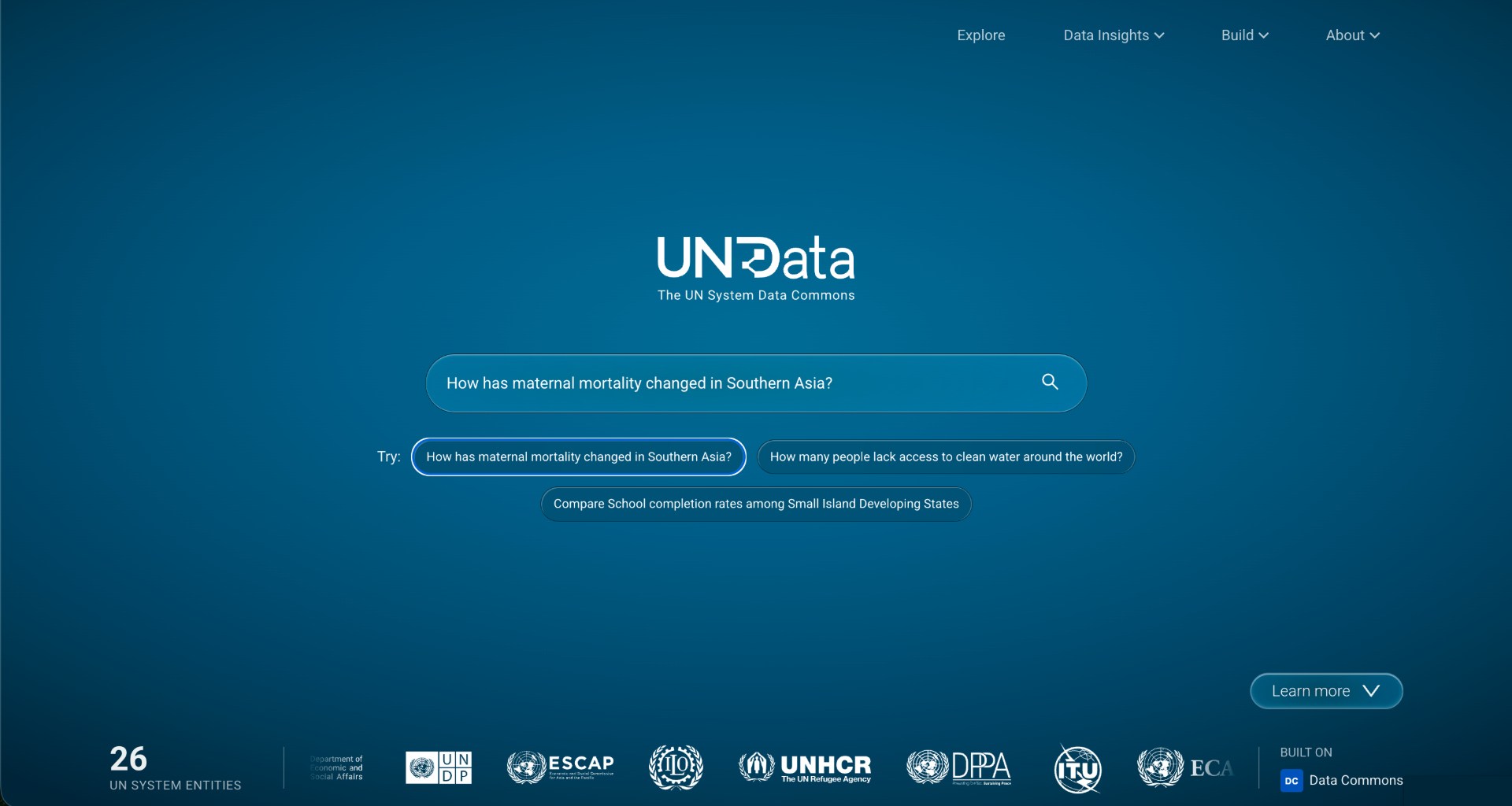
The United Nations is responding by replacing the legacy UNData portal with the UN System Data Commons, an AI-ready data engine developed with Google. Since 2008, UNData had brought together more than 60 million data points from dozens of specialized agency databases, but its manual browsing tools, structured SQL-like searches, and CSV downloads were designed for human researchers rather than neural networks.
The UN Statistics Division, established in 1947 to standardize international statistical systems, now oversees the shift. The new platform supports natural-language searches for human users and incorporates the Model Context Protocol (MCP), an open standard for connecting AI models to secure external data sources.

With MCP, an AI agent can query the UN database instead of relying on pre-trained internal weights or scraping unstructured web pages. The system records the exact provenance of each statistic, giving users a verifiable route to the originating UN agency. “We are orders of magnitude more advanced in scale, scope, and flexibility, connecting for the first time across so many agencies across the UN system,” said Shantanu Mukherjee, acting director of the UN Statistics Division. “And [we are] taking this moment to also make our data AI-ready.”
Google introduced its Data Commons initiative in 2018 to organize public datasets from the U.S. Census Bureau, the Centers for Disease Control and Prevention (CDC), and the World Bank in a unified knowledge graph. The framework maps differing data schemas to a shared standard, addressing conflicts involving geographic boundaries, time periods, and demographics.
Google.org provided $2 million in capacity-building funding and hands-on technical support to adapt the technology for the UN. Prem Ramaswami, who leads Google’s Data Commons division, said the system runs on a UN-governed instance. The project used a “train-the-trainer” approach so UN personnel can manage, operate, and expand the infrastructure independently.
Nearly 20 UN entities had made statistics available when the platform launched, while 26 entities had committed to the transition. The UN plans to move 80% of the statistical datasets across the entire UN system to the Data Commons platform by 2027. The datasets support monitoring of the 17 Sustainable Development Goals (SDGs), established by the UN General Assembly in 2015 and measured through 231 unique indicators tied to 2030 targets.
Structured data exposed through MCP also allows AI systems to combine indicators in real time. In a demonstration, Google connected an AI assistant to the database and used HIV infection rates, AIDS-related mortality, and overall life expectancy to produce custom dashboards, charts, and narrative analyses about the impact of the U.S. President’s Emergency Plan for AIDS Relief (PEPFAR) in Africa. Previously, a human researcher would have had to find, download, and reconcile the datasets manually across multiple agency databases.
Clean data does not remove the possibility of faulty reasoning by AI models. “Because models can misinterpret nuance, a human should always review the outputs before citing or publishing them,” Ramaswami said.