Older Americans’ Net Worth Surged 38% as Young Adults Lost Ground
Asset ownership, declining youth homeownership, and expiring pandemic aid drove a 15-to-1 wealth ratio between the oldest and youngest Americans.
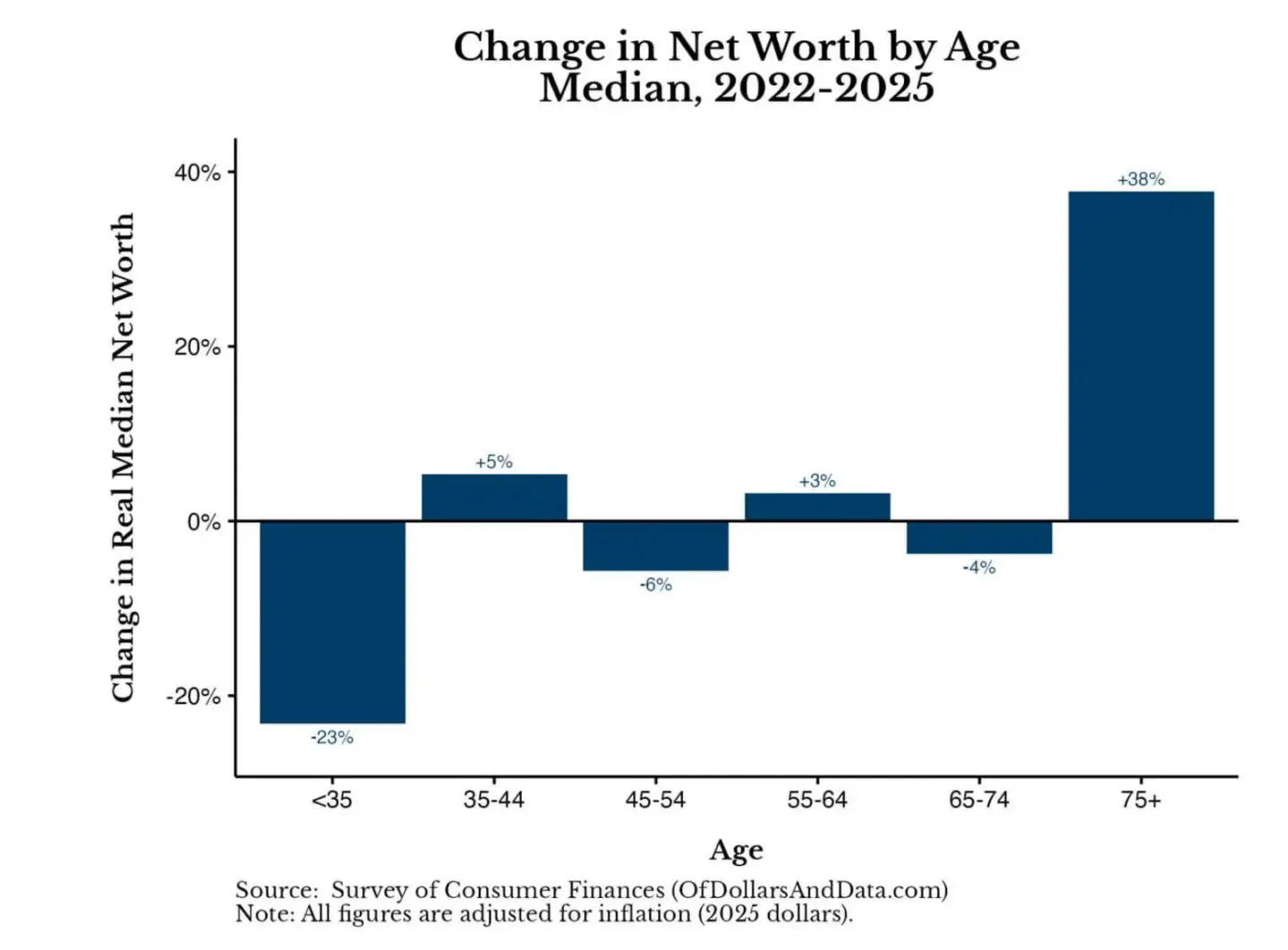
Americans under 35 lost nearly a quarter of their inflation-adjusted wealth between 2022 and 2025, while households headed by someone 75 or older saw their median net worth jump 38%, according to the Federal Reserve’s latest Survey of Consumer Finances. The triennial report exposes an accelerating generational divide driven almost entirely by asset ownership rather than income.
The oldest cohort finished the survey period with a median net worth of $504,600 in 2025 dollars, up from $366,288 three years earlier. For adults under 35, the median fell from $42,725 to $32,820. The ratio of wealth between the oldest and youngest brackets widened from roughly 9-to-1 to 15-to-1. Across all U.S. families, the inflation-adjusted median net worth rose just 2% to $215,900, masking the extreme polarization at the edges of the age spectrum.
This concentration has reached historic scale. Americans aged 55 and older now hold approximately $140 trillion, representing about three-quarters of total national net worth, according to a Bank of America Institute analysis of the Fed data released this month.


The divergence traces directly to what each generation holds. Older households are heavily invested in real estate and equities. Younger households own fewer homes and carry a disproportionate share of their assets in depreciating vehicles. Between 2022 and 2025, U.S. stock markets climbed sharply, propelled by artificial intelligence-related capital spending, while used car prices retreated from pandemic-era peaks. Those macroeconomic shifts mechanically transferred wealth upward along the age curve.
Homeownership remains the primary structural barrier. The share of under-35 households owning a home dropped from 38.5% in 2022 to 35.6% in 2025. Nearly two-thirds of young adults were therefore locked out of the asset class that historically anchors middle-class wealth accumulation. By contrast, homeownership among those 65 and older has remained above 78% for decades, insulating them from rent inflation while their properties appreciated.
The recent decline for younger adults partially unwinds an unprecedented anomaly. Stimulus payments, paused student loan obligations, and a surge in retail investing drove the inflation-adjusted median net worth for the under-35 bracket from roughly $18,000 in 2019 to nearly $43,000 in 2022 — a 140% increase that stands as the largest on record in the Fed survey’s history. With federal pandemic support exhausted and student debt repayment resumed in late 2023, much of that temporary gain evaporated. Still, young households remain nominally wealthier than they were before 2020.
Demographic mechanics also inflated the gains at the top. The 75-and-older bracket is not exclusively baby boomers; it includes the Silent Generation. However, as wealthier boomers born around 1950 aged into this category between survey cycles, they lifted the group’s overall median. Nick Maggiulli, chief data officer at Ritholtz Wealth Management, calculated that following a consistent birth cohort — comparing households aged 72 and older in 2022 with those 75 and older in 2025 — yields a smaller but still substantial 21% increase. No other age bracket recorded a change in median net worth larger than 6% in either direction.
The widening gap extends a four-decade trend. Research submitted to the National Bureau of Economic Research by economist Edward Wolff found that average wealth among households under 35 fell from 21% of the national household average in 1983 to 16% in 2022. That relative decline demonstrates that younger Americans have been systematically losing ground long before the pandemic disrupted global markets.
Yale University law and history professor Samuel Moyn argues the data reflects more than demographic aging. In his book “Gerontocracy in America,” Moyn contends that concentrated wealth among older citizens fundamentally alters whose interests economic policy serves. He describes a system where aging Americans control the largest bank accounts and stock portfolios, pulling away from the rest of the population.
“The question is whether the age correlation of the haves versus have-nots with the older versus the younger is fair,” Moyn said regarding the new Fed figures. “And it isn’t. So this is a case of the older getting richer, not just the rich getting richer.”
Moyn noted that even within affluent families, inheritance increasingly arrives too late to shape a younger person’s prime earning or family-building years. Boomers benefited from acquiring assets early and riding multiple market expansions, but he expects the structural pattern of wealth concentrating toward the upper end of the age spectrum to persist regardless of which specific generation occupies it.
The financial disconnect carries electoral weight. More than half of men under 30 backed Donald Trump in the 2024 presidential election, a sharp reversal from 2020, according to AP VoteCast. Recent polling ahead of the upcoming midterm elections indicates some of that coalition is fracturing, with surveys showing young voters and young men shifting their congressional preferences toward Democrats. While the Fed survey does not measure political attitudes, a rising stock market functions differently as an economic argument for those holding portfolios than for those priced out of the housing market.
Maggiulli, author of “The Wealth Ladder,” previously documented how millennials eventually caught up to prior generations’ wealth benchmarks after lagging during the 2010s. He sees a distinct challenge emerging for Gen Z, pointing to the worst entry-level job market for recent college graduates on record combined with housing affordability hitting its lowest point in 40 years.
The Federal Reserve collected the underlying data for the 2025 Survey of Consumer Finances throughout 2025, interviewing over 7,000 families. The central bank plans to release detailed microdata files later this year, which will allow researchers to examine how racial disparities, debt loads, and regional housing markets intersect with the generational wealth divide.