

Tesla Roadster Thrusters Borrow From Missile Defense Tech
The sports car's compressed-air nozzles use the same kinetic steering physics developed for Pentagon hit-to-kill interceptors.
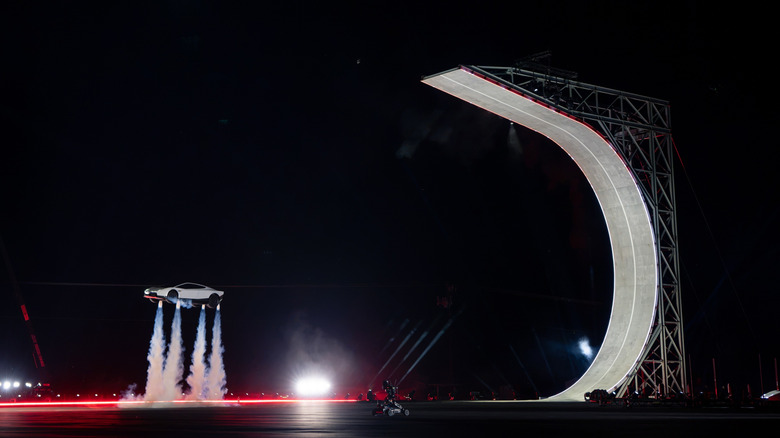
Cold-gas thruster arrays capable of reorienting a vehicle in midair have existed inside classified U.S. defense laboratories for more than two decades. Tesla just bolted one to a sports car.
When the automaker formally reintroduced its long-delayed Roadster on October 15, the headline specification was a sub-one-second zero-to-60 mph acceleration time paired with an angular design language mirroring the Cybertruck. The engineering reality drawing scrutiny from aerospace veterans is the optional SpaceX package: two high-pressure air tanks feeding ten nozzles distributed across the chassis. By venting compressed air in controlled bursts, the system alters the vehicle’s pitch, yaw, and roll while airborne, enabling maneuvers that resemble skateboarding kickflips more than traditional automotive dynamics.
The physics governing those stunts are identical to the principles behind hit-to-kill missile interceptors. Rather than detonating an explosive warhead near an incoming threat, modern ballistic missile defense relies on kinetic energy — slamming a precisely guided projectile directly into a target at hypersonic speeds. Executing that collision requires instantaneous directional changes in the vacuum of space or the upper atmosphere, where aerodynamic control surfaces like fins become useless. Compressed gas thrusters provide the only viable steering mechanism.

Lockheed Martin formalized this approach for multi-target engagements under a $760 million contract awarded by the Missile Defense Agency in 2004. The resulting Multiple Kill Vehicle program aimed to deploy a single interceptor carrying several smaller projectiles, each equipped with independent thruster arrays to hunt separate warheads and decoys released by an intercontinental ballistic missile. Raytheon pursued a parallel development track during the same period.
Both contractors inherited research rooted in the Strategic Defense Initiative, the Reagan-era anti-ballistic missile architecture widely known as “Star Wars.” While SDI explored directed-energy weapons and nuclear-pumped X-ray lasers, the kinetic interceptor concepts it funded matured into the ground-based midcourse defense systems currently protecting the U.S. homeland. The MKV program itself was terminated in 2009 amid broader Pentagon budget reductions, though the underlying thruster technology migrated into subsequent interceptor upgrades.
A critical engineering distinction separates the military application from the commercial one. Lockheed Martin’s interceptors relied on hot-fire propulsion systems burning chemical fuel to generate thrust. Tesla engineered the Roadster around cold-gas thrusters using strictly compressed air. Cold-gas systems sacrifice the raw specific impulse of combustion engines but eliminate thermal signatures, toxic exhaust, and catastrophic fire risks — essential trade-offs for a street-legal consumer product, even one explicitly barred from public roads when the thrusters are active.
Buyers will not get uniform access to the technology regardless. Tesla segmented the capability across three configurations. The top-tier Rocket trim includes the full ten-nozzle array. The intermediate Thruster trim restricts the hardware to rear-mounted nozzles. The base Performance model omits the pneumatic system entirely. The company claims the onboard compressors can refill the air tanks autonomously between deployments, removing the need for external pressurization equipment typically required in aerospace testing.
Translating spacecraft attitude control to a two-ton electric vehicle introduces regulatory complications that do not exist in orbital mechanics. Federal Motor Vehicle Safety Standards dictate strict parameters for crash structures, pedestrian impact zones, and electronic stability control. A system designed to intentionally destabilize and rotate a chassis conflicts directly with those mandates, explaining why Tesla preemptively restricted the feature from public roadways.
Production timelines remain fluid. Originally unveiled as a prototype in 2017 with a promised 2020 delivery window, the second-generation Roadster has endured repeated delays as Tesla redirected manufacturing capacity toward the Model Y, the Cybertruck, and its Optimus humanoid robotics division. No confirmed production start date has been published for the Rocket trim configuration.









