

Google is giving its artificial intelligence a corporate identity. The company announced Thursday that Gemini will receive its own Workspace account, complete with an email address and organizational context, as part of a broader rollout of autonomous agents designed to execute multi-step business workflows rather than simply answer questions.
The architectural shift transforms the AI from a chatbot interface into what functions essentially as a digital employee. By holding a dedicated Workspace account, the agent can map internal team structures, track time zones, identify approval hierarchies, and read calendars. Workers interact with it by tagging it in documents, emailing it directly, or adding it to group chats. Every action generates an audit trail attributed to the agent itself, establishing a clear chain of custody for automated work that previously did not exist in standard AI deployments.
This approach diverges sharply from how competitors have structured enterprise automation. Microsoft’s Copilot operates primarily as an embedded assistant within existing applications like Word and Excel, while Salesforce’s Agentforce focuses heavily on customer relationship management pipelines. By granting Gemini its own credentials and inbox, Google is treating the model as a distinct node on the corporate network.


To manage these operations, users monitor progress through a tasks inbox that displays the agent’s reasoning process, its delegation of subtasks to specialized subagents, and its execution of custom code. Thomas Kurian, CEO of Google Cloud, emphasized that the system accepts objectives rather than step-by-step instructions, planning its own path to completion using connected tools.
Crucially, the agent does not rely exclusively on proprietary technology. While it defaults to selecting the optimal internal model for a given task, administrators can manually route requests to third-party systems, beginning with Anthropic’s Claude models. Support for open-source and private models will follow. This multi-model orchestration reflects a broader industry reality: enterprises rarely want vendor lock-in when deploying generative AI, particularly as specialized models frequently outperform general-purpose ones in narrow domains like legal review or financial modeling.
Connectivity relies heavily on the Model Context Protocol (MCP), allowing the agent to securely interface with MCP servers both inside and outside corporate firewalls. Native integrations span a wide operational footprint, including Slack, Jira, Confluence, Git, BigQuery, Databricks, Postgres, Snowflake, ServiceNow, and Microsoft 365. Access points cover iOS, Android, Windows, Mac, and command-line interfaces.
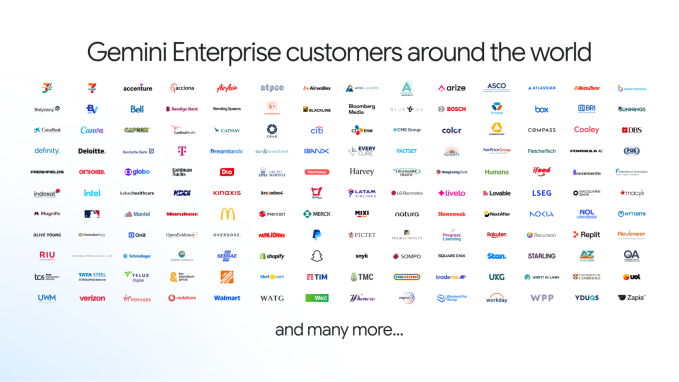
Chief Executive Sundar Pichai cited over 1 billion monthly active users across the Gemini ecosystem, alongside adoption by nearly 90% of Fortune 100 companies via Gemini Enterprise. Despite this massive consumer footprint, the agentic capabilities will debut strictly within enterprise environments. Pichai noted that business deployments force the resolution of complex security, scale, and performance challenges before consumer release.
Early testing involved Shopify, PayPal, and sportswear brand On. Existing enterprise customers integrating the broader platform include BNP Paribas, Bradesco, Merck, Orange Spain, Santee Cooper, SOMPO, Ulta Beauty, and Wesfarmers.
Because autonomous agents consume significantly more compute tokens than conversational queries—often running iterative loops to verify their own outputs—cost control represents a primary barrier to enterprise adoption. To address this, Google introduced real-time spend caps and smart routing mechanisms designed to prevent runaway inference bills during extended autonomous sessions.



