

Tesla Reveals Thruster-Equipped Roadster, Targets 2028 Production
Compressed air nozzles replace rockets as Tesla confirms 2028 production target for the long-delayed sports car.
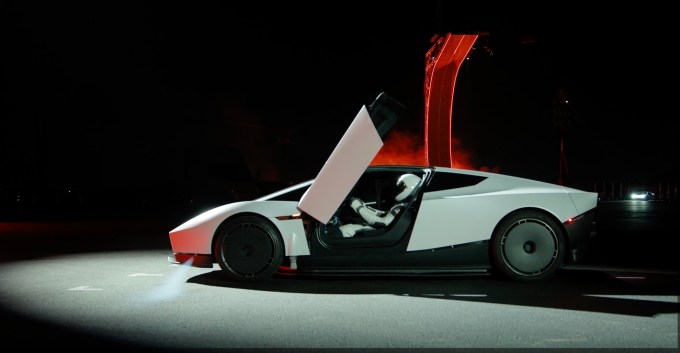
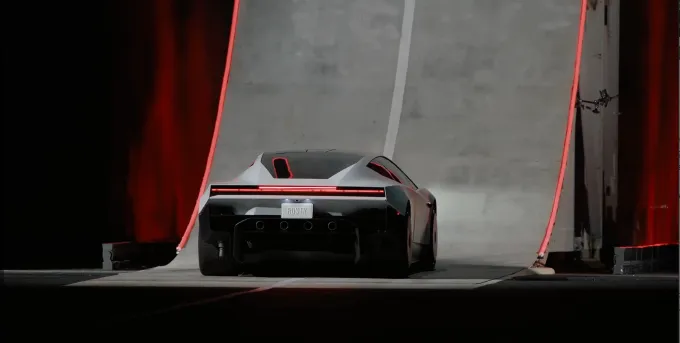
Tesla has finally demonstrated the second-generation Roadster in flight, using compressed air thrusters developed with SpaceX to lift the electric sports car over other vehicles and navigate an inverted ramp. The reveal outside Waco, Texas, ends nearly nine years of delays for a vehicle first announced in 2017, though buyers will have to wait until 2028 before Tesla plans to begin manufacturing.
The demonstration showed the stark white prototype accelerating from zero to 60 miles per hour in one second before deploying its propulsion system. Engineering Vice President Lars Moravy confirmed the car uses 10 nozzles connected to a rechargeable tank holding 600 liters of compressed air to achieve lift and mid-air rotation. During the event, the Roadster used this thrust to clear a lineup consisting of a Cybercab, Cybertruck, Tesla Semi, Model Y, and Model 3 while moving.
CEO Elon Musk did not announce pricing for the production version but described the vehicle as “the best of the last of the human-driven cars,” positioning it against the company’s broader push toward autonomous robotaxis. He explicitly framed the Roadster as a halo product rather than a volume seller, acknowledging it may not significantly impact revenue.


Musk also addressed the inherent risks of a road-legal vehicle capable of jumping. “If safety is your number one goal, do not buy the Roadster,” he said on a podcast earlier this year, comparing the philosophy to Ferrari’s approach to performance engineering. He added that Tesla would “aspire not to kill anyone in this car.” This stance diverges sharply from the regulatory framework governing standard passenger vehicles, where Federal Motor Vehicle Safety Standards dictate strict crash-test requirements. Integrating high-pressure pneumatic systems into a street-legal chassis presents unique homologation challenges that the National Highway Traffic Safety Administration has never evaluated for consumer automobiles.
The exterior design marks a significant departure from the rounded prototype shown in 2017. The new angular styling draws visual parallels to Lamborghini’s current design language and the Lotus Esprit submarine car from the James Bond film *The Spy Who Loved Me*. Musk owns that specific movie prop, which was displayed at the Texas event. He suggested the team might attempt to jump the Snake River Canyon, a stunt famously tried by Evel Knievel in 1974 using a steam-powered rocket called the Skycycle X-2. Knievel’s attempt failed when his parachute deployed prematurely, sending him into the canyon—a historical reality that underscores the physical danger of Musk’s proposal.
Tesla originally unveiled the second-generation Roadster as a surprise addition to the Tesla Semi launch event in November 2017. The company immediately began accepting $50,000 deposits, with 1,000 customers paying $250,000 upfront to reserve “Founders Series” units. At the time, Tesla promised delivery within a few years. Musk first publicly discussed adding thrusters to the platform in 2018, initially describing them as small rocket engines that could allow the car to fly.
Those ambitions stalled as Tesla entered what Musk termed “production hell” while scaling the Model 3 sedan. Resources subsequently shifted to the Model Y—which became the world’s best-selling vehicle—and the Cybertruck. Musk formally delayed the Roadster in 2020, 2021, 2023, and 2024. Frustration among deposit holders grew visible over the years, with several high-profile reservation holders publicly criticizing the timeline.
Late last year, Musk told Joe Rogan he intended to reveal the car by the end of 2025. Days later, during the shareholder meeting where he secured a $1 trillion compensation package, he pushed the date to April 1, 2026, noting that an April Fools’ Day event would give him “some deniability” if another delay occurred. An October 1 attempt was ultimately scrubbed due to severe weather before this week’s successful demonstration.
While the original 2018 concept relied on chemical rocket propulsion similar to SpaceX’s cold-gas thrusters used for Falcon 9 orientation, the production hardware pivoted entirely to compressed air. This shift likely reflects both regulatory realities and packaging constraints, as storing volatile propellants in a consumer vehicle would face insurmountable safety certification barriers. The 600-liter pneumatic system represents a compromise that delivers the visual spectacle of flight without the explosive hazards of combustion-based thrust.
Tesla has not specified whether the 2028 production target applies globally or begins with a limited U.S. rollout, nor has the company clarified how existing Founders Series reservations will be honored given the radical redesign and eight-year gap since those deposits were collected.









