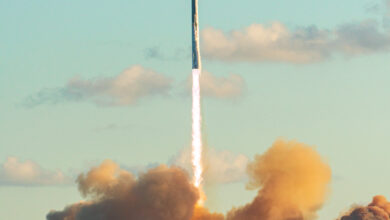
SpaceX achieved orbital insertion with its Starship rocket for the first time on Monday, using the milestone 14th test flight to deploy 26 commercial-grade Starlink V3 broadband satellites. The mission immediately shifts the economics of SpaceX’s internet constellation by introducing spacecraft too large for the company’s workhorse Falcon 9 rocket.
The deployment resolves a looming bottleneck for Starlink. Each V3 satellite weighs approximately 2 metric tons at launch and features expanded solar arrays and upgraded antennas capable of delivering 1 terabit per second of network capacity — roughly 10 times the throughput of earlier generations. Because the flat-packed dimensions of the V3 bus exceed the payload fairing limits of Falcon 9, Starship is currently the only operational vehicle in the world capable of launching them into orbit. While this inaugural orbital run carried 26 units, the rocket’s massive cargo bay is designed to eventually accommodate up to 60 V3 satellites per mission, drastically reducing the cost per gigabit of deployed space infrastructure.
Reaching that deployment altitude required overcoming significant propulsion anomalies during the flight. Two engines on the Super Heavy booster experienced issues, one during the initial ascent out of Starbase in South Texas and another during the booster’s return trajectory before it splashed down in the Gulf of Mexico. More critically, one of the six Raptor engines on the Starship upper stage shut down prematurely.


The upper stage initially followed a suborbital arc similar to previous test profiles. To achieve orbit, controllers had to restart a Raptor engine after the main ascent burn concluded. SpaceX delayed the maneuver while the flight control team evaluated the earlier engine shutdown. Controllers ultimately authorized a 19-second restart that added about 204 mph to the vehicle’s velocity, pushing Starship into an orbit approximately 171 miles above Earth.
Once in position, the spacecraft pushed the V3 satellites out sequentially through a dedicated cargo-bay deployment mechanism. SpaceX confirmed contact with all 26 units shortly after separation. The company expects the new hardware to begin providing service within weeks, bolstering both consumer broadband and Starlink’s direct-to-cellular offerings. Future V3 deployments are also slated to support Starshield, the company’s classified and government-focused satellite division.
Monday’s success contrasts sharply with a Starship test flight in July, which carried V3 prototypes along a purely suborbital trajectory that resulted in their immediate atmospheric reentry and destruction. This week’s orbital insertion was the first opportunity to integrate the next-generation hardware into the active constellation.
Despite the successful payload delivery, the recurring engine failures prompted SpaceX to truncate the remainder of the flight plan. Rather than conducting extended orbital tests, the team executed an early deorbit burn targeting a pre-cleared splashdown zone in the northern Pacific Ocean. Starship endured reentry temperatures reaching 2,600 degrees Fahrenheit, maintaining a controlled belly-first descent before flipping upright for a landing burn near Hawaii approximately three hours after liftoff. As anticipated for this phase of testing, the vehicle tipped over and broke apart upon water impact.
The propulsion glitches compound a persistent challenge with the Raptor 3 engine architecture. All three Starship flights utilizing the newer Raptor 3 variant have recorded engine problems. The design eliminates numerous components to reduce mass and increase thrust, but CEO Elon Musk has noted that simplifying the engine makes refinement exponentially more difficult. “While deleting parts sounds easy in theory, it is actually very difficult to figure out how to do so in practice and requires many iterations,” Musk wrote regarding the engineering trade-offs.
Federal regulators are treating the anomalies as expected test parameters rather than mission failures. The Federal Aviation Administration confirmed it will not mandate a formal mishap investigation, determining that the engine events fell within the scope of authorized activities. This regulatory clearance allows SpaceX to maintain its rapid launch cadence without grounding the fleet for prolonged reviews.
SpaceX is now preparing subsequent Starship missions from its Texas facility while simultaneously activating a second launch complex at NASA’s Kennedy Space Center in Florida. Upcoming flights are scheduled to test longer orbital durations, in-orbit propellant transfer, and eventual attempts to catch the returning booster using mechanical arms on the launch tower.