

Amazon Alexa Tablet Review: Android Hardware, Amazon Software
Full Play Store access and a MediaTek Dimensity 8400 processor redefine Amazon's approach to tablet hardware beyond the legacy Fire OS era.
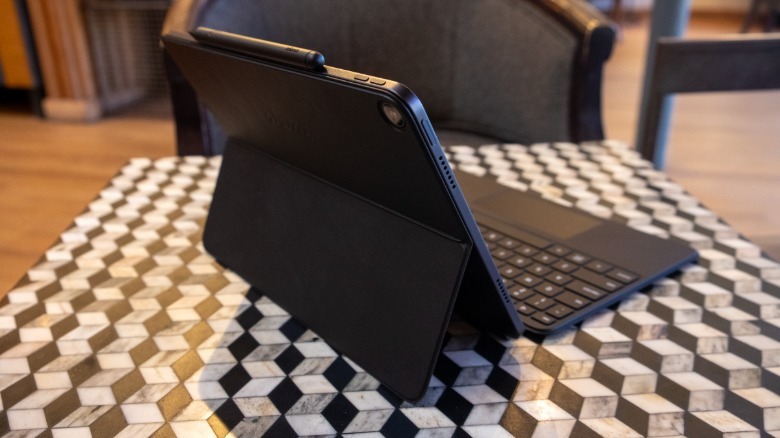
The Amazon Alexa Tablet runs a full version of Android with unrestricted access to the Google Play Store, but the device is engineered from the boot sequence to keep users inside Amazon’s services ecosystem. Unlike previous Fire tablets that relied on heavily restricted versions of Android without native Play Store support, this hardware represents a fundamental shift in how Amazon approaches tablet computing.
Three distinct widgets dominate the home screen interface, establishing the device’s priorities before a user opens a single application. The upper-left corner surfaces recent activity exclusively from Amazon properties, providing one-tap resumption for Kindle books, Amazon Music playlists, or ongoing Alexa+ queries. A dedicated chat window for Alexa+ occupies the bottom-right corner, accessible via touch or voice command. Yet Amazon concedes significant ground by placing a persistent Google Search widget in the top-right corner, an unusual compromise for a company historically intent on walling off its devices from rival search infrastructure.
Pre-installed shortcuts push Kindle, Prime Video, Luna cloud gaming, Audible, and the Silk browser to the forefront. However, because the underlying operating system is standard Android rather than Amazon’s legacy Fire OS, downloading Chrome, Gmail, YouTube, Maps, and Meet requires no sideloading workarounds. Users can effectively overwrite the Amazon experience with competing applications within minutes of setup.


Under the hood, the tablet relies on the MediaTek Dimensity 8400 processor. This chip positions the device squarely in the premium mid-range tier, sharing silicon architecture found in several high-end Android smartphones released over the past year. The base configuration pairs this chipset with 8GB of RAM and 128GB of storage, though buyers can double both specifications. An optional nanomatte display upgrade is available at checkout, targeting users who prioritize reduced glare for reading or outdoor use over raw resolution.
Audio performance benefits from Dolby Atmos support. While spatial audio processing on compact tablet speakers has inherent physical limitations, dialogue separation during film playback registers noticeably better than standard stereo output. Casual music listening in smaller rooms holds up well, easily surpassing the flat, tinny reproduction typical of most laptop speakers.
Productivity workflows reveal the persistent weakness of the broader Android tablet market. Application optimization for larger screens remains inconsistent across the Play Store. Communication tools like Slack function adequately but fail to utilize the expanded display real estate, rendering as scaled-up smartphone interfaces rather than offering multi-column layouts. Conversely, Adobe Lightroom and task management software like Todoist demonstrate proper tablet scaling. Applications redesigned during Google’s push for the Pixel Tablet — including Docs, Keep, and Gmail — translate seamlessly to the Alexa Tablet’s screen dimensions.
To mitigate app-scaling shortcomings, Amazon implemented a flexible multitasking layer. Any fullscreen application can be snapped into a split-view arrangement or pushed to a freeform desktop environment via a top-screen navigation bar. The desktop mode permits overlapping, resizable windows, handling six simultaneous applications without crashing. However, occasional unresponsiveness and lag when rapidly switching between active windows indicate that the Dimensity 8400 still strains under heavy desktop-style multitasking loads.
Power efficiency varies drastically depending on the workload. Amazon advertises up to 16 hours of continuous video playback. Real-world mixed productivity testing — encompassing document editing, web browsing through Chrome, and persistent background communication apps — yields closer to eight hours of battery life before requiring a charge. Independent standardized battery benchmarks are currently being compiled to verify these mixed-use figures against Amazon’s official media consumption estimates.









