South Korean Crypto Volumes Surge 600% as Tech Sell-Off Batters Local Equities
Stablecoin trading accelerates on Upbit as retail investors pivot away from declining tech stocks toward offshore hedging strategies.
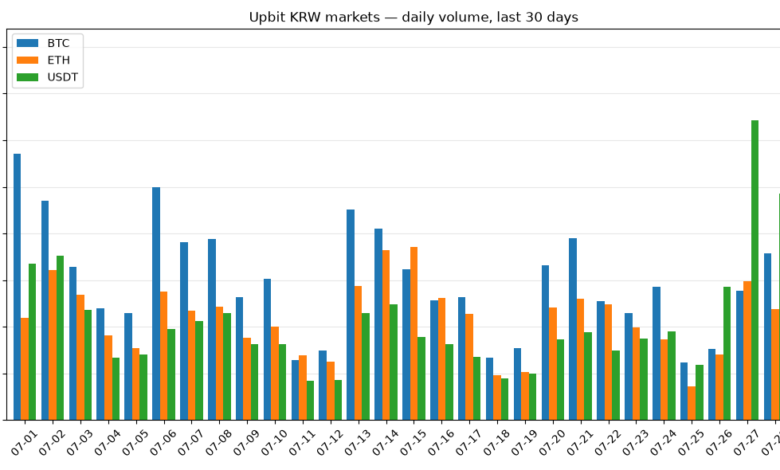
A sharp downturn in South Korea’s equity benchmark has triggered a massive capital flight into digital assets, with trading volumes for stablecoins surging sixfold on the country’s dominant cryptocurrency platforms. As a sell-off in major semiconductor shares dragged the KOSPI down nearly 18%, domestic retail traders turned heavily to the Tether (USDT) market to reposition capital and hedge against falling stock prices.
Trading activity between the Korean won and Tether on Upbit, South Korea’s largest digital asset venue, climbed rapidly from 20 million USDT on July 25 to roughly 140 million USDT—equivalent to nearly 200 billion won—by July 29. The jump represents a 600% increase in turnover over a four-day span, reflecting heightened urgency among domestic investors as equity losses mounted. Similar spikes were recorded earlier in the month, including an abrupt volume surge on July 14 after the KOSPI suffered a single-day plunge of 10%.
The rapid accumulation of USDT highlights how South Korea‘s highly active retail investor base utilizes stablecoins during periods of domestic market stress. Local analysts indicate that the rush into dollar-pegged assets is largely aimed at facilitating rapid cross-border transfers. Cho Yoon-sung, a senior researcher at digital asset research firm Tiger Research, noted that retail market participants frequently move funds off domestic venues to personal wallets or international exchanges to access perpetual stock futures and derivative contracts not available under local regulations.
South Korea’s domestic equity market is heavily weighted toward technology and semiconductor manufacturers, making the KOSPI particularly vulnerable to shifts in global artificial intelligence sentiment and hardware supply chains. While South Korea’s Financial Services Commission maintains strict foreign exchange controls and rigorous capital restrictions on institutional digital asset activity, retail market participants—often referred to locally as “Ants”—have increasingly utilized crypto liquidity rails to bypass traditional foreign exchange friction.
Despite the volatility shaking both Asian equity benchmarks and Western technology equities, top-tier cryptocurrencies have displayed notable independence from tech stock declines. European head of research at Bitwise, Andre Dragosch, highlighted that Bitcoin maintained a largely flat trajectory even as semiconductor stocks retreated from their late-June peaks. Bitwise research further underscored that Bitcoin has outperformed leading U.S. mega-cap technology firms, suggesting the digital asset may be functioning as an early barometer for prospective global central bank monetary easing rather than tracking short-term equity market stress.