Robinhood Posts Record $1.31 Billion Revenue as Event Contracts Outpace Crypto
Strong demand for prediction markets and options drives quarterly beat despite crypto slowdown and hawkish Federal Reserve signals.

Robinhood Financial delivered its highest-ever quarterly net revenue of $1.31 billion, surging 32 percent year-over-year and outperforming Wall Street expectations, driven by a rapid expansion in event contracts and options trading that cushioned a drop in retail crypto activity.
The retail trading platform posted diluted earnings per share of $0.62, beating consensus estimates of $0.41, while net income climbed 48 percent to $573 million. Total platform assets reached $369 billion, backed by record net deposits of approximately $21.7 billion during the period.
A notable shift occurred within the company’s revenue distribution. Revenue from event-based prediction markets jumped more than tenfold from the prior year to $156 million, outstripping both equities trading ($129 million) and cryptocurrency transactions ($100 million). Digital asset revenue dropped 38 percent from $160 million a year earlier as retail crypto trading volumes moderated. Meanwhile, options transactions remained Robinhood’s largest trading revenue source, expanding 29 percent to $342 million.
Chief Executive Officer Vlad Tenev highlighted the diversification of the firm’s business model during the earnings call, stating that 13 distinct business lines now generate over $100 million in annualized revenue. Tenev also discussed the launch of Robinhood Chain, noting that decentralized exchanges operating on the network have processed over $12 billion in volume while total value locked reached approximately $325 million. During a live mobile demonstration of the network, Tenev displayed the ecosystem token CASHCAT, prompting a brief 40 percent surge in the token’s market price.
Despite the blowout earnings, Robinhood shares faced pressure alongside the broader equity market following monetary policy guidance from the Federal Reserve. The central bank held the benchmark interest rate unchanged at 3.50 to 3.75 percent in a split 9–3 decision, marking the highest number of dissenting votes among regional Fed presidents since 2016 as hawks pushed for additional tightening.
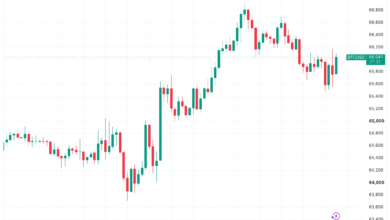
Broader digital asset markets remained largely flat following the Fed announcement, with Bitcoin holding near $64,800 and Ethereum trading around $1,920. Institutional trading platform Coinbase encountered lowered Wall Street expectations ahead of its upcoming earnings report, with second-quarter spot trading volumes estimated at $152 billion against prior projections of $178 billion.
Regulatory positioning in the United States continues to evolve alongside shifting trading models. U.S. Securities and Exchange Commission Chair Paul Atkins signaled that the agency stands prepared to establish independent regulatory frameworks for digital assets should legislative efforts under the CLARITY Act fail to pass Congress. Concurrently, Binance US announced plans to submit an application for Designated Contract Market status with the Commodity Futures Trading Commission, aiming to enter the domestic prediction market arena.
The prediction market push aligns with broader structural shifts in institutional finance, where executives at Morgan Stanley noted that stablecoins and asset tokenization are accelerating the transition away from traditional operating hours toward continuous 24/7 settlement cycles.
In protocol and infrastructure developments, MoonPay launched an AI payment system called PayBox that integrates non-custodial payment workflows into conversational platforms like ChatGPT and Claude, while decentralized finance protocol Aave initiated the retirement of its deployments across six smaller networks—including Scroll, zkSync, and Aptos—reclaiming roughly $98.1 million in deposits to streamline security risk.