Beyond Tax Havens: How the British Virgin Islands Became a Global Hub for Tokenized US Treasuries
The Caribbean territory now accounts for over 10% of the global market for on-chain government debt, driven by the VASP Act and legal certainty.

In the rapidly evolving landscape of Real-World Assets (RWA), the British Virgin Islands has quietly positioned itself as a cornerstone of the digital financial system. New data indicates that more than $1 out of every $10 of the world’s tokenized US Treasuries is now issued by a company incorporated in the Caribbean territory, signaling a shift in how institutional crypto infrastructure is being built.
According to the “Destination Digital” report released in June by BVI Finance, the territory now sits behind only the United States as a primary jurisdiction for this burgeoning asset class. As of June 1, BVI-linked entities accounted for approximately $1.5 billion of the $14.98 billion global market for tokenized US Treasuries. This growth comes as high interest rates in the traditional financial sector have turned government debt into the “killer app” for blockchain-based finance, allowing investors to earn yield on-chain without exiting the ecosystem.
The British Virgin Islands is no longer just a destination for legacy offshore finance; it has become a preferred home for some of the industry’s most recognizable names. The list of firms utilizing the jurisdiction includes Kraken’s parent company, Payward, as well as Bitstamp (recently acquired by Robinhood), 1inch, and Bitfinex. This concentration of institutional players has bolstered the local ecosystem, which now boasts a stablecoin market cap of about $1.2 billion held in BVI-linked addresses, supported by roughly 28,000 stablecoin asset holders.
The territory’s dominance is particularly visible in the sheer volume of products launched. According to Bernstein Research, the Islands host 305 tokenized securities—the highest count for any single jurisdiction in the RWA.xyz dataset. Furthermore, more than 25 virtual asset service providers (VASPs) have already received approval under the territory’s specialized regulatory regime.
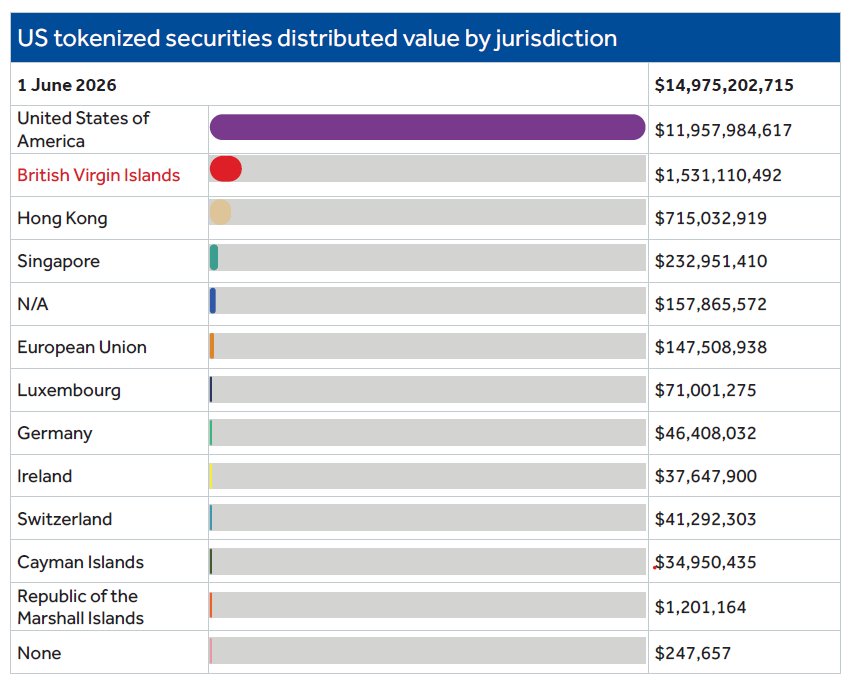
US tokenized securities distributed value by jurisdiction. Source: Destination Digital
The Shift from Tax Neutrality to Regulatory Clarity
While the British Virgin Islands has historically been associated with tax efficiency, industry experts suggest the current wave of crypto adoption is driven by a different set of priorities. Andrew Jowett, a partner at Appleby (BVI) Ltd who advises digital asset businesses on corporate structuring, notes that while clients compare the BVI to the Cayman Islands, United Arab Emirates, Singapore, and Switzerland, tax is rarely the deciding factor.
“The overriding factor for choosing the BVI has been digital asset regulation and not tax,” Jowett said. While the territory offers attractive policies—including no corporate income tax or capital gains tax—these features are now considered “table stakes” in the competitive world of global crypto hubs. The UAE and Cayman Islands offer similar tax neutrality, forcing jurisdictions to compete on the quality of their legal frameworks instead.
Saeed Al-Marri, chief executive of digital asset infrastructure firm Ethra, which is incorporated in the BVI, emphasized that the territory provides the legal certainty and regulatory clarity necessary for institutional adoption. This sentiment was echoed by Jack Yang, founder and CEO of LTP, an institutional digital asset infrastructure provider with operations in the BVI, Hong Kong, Australia, and the UAE.
“A tax-neutral structure that cannot pass review by banks, custodians, auditors, investment committees, or regulators has limited practical value,” Yang explained, highlighting that as tokenization moves into mainstream finance, the ability to withstand rigorous institutional scrutiny is paramount.
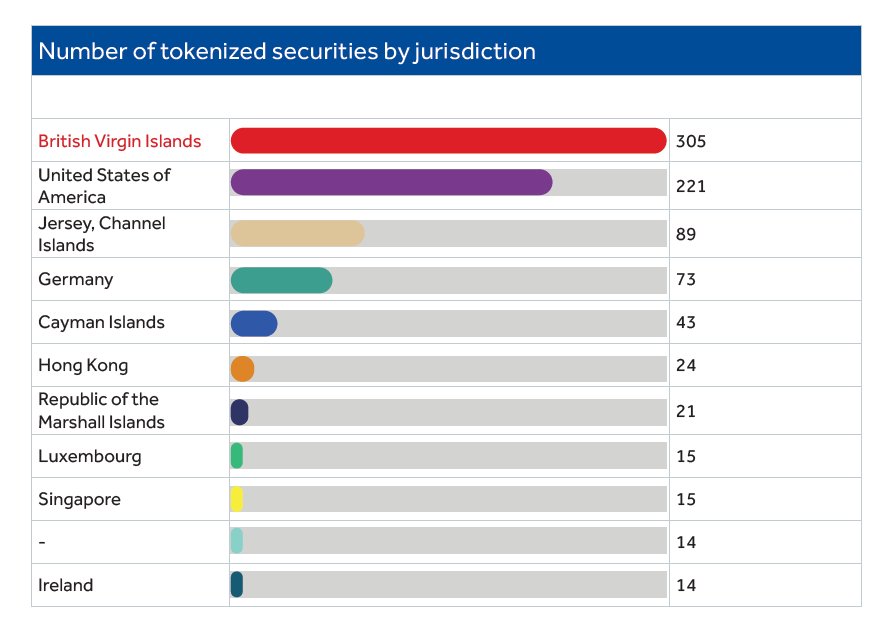
Number of tokenized securities by jurisdiction. Source: Destination Digital
The VASP Act and the Race for Infrastructure
To maintain its edge, the BVI introduced the Virtual Assets Service Providers Act (VASP Act) in 2023. Overseen by the BVI Financial Services Commission (FSC), the VASP Act provides a structured pathway for companies to operate legally while maintaining compliance with international anti-money laundering standards.
The appeal of the BVI often lies in its “ease of launch.” The FSC aims to respond to VASP applications within six weeks and complete the full review process within six months—a significantly faster turnaround than many onshore jurisdictions. Furthermore, the BVI’s legal system is based on English Common Law, which provides a familiar and predictable framework for international investors and lawyers.
Orest Gavryliak, chief legal officer at decentralized exchange aggregator 1inch, noted that DeFi protocols are increasingly prioritizing long-term sustainability over the lowest tax burden. “Jurisdiction isn’t exactly becoming irrelevant, but its role is changing,” Gavryliak said. “Protocols are increasingly weighing factors such as regulations, institutional credibility and long-term sustainability.”
British Virgin Islands. Source: Destination Digital
Incorporation vs. Physical Presence
Despite the high volume of tokenized securities and registered entities, the BVI’s role remains primarily that of a legal and administrative hub rather than a physical operations center. Most crypto companies are not relocating their engineering teams to the Caribbean; instead, they use the territory to incorporate token issuers, treasury vehicles, and special purpose vehicles (SPVs).
Yang confirmed that LTP does not employ full-time staff “on the ground” in the BVI, with the entity being overseen by a board and supported by staff from other global offices. Similarly, while Kraken’s parent company is a BVI entity, its core operations remain centered in the United States.
This model of borderless operation is a defining characteristic of the digital asset industry. For the British Virgin Islands, being the legal home for the world’s tokenized US Treasuries may be enough to secure its place in the future of finance, even if the servers and the people behind them remain thousands of miles away.