Iran Reshuffles Top Military Command With Revolutionary-Era Veterans
Tehran promotes veteran hardliners to lead armed forces and security organs
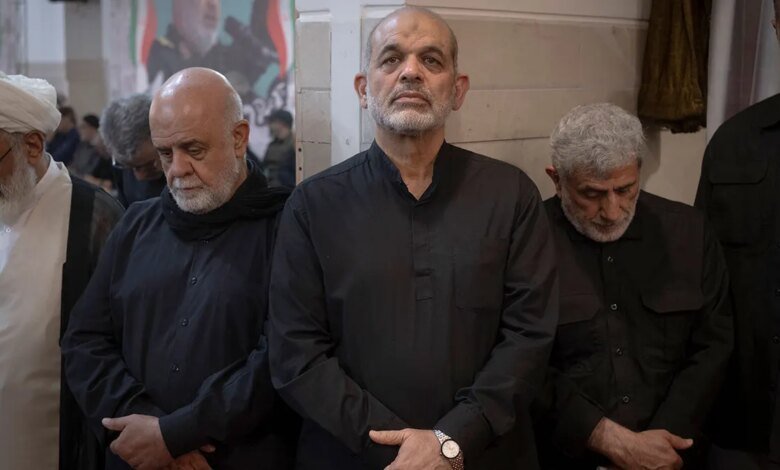
Iran’s state leadership has reorganized the command structure of its conventional military, Islamic Revolutionary Guard Corps, and highest national security bodies, filling critical vacancies left by months of U.S. and Israeli wartime strikes with a circle of veteran military and intelligence figures.
According to official state news agency IRNA, Supreme Leader Mojtaba Khamenei appointed Ali Abdollahi as chief of staff of the Armed Forces, with Kioumars Heydari named as his deputy. The reshuffle elevated Ahmad Vahidi to major general and commander-in-chief of the IRGC, appointed Mostafa Izadi as deputy IRGC commander, designated Rear Adm. Ali Ozmaei to head the IRGC Navy, and assigned cleric Hossein Taeb to lead the Basij paramilitary force.
The high-level realignment follows the deaths of several key military commanders since joint wartime actions expanded on Feb. 28. In a parallel move reported by Reuters, 71-year-old former IRGC commander Mohsen Rezaei was appointed secretary of the Supreme National Security Council and named Khamenei’s personal representative on the council. Rezaei replaced Mohammad Baqer Zolqadr, who had assumed the position in late March following the death of predecessor Ali Larijani.
The appointment of Abdollahi puts a veteran commander at the apex of the military command structure. Abdollahi previously directed the Khatam al-Anbiya Central Headquarters, the operational hub responsible for directing joint armed forces operations during wartime. French newspaper Le Monde reported that Abdollahi’s directive includes fully integrating the Khatam al-Anbiya headquarters with the Armed Forces General Staff to streamline central command authority.
Vahidi, who previously served as defense minister and later interior minister during the 2022 protest crackdowns, moves to the helm of the IRGC after playing an influential role in Tehran’s wartime strategy. Both Vahidi and newly appointed security council chief Rezaei remain subject to INTERPOL Red Notices issued in 2007 at the request of Argentina in connection with the 1994 bombing of the AMIA Jewish community center in Buenos Aires.
On the naval front, Rear Adm. Ali Ozmaei assumes command of the IRGC Navy, filling the position left vacant after former commander Alireza Tangsiri was killed in an Israeli airstrike in March. The IRGC Navy maintains primary jurisdiction over Iranian operations in the Persian Gulf and the strategic Strait of Hormuz.
The maritime leadership change coincided with hardline statements from senior officials regarding global shipping lanes. Following the appointments, Rezaei publicly announced that the Strait of Hormuz would remain closed unless the United States meets Tehran’s demands, which include halting wartime military operations and releasing frozen Iranian assets held overseas.
The return of Hossein Taeb to lead the Basij paramilitary force places a long-standing intelligence chief at the head of Iran’s primary internal security apparatus. Taeb previously served as the commander of the Basij during the 2009 election demonstrations before being named the first head of the expanded IRGC Intelligence Organization.
The U.S. Department of the Treasury sanctioned Taeb in 2010, citing his direct oversight of Basij forces involved in beatings, arbitrary arrests, and killings of peaceful demonstrators. Iranian Parliament Speaker Mohammad Bagher Ghalibaf praised Taeb’s appointment, stating that his leadership would advance long-term efforts to build a 20-million-strong volunteer force embedded across factories, universities, and government ministries.
Former American detainee Morad Tahbaz, who was arrested in 2018 during Taeb’s tenure at IRGC intelligence and released in a September 2023 prisoner swap, noted that Taeb maintains a decades-long relationship with Mojtaba Khamenei dating back to their service together in the Habib Battalion during the Iran-Iraq War. Tahbaz characterized the appointments as a repeated rotation of long-standing loyalists within the supreme leader’s inner circle.
The transition also integrates senior officers from the regular army, known as the Artesh, into joint operational leadership. Deputy Chief of Staff Kioumars Heydari previously commanded the Army Ground Forces, a move that analysts at the Middle East Forum noted reflects increased integration of regular military forces into Tehran’s broader internal security and operational hierarchy.
Beni Sabti, an Iran specialist at Israel’s Institute for National Security Studies, told Fox News Digital that relying on figures who began their careers during the 1979 revolution and the 1980-1988 Iran-Iraq War underscores a shrinking pool of trusted leaders. Sabti noted that concentrating authority among a narrowed group of ideological veterans signals reduced internal debate within Tehran’s security decision-making apparatus.