Spain Mobilizes Military for Rapid Migrant Returns in Ceuta
Military deployed as thousands crossed into Spanish enclave from Morocco
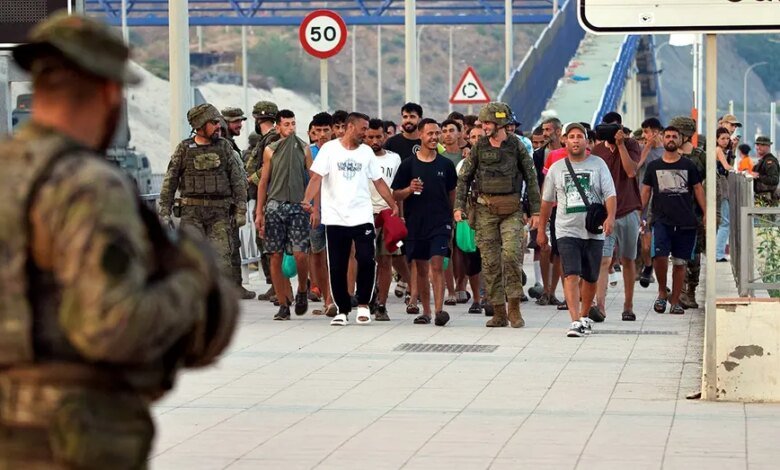
MADRID — Spanish military personnel and Civil Guard officers executed immediate returns of thousands of migrants who crossed into the North African enclave of Ceuta from Morocco, moving to restore security along the European Union’s only direct land frontier on the African continent.
The emergency deployment came after an unprecedented border surge during which an estimated 8,000 to 10,000 individuals crossed into the 18-square-kilometer Spanish territory within a 48-hour window. Migrants, including young men, families, and unaccompanied youths, waded and swam around the coastal breakwater at Tarajal, bypassing the perimeter from the adjacent Moroccan town of Fnideq after Moroccan border posts unexpectedly ceased routine patrols.
Spanish Prime Minister Pedro Sánchez mobilized armored military vehicles, special national police units, and extra Civil Guard regiments to secure the border zone. Spanish official records confirmed that troops established temporary holding corridors along the Tarajal beach to process arrivals before handing them directly back to Moroccan border forces across the boundary gate.
The rapid expulsions were executed under the legal framework of a 1992 bilateral readmission agreement between Spain and Morocco. The accord permits Madrid to return adult foreign nationals who enter Spanish territory outside designated legal checkpoints, provided the readmission process occurs rapidly following the unauthorized crossing.
According to figures released by the Spanish Interior Ministry, more than 5,600 migrants were returned to Morocco within the initial 72 hours of the operation. Military medical units set up field tents along the shore to treat individuals for severe hypothermia, cuts, and exhaustion after they traversed the breakwater in rough Mediterranean sea conditions.
International human rights groups, including Amnesty International and Human Rights Watch, alongside representatives from the United Nations High Commissioner for Refugees, criticized the broad application of summary returns. Legal scholars noted that European human rights standards require individual legal assessments and access to international protection procedures before any forced removal can occur.
The border crisis highlighted acute geopolitical friction between Madrid and Rabat. Diplomatic relations had deteriorated rapidly after the Spanish government secretly allowed Brahim Ghali, leader of the Polisario Front seeking independence for Western Sahara, into a hospital in Logroño for medical treatment. Moroccan officials subsequently scaled back perimeter enforcement along the land fences surrounding both Ceuta and Spain’s other North African enclave, Melilla.
The handling of unaccompanied minors presented complex legal and humanitarian challenges for regional authorities. Under Spanish child protection statutes, underage migrants cannot be subjected to rapid expulsion procedures. Regional social services in Ceuta were tasked with housing, identifying, and accommodating more than 1,100 unaccompanied youths in temporary reception centers, sports halls, and converted industrial warehouses across the city.
Ceuta and Melilla serve as strategic points for European migration management, benefiting from extensive security funding provided by the European Border and Coast Guard Agency, known as Frontex. The physical barrier encompasses high-density fencing reaching up to ten meters, supported by ground motion detectors, thermal imaging systems, and continuous maritime patrol craft.
Border stability was eventually restored following high-level communications between European Union leaders, Spanish ministers, and Moroccan officials. Morocco reinstated security cordons on its side of the fence, while Spanish defense forces maintained enhanced vigilance along the maritime boundary and land perimeter to prevent recurring pushbacks.