2027 Toyota Tundra and Sequoia Add Trailhunter Trim, Unified Design
Full-size Toyota trucks receive overlanding upgrades and standard 14-inch tech.
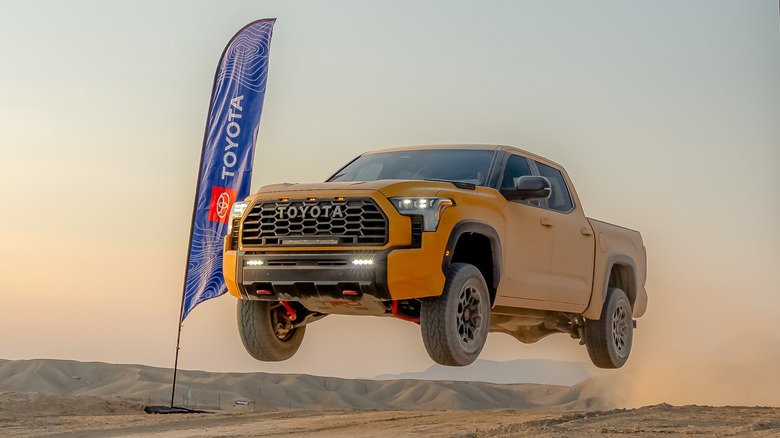
Toyota Motor North America has expanded its full-size utility lineup for the 2027 model year, introducing the overland-focused Trailhunter trim to both the Tundra pickup and Sequoia SUV while standardizing front-end design and cabin technology across the shared platform.
The introduction of the Trailhunter variant establishes a two-track off-road hierarchy within Toyota’s full-size truck and SUV offerings. While the established TRD Pro series remains tailored for high-speed desert running with tuned dampening, the 2027 Trailhunter trims are engineered specifically for low-speed technical terrain and multi-day overland travel. Key mechanical components integrated into the Tundra and Sequoia Trailhunter include an Old Man Emu tuned suspension system, an electronic locking rear differential, front recovery hooks, reinforced underbody skid plates, specialized trail tires, and bronze-finished alloy wheels.
Visual alignment between the two platforms has been unified for 2027. The Sequoia adopts the aggressive front fascia design from the Tundra, giving the full-size SUV identical front styling to the pickup platform. Cabin technology has also seen standardizations across both model lines. A 14-inch central infotainment touchscreen, previously offered as an upgraded option on select configurations, is now standard equipment across both Tundra and Sequoia ranges. The hardware update includes the deployment of Toyota’s latest multimedia user interface alongside updated active safety systems.
Under the hood, both vehicles retain Toyota’s i-FORCE MAX twin-turbo hybrid V6 engine, which pairs a 3.4-liter V6 motor with an electric motor-generator to deliver instant low-end torque. During multi-day terrain testing conducted through western Colorado and eastern Utah—where ambient vehicle temperature readouts registered up to 128 degrees Fahrenheit—the hybrid cooling architecture maintained normal operating temperatures during continuous desert runs and steep high-altitude climbs reaching 9,000 feet above sea level.
Driving dynamics on open sand courses highlighted mechanical differences resulting from body configurations. The Tundra TRD Pro exhibited greater rear-end rotational slide on loose surfaces, attributed to lighter weight distribution over the open bed and rear axle. In contrast, the Sequoia TRD Pro demonstrated more linear traction and predictable yaw control under hard throttle due to the added weight of its rear cabin structure. Suspension valving on both models successfully absorbed high-velocity impacts during vertical jump tests without bottoming out or destabilizing upon landing.
In low-speed rock crawling evaluations along desert sandstone formations near Moab, Utah, the Trailhunter’s Crawl Control system and Sand mode electronically regulated wheel slip and torque delivery. Built-in underbody protection absorbed surface contact over off-camber rock ledges. Field testing noted that while the digital trail monitor system successfully assisted driver placement, camera image resolution on the 14-inch screen lacked ideal sharpness for precise tire placement on narrow technical lines.
The addition of dedicated factory overland builds comes as price points for fully equipped off-road trucks and SUVs consistently reach into the $70,000 range. Despite the heavy-duty off-road hardware, testing on paved transit corridors showed that the Old Man Emu dampening configuration maintains civil on-road compliance, controlling body roll without generating the harsh ride characteristics often associated with aftermarket lifted suspensions.