Polestar 5 Performance Tested on Spain’s ‘Silent Route’ with Custom Aluminum Architecture
The 884-horsepower electric sedan showcases its bespoke bonded aluminum platform and advanced chassis dynamics on Spain's demanding mountain roads.
SITGES, Spain — Polestar has put its upcoming high-performance electric sedan, the Polestar 5, through its paces on a grueling 375-mile driving route in Spain. The test took place primarily on “the silent route,” a series of spectacular, narrow, and winding roads that snake through the Spanish countryside and carve around mountains. These roads are rarely used by tourists or local residents, offering an ideal environment to evaluate the vehicle’s driving dynamics.
Navigating the Silent Route
The journey began in the coastal town of Sitges, where the roads immediately narrowed. The Polestar 5, measuring 200.3 inches long and just over an inch wider than a current Porsche Panamera with its mirrors folded, occupied nearly the entire lane. Early in the drive, the route’s isolation was briefly interrupted by an encounter with a McLaren W1 test car on a tight bend, highlighting the demanding nature of the mountain passes.
As the roads widened, the vehicle’s powertrain capabilities became clearer. The tested model was the Performance trim, the higher of the two available configurations for the Polestar 5. Powered by dual motors, the system produces a combined 884 horsepower and 749 pound-feet of torque. The rear motor, designed in-house, contributes 603 horsepower and 487 pound-feet of torque. Polestar estimates a 0-60 mph acceleration time of 3.1 seconds.
Daniel Golson/Jalopnik
Drivers can select between standard and Performance modes for the powertrain. The Performance mode increases responsiveness and unlocks full power without making the vehicle overly sensitive during slower driving.
Bespoke Architecture and Chassis Dynamics
Rather than utilizing an existing scalable architecture from other Geely brands, Polestar developed a custom bonded aluminum platform from scratch. Known as the Polestar Performance Architecture, this structure offers rigidity comparable to a carbon-tubbed two-seat supercar while remaining lighter and stronger than conventional electric vehicle platforms.
The vehicle features a 120.2-inch wheelbase, which is four inches longer than that of a Porsche Panamera. Weighing 5,512 pounds—nearly 500 pounds more than a Taycan GTS—the Polestar 5 relies on its fundamental chassis setup rather than active anti-roll bars, air springs, torque vectoring, or rear-wheel steering.
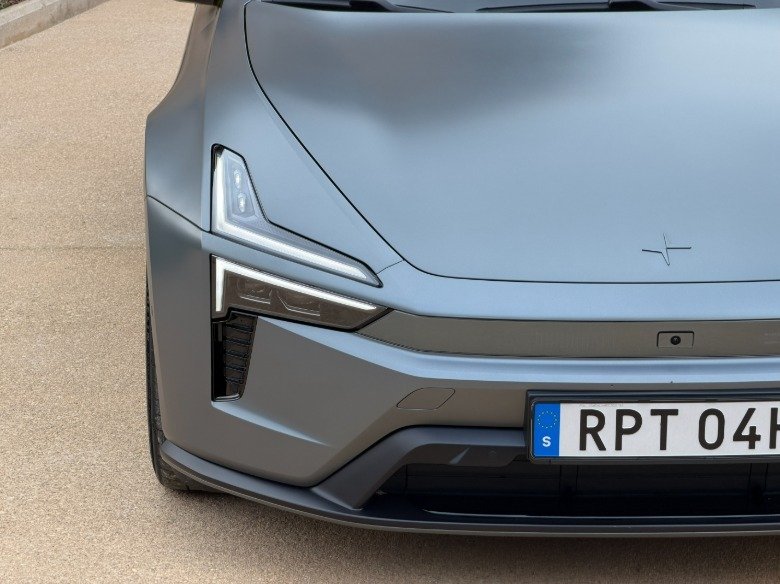
To optimize weight distribution and design, the double-wishbone suspension, front brakes, and steering rack are positioned ahead of the front axle. This layout allowed designers to lower the hood line significantly. The steering system offers three selectable modes: Light, Standard, and Firm.
 Daniel Golson/Jalopnik
The Performance trim features coil springs paired with semi-active MagneRide dampers, which read the road surface up to 1,000 times per second and offer three stiffness settings: Standard, Nimble, and Firm. Despite its weight, the vehicle maintains a 50:50 weight balance, keeping body roll flat through uphill hairpins and rougher cobblestone streets.
Wheels, Tires, and Braking Systems
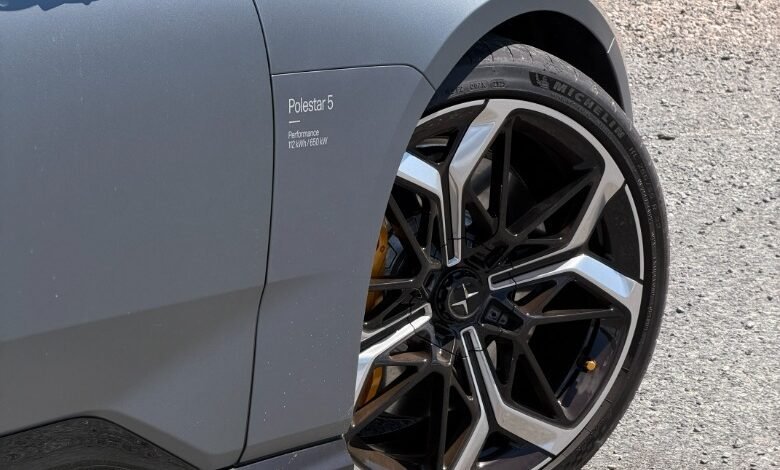
The Performance model is equipped with optional 22-inch wheels, wrapped in Michelin Pilot Sport S5 tires featuring a Polestar-specific compound (sized 255/35 at the front and 295/30 at the rear). The standard Dual Motor variant comes with 20-inch aero wheels.
Stopping power is provided by Brembo front brakes with four-piston calipers and 15.7-inch two-piece ventilated discs. The Performance trim adds Swedish Gold calipers. The regenerative braking system features three adjustable settings, with the most aggressive mode enabling true one-pedal driving.
Background and Technical Context
Polestar, originally established as a racing team and later acquired by Volvo Cars, operates as an independent premium electric vehicle manufacturer under the umbrella of Zhejiang Geely Holding Group. The decision to engineer a bespoke bonded aluminum platform for the Polestar 5 represents a significant departure from standard industry practices, where platforms are typically shared across multiple brands to reduce development costs.
Bonded aluminum technology is highly regarded in the automotive industry for its exceptional strength-to-weight ratio. Historically utilized by low-volume supercar manufacturers, the material provides high torsional rigidity, which directly improves handling precision and crash safety. By applying this manufacturing method to a mass-production four-door grand tourer, Polestar aims to position the vehicle as a direct competitor to established high-performance luxury electric vehicles.