

Apple Eyes a 2029 Return to Enterprise Servers
M8 Ultra servers could bring Apple back to enterprise infrastructure
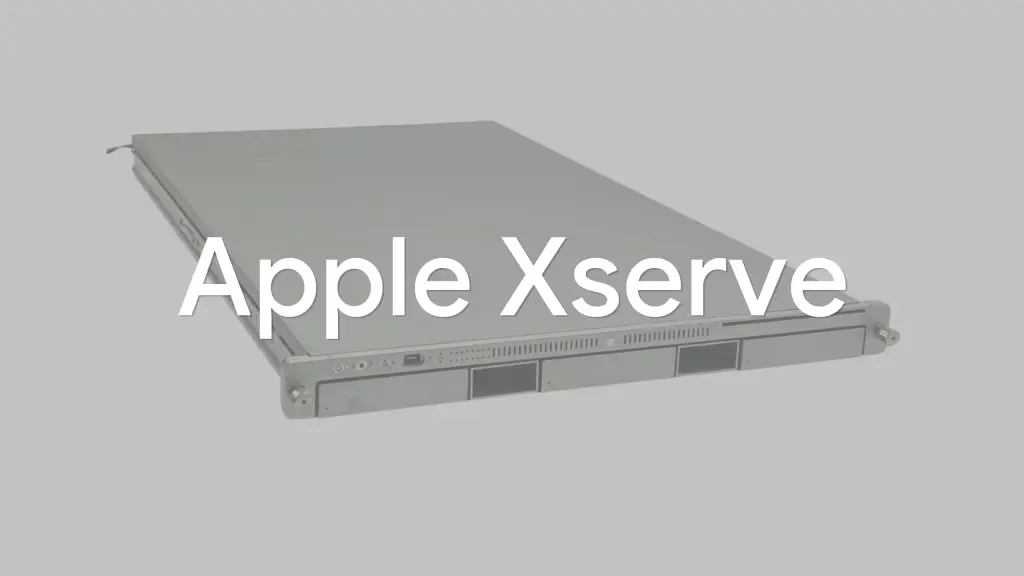
CUPERTINO, California — Apple is exploring a return to the enterprise server market as demand for generative artificial intelligence infrastructure surges globally, according to a report from *The Information*. The company has not finalized its plans, but a potential rollout of third-party enterprise servers is projected for 2029.
The tentative hardware roadmap calls for servers powered by Apple’s yet-to-be-announced M8 Ultra processors. Depending on the configuration selected by enterprise buyers, each unit would contain either two or four of the high-performance chips. Using multiple M8 Ultra processors in one server chassis would scale Apple’s silicon architecture for the massive datasets and computational workloads needed to train and run large language models.
Apple’s current Ultra processors, including the M2 Ultra, use UltraFusion, a proprietary ultra-high-density packaging technology that fuses two individual chips together to double performance.



Apple has reportedly begun discussions with Nvidia about incorporating NVLink to handle high-speed data transfers in multi-chip server configurations. Nvidia’s proprietary interconnect protocol enables multiple graphics processing units (GPUs) and processors to communicate at high speeds while bypassing traditional system bus bottlenecks. The technology would allow Apple’s custom silicon to work cohesively inside large-scale data center environments.
The discussions would extend an existing relationship between the two companies. Apple already uses Nvidia hardware in the backend infrastructure supporting its cloud-based Siri AI services. Apple and Nvidia are currently two of the world’s most valuable publicly traded companies.
Apple has spent the past several years designing and deploying proprietary servers for its own internal data centers. Built with consumer-grade Apple Silicon chips, those systems power the company’s cloud services and applications. In June 2024, Apple introduced Private Cloud Compute (PCC) alongside its Apple Intelligence platform; PCC uses custom-built servers equipped with M2 Ultra chips to process complex user AI requests in the cloud while maintaining user privacy.
Those proprietary cloud servers have never been available for purchase by corporate clients or third-party data center operators. A move into commercial hardware would mark a significant shift for a business that has spent the last decade concentrating on consumer products such as the iPhone, iPad, Mac, and Apple Watch, as well as digital services.
The project would likely fall under the responsibility of John Ternus, Apple’s Senior Vice President of Hardware Engineering. Industry analysts have widely cited Ternus as a leading candidate to eventually succeed Tim Cook as chief executive officer. It remains unclear whether Apple would revive the Xserve name for the new enterprise line or launch it under an entirely new product name.
Apple first entered the enterprise rack-server market in May 2002 with the Xserve, a 1U rack-mount server designed for standard industry enclosures. The product line passed through three major hardware generations during its nine-year run. The first two used Motorola and IBM PowerPC G4 and G5 processors, respectively.
In 2003, Virginia Tech used 1,100 dual-processor Power Mac G5 systems to build “System X,” which ranked among the fastest supercomputers in the world at the time. The system demonstrated the high-performance computing capabilities of Apple hardware.
Apple moved the Xserve to Intel Xeon processors in 2006 as part of its broader transition away from the PowerPC architecture. The line developed niche popularity among educational institutions, creative professionals, and scientific researchers, but Apple struggled to gain a dominant share of the wider enterprise IT market.
In November 2010, Apple announced that it would stop producing Xserve, officially discontinuing the line in February 2011. The company directed enterprise customers toward the Mac Pro Server or the Mac mini running OS X Server, although neither provided the standardized slide-out rack-mount form factor of the original Xserve.
If Apple proceeds with its 2029 plans, it will enter an enterprise AI hardware market dominated by infrastructure providers including Super Micro Computer, Dell Technologies, and Hewlett Packard Enterprise. These companies supply data centers with high-density GPU servers designed specifically for artificial intelligence workloads.










One Comment