Australia Small-Scale Solar Hits 312 MW in September
Federal battery rebate requirements push year-to-date rooftop PV installations 43% above 2025 totals as average system sizes continue to grow.
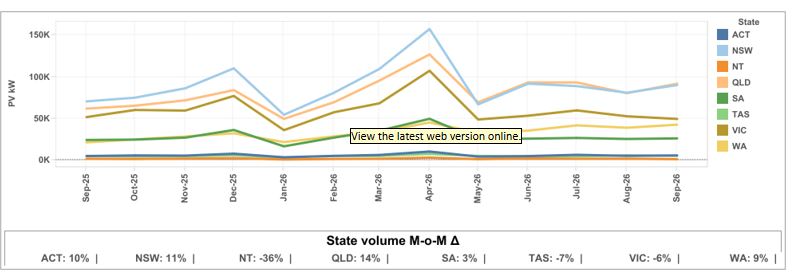
Australia’s residential and small commercial solar market added 311.8 megawatts of new capacity in September 2026, driven by a federal policy that has fundamentally altered how homeowners purchase rooftop energy systems. The monthly total represents a 7.29% increase over August and pushes year-to-date installations for sub-100 kilowatt systems 43% ahead of the same period last year, according to data released by industry analyst SunWiz.
The surge traces directly to the Australian government’s Cheaper Home Batteries Scheme, which ties financial rebates for residential battery storage to the installation of new or existing photovoltaic arrays. By making solar panels a prerequisite for accessing subsidized storage, the policy has created a structural incentive that continues to pull forward demand across the country. Cumulative registrations through the first nine months of 2026 have already exceeded the entire volume recorded for all of 2025.
September ranks as the third-highest month for small-scale solar registrations this year, trailing only April’s 505-megawatt peak—boosted by end-of-financial-year purchasing—and July’s 320-megawatt tally. Compared with September 2025, when roughly 240 megawatts were installed, the latest figures reflect a sustained acceleration rather than a temporary spike. Australia historically leads developed nations in per-capita rooftop solar adoption, with more than 3.5 million systems already operating nationwide prior to this year’s expansion.

Queensland and New South Wales accounted for the bulk of the activity. Queensland registered 91.8 megawatts, a 14% gain over August, maintaining its position as the country’s largest rooftop solar market due to high irradiance levels and favorable state-level feed-in frameworks. New South Wales followed closely with 90.1 megawatts, up 11%. Five of Australia’s eight states and territories recorded month-over-month growth.
System sizing data indicates consumers are optimizing for self-consumption rather than grid export. The 10-15 kilowatt bracket generated 105.94 megawatts of new capacity, more than double the 53.04 megawatts from the 6-8 kilowatt segment. The national average system size climbed to 9.98 kilowatts, continuing a steady upward trajectory from a 12-month low of 9.35 kilowatts in May. Larger residential systems have become increasingly practical as modern string inverters routinely support higher DC inputs and households integrate electric vehicle chargers alongside standard loads.
Battery storage deployments reached an estimated 966.5 megawatt-hours in September, rising 12.5% from August and marking the strongest month since April’s 3,262-megawatt-hour record. Warwick Johnston, managing director at SunWiz, noted the storage sector has stabilized near one gigawatt-hour of monthly installations.
Average battery capacity continues to expand alongside solar system sizes. Units exceeding 30 kilowatt-hours now represent 45% of the market. The 20-30 kilowatt-hour segment remained the single largest category at 368 megawatt-hours, while the 40-50 kilowatt-hour band delivered 250 megawatt-hours. Conversely, smaller batteries lost ground: the 10-20 kilowatt-hour range fell 2% to 148 megawatt-hours, and sub-10 kilowatt-hour units dropped 13% to just 11 megawatt-hours. The national average battery size rose to 26.30 kilowatt-hours, its fourth consecutive monthly increase, reflecting consumer preference for systems capable of sustaining overnight household loads without relying on grid power.