SK Hynix Offers US NAND Fab to Unlock China Chip Tools
Parent company offers Washington its first domestic NAND plant in years to resolve an export licensing standoff over an idle Chinese cleanroom.

SK hynix has proposed building a NAND flash fabrication plant in the United States, offering Washington its first domestic source of advanced memory chips in years in exchange for export licenses to equip an existing factory in Dalian, China. The proposal centers on Solidigm, the American enterprise storage subsidiary SK hynix acquired from Intel in 2021, and reflects the intensifying friction between U.S. semiconductor containment policy and the operational realities of multinational chipmakers.
The immediate bottleneck is physical space at Solidigm’s Dalian facility. A second manufacturing module, known as Mod B, was completed in 2023 during a severe downturn in the global memory market. Because demand collapsed before the building could be fully outfitted, much of the cleanroom space remains empty. Solidigm currently sells every solid-state drive it produces, primarily to hyperscale data center operators running artificial intelligence workloads, but cannot increase output without installing additional tools in that idle footprint.
Equipping Mod B requires machinery from American suppliers including Applied Materials, Lam Research, and KLA. Under current Commerce Department regulations, these vendors must obtain export licenses to ship semiconductor manufacturing equipment to Chinese facilities. While Washington has generally permitted multinationals like Samsung and SK hynix to maintain baseline operations at their Chinese plants, the explicit policy goal is to prevent those sites from expanding capacity or adopting more advanced process nodes.

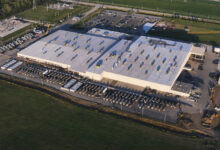
This creates a regulatory gray area for the Dalian request. Because Mod B was structurally completed three years ago, SK hynix can argue that installing tools constitutes finishing an existing project rather than expanding the factory’s footprint. However, adding equipment would undeniably raise total NAND production volume, directly testing the Commerce Department’s definition of prohibited expansion. Officials have not yet signaled how they will interpret that distinction.
Solidigm holds limited authorization, granted by the Commerce Department last December, to receive specific equipment shipments through 2026. No corresponding approval has been issued for 2027, leaving the company’s near-term production pipeline uncertain.
To break the impasse, SK hynix is leveraging a critical vulnerability in the American semiconductor supply chain. Despite billions of dollars allocated through the CHIPS and Science Act to subsidize domestic logic chip manufacturing, the United States lacks any active commercial production of NAND flash memory. Micron Technology, the last major American manufacturer of NAND, ceased domestic production of the memory type years ago when it shifted its primary fabrication efforts to Singapore and Japan. An SK hynix-built fab would restore a strategic capability that Washington currently cannot access domestically.
The proposal ties this investment directly to continued access to American tools for the Chinese operation. By offering to build in the U.S., SK hynix provides the Trump administration with a tangible domestic manufacturing victory while securing the operational continuity of its most profitable enterprise storage division.
Financial mechanics complicate the timeline. Constructing a modern memory fab typically requires well over $10 billion and several years of development. Increased NAND output from a fully equipped Dalian plant would generate the revenue necessary to help finance American construction and sustain Solidigm until domestic production comes online. To further secure capital, the company is evaluating an initial public offering potentially scheduled for 2027.
Technology roadmaps add another layer of complexity. Solidigm currently relies on Dalian as the sole global production site for its 192-layer floating-gate 3D NAND architecture. Unlike the charge-trap technology favored by competitors such as Samsung and Micron, Solidigm retained Intel’s floating-gate design because of its endurance advantages in write-heavy enterprise environments. At Computex 2026, Avi Shetty, who leads the company’s AI solutions and ecosystem business, confirmed plans to develop fifth- and sixth-generation floating-gate NAND.
Scaling production of the existing 192-layer memory and transitioning to next-generation architectures require distinct regulatory treatments under U.S. export controls. Installing tools to produce more of the current generation is one negotiation; obtaining permission to manufacture an entirely new node in Dalian is another. The SK hynix proposal does not specify which NAND generation a future American fab would produce, nor does it clarify whether requested Dalian licenses would cover equipment needed for upcoming technological shifts.
None of the structural changes are finalized. The U.S. fab remains a formal proposal awaiting government response, the equipment requests sit in regulatory review, and the IPO is still under internal evaluation. The Commerce Department’s limited authorization for 2026 equipment deliveries currently dictates the pace at which Solidigm can activate its idle Dalian cleanrooms.