Uniswap v3 LPs Missing Out on $150 Million Annually Due to Idle Capital, Dune Study Finds
A new report commissioned by 1inch highlights the high cost of manual liquidity management in concentrated liquidity pools.
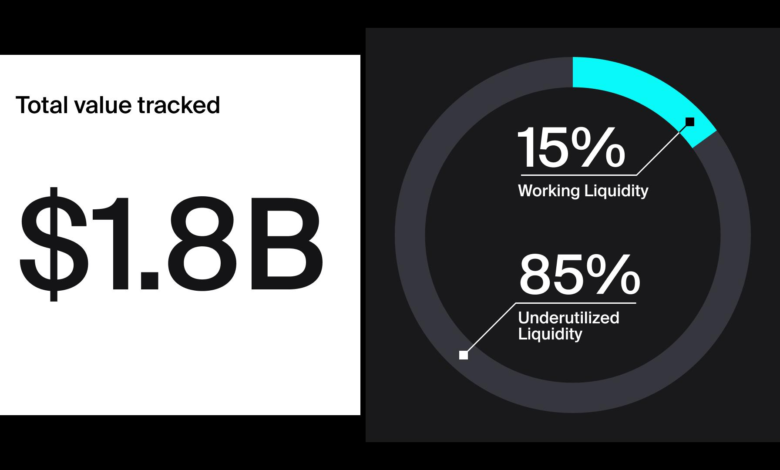
The promise of concentrated liquidity revolutionized decentralized finance (DeFi) when Uniswap v3 launched in 2021, offering unprecedented capital efficiency. However, a new study reveals that this advanced mechanism has also left a massive trail of inactive assets in its wake, costing users millions in lost revenue.
According to research conducted by blockchain analytics platform Dune, liquidity providers (LPs) on Uniswap v3 are missing out on an estimated $150 million in fees annually because their capital is sitting idle outside of active trading ranges.
Dune estimated that these out-of-range providers, that are sitting idle, could be missing roughly $150 million in fees each year, based on a blended in-range fee APR of about 35%.
The Mechanics of Concentrated Liquidity
In automated market maker (AMM) models, liquidity providers deposit token pairs that decentralized exchanges use to complete swaps. They earn a share of the fees paid for trades using that liquidity pool while their positions remain in the range they set.
Unlike older protocols where capital was spread thinly across all price points from zero to infinity, Uniswap v3 allows users to bound their funds within custom price intervals. When the market price of an asset fluctuates outside an LP’s specified boundaries, the position goes out-of-range and ceases to earn trading fees. To resume earning, the LP must manually adjust their parameters—a process that requires burning the existing position and minting a new one.
The Retail vs. Whale Divide
The Dune study highlights a stark contrast in how different tiers of market participants manage their positions. Smaller retail depositors struggle significantly to keep their capital active. Around 54% of liquidity in positions below $1,000 was out of range, compared with 26% for positions above $1 million.
This disparity is largely driven by economic realities. For a retail user with a small deposit, the gas fees required to constantly adjust and rebalance a position can easily wipe out any potential yield.
However, while larger players are more diligent in keeping their positions active, their sheer size means they still represent the lion’s share of unused funds. The study found that positions worth more than $1 million accounted for 47% of all idle capital, or roughly $260 million.
Manual Management vs. Automation
The research also underscores the limitations of manual portfolio management in fast-moving crypto markets. While contract-managed positions stayed within a more consistent range, individual wallets accounted for between 82% and 94% of the attributed idle capital on Uniswap v3, depending on the chain. That suggests liquidity deposited directly by users and requiring manual adjustments is more likely to go unattended and fall out of range.
Smart contract-managed positions, often operated by automated liquidity managers or yield optimizers, programmatically adjust ranges to track market prices. This automation drastically reduces the time and attention required from individual LPs, though it does not completely eliminate risk.
Indeed, the research said that the figure is not guaranteed recoverable income. Keeping positions active can add transaction costs, execution risk and exposure to unfavorable price movements. Constant rebalancing can lead to impermanent loss, where the value of holding the tokens outright exceeds the value of providing liquidity, especially during periods of high volatility.
Industry Implications and the Road Ahead
The study comes at a pivotal moment for decentralized exchange aggregators looking to solve capital inefficiency. Decentralized exchange aggregator 1inch commissioned the research ahead of the planned launch of Aqua, a new liquidity protocol. Dune said it developed the methodology and reached its conclusions independently.
By highlighting the massive volume of underutilized capital, the findings validate the industry’s push toward automated liquidity management solutions. As protocols like Aqua prepare to enter the market, the goal is to bridge the gap between retail simplicity and institutional-grade efficiency, ensuring that capital does not sit idle while millions in potential fees go uncollected.