Robinhood Chain Signals New Era of Tokenized Equities on Ethereum Layer-2
The platform integrates tokenized stocks and ETFs via Arbitrum technology.

The launch of Robinhood Chain on July 1, 2026, represents a strategic shift for the brokerage firm, moving from a retail interface to a foundational infrastructure provider for tokenized real-world assets. By deploying an Ethereum layer-2 network built on Arbitrum technology, the company is attempting to bridge the gap between traditional brokerage services and the borderless nature of decentralized finance.
Johann Kerbrat, SVP and general manager of crypto and international at Robinhood, stated that the initiative aims to expand financial ownership globally by merging the efficiencies of decentralized finance with traditional market structures. This move comes as the broader financial industry increasingly explores the tokenization of assets to improve settlement speeds and reduce intermediary costs.
At the center of this ecosystem are Stock Tokens, blockchain-based instruments that provide exposure to equities and ETFs. Robinhood has clarified that these are not direct legal shares and do not grant voting rights. Furthermore, due to the complex regulatory environment surrounding digital securities, these tokens are currently unavailable to U.S. users. The company noted on its website that these assets are not registered under U.S. securities laws and are subject to strict distribution restrictions in jurisdictions including the United Kingdom and Canada.
Technically, the network operates as a customizable layer-2 system that uses ETH for gas fees. Unlike the competitive fee structures found on many blockchains, Robinhood Chain employs a first-come, first-served sequencing model. This prevents users from paying premium fees to jump the queue, a decision that aligns with the firm’s historical emphasis on democratizing market access.
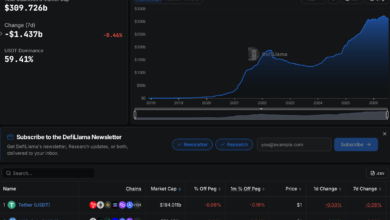
Early performance metrics indicate significant retail interest, though the nature of that activity remains mixed. In its debut week, the network processed over 17 million transactions and saw decentralized exchange volume surpass $1 billion. However, a discrepancy has emerged regarding the network’s scale; while internal Robinhood metrics placed the total value locked at $250 million, independent data from DefiLlama tracked the core protocol at approximately $94 million.
While the network is designed for institutional-grade tools like Morpho for lending and Chainlink for price oracles, the initial surge in traffic was driven largely by speculative assets. The meme coin Cash Cat emerged as a primary driver of early volume, reflecting a familiar pattern where high-speed, low-fee networks attract volatile retail trading before established financial applications take root.
Infrastructure support for the network is already diverse, featuring integrations with BitGo for custody and Paxos for stablecoin liquidity. Developers are able to build on the network using standard Ethereum tools, as the environment remains fully compatible with the Ethereum Virtual Machine.