US Regulators Miss Key GENIUS Act Deadline, Leaving Stablecoin Framework in Limbo
One year after President Trump signed the landmark stablecoin bill, federal agencies fail to finalize rules, prompting industry calls to pass the CLARITY Act.
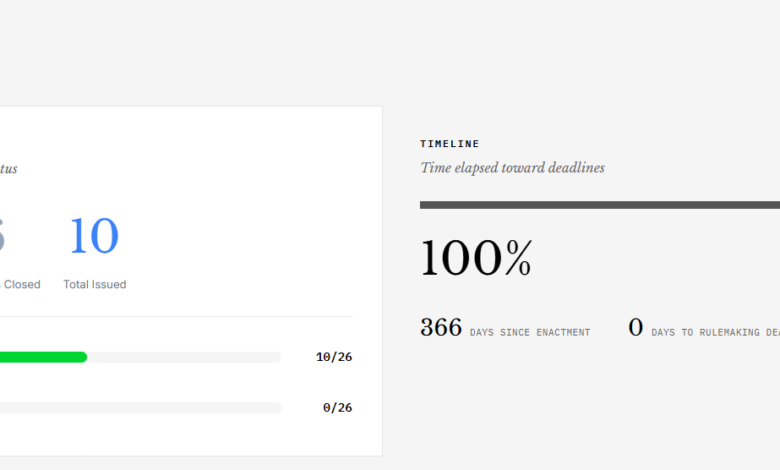
Federal financial regulators missed a critical statutory deadline on Saturday, marking one full year since the landmark Guiding and Establishing National Innovation for US Stablecoins (GENIUS) Act was signed into law. The milestone passed without the implementation of finalized rules, leaving the digital asset industry to navigate an incomplete regulatory landscape.
The GENIUS Act, which was signed into law by President Donald Trump on July 18, 2025, was hailed as the country’s first comprehensive federal regulatory framework for stablecoins. Designed to bring structural integrity to pegged digital assets—which serve as the primary liquidity plumbing for the broader decentralized finance (DeFi) and crypto markets—the law mandated that federal agencies establish clear, uniform guidelines within 12 months. However, despite a flurry of preliminary activity, no final regulations were codified before the July 18, 2026, cutoff.
According to rulemaking trackers maintained by law firm Chapman and crypto investment firm Paradigm, several key agencies—including the Department of the Treasury, the Office of the Comptroller of the Currency (OCC), the Federal Deposit Insurance Corporation (FDIC), and the Federal Reserve Board—published preliminary proposals and gathered public feedback over the past year, but failed to cross the finish line.
While missing the statutory deadline does not invalidate the GENIUS Act, legal experts warn that the lack of finalized rules will perpetuate regulatory uncertainty for stablecoin issuers. Without concrete federal standards, issuers of dollar-pegged assets remain in a holding pattern regarding reserve management, custody requirements, and operational compliance.
A Year of Proposals but No Final Rules
The failure to meet the deadline was not due to a lack of administrative effort. Federal regulators issued 10 notices of proposed rulemaking (NPRM) during the GENIUS Act’s inaugural year, according to data compiled by Paradigm. These proposals sought to divide oversight responsibilities among the nation’s primary financial watchdogs, but ultimately stopped short of finalization.
The Department of the Treasury led the administrative push by issuing four proposals. These covered the broad implementation of the act, including standards for determining whether state-level stablecoin regulatory regimes are equivalent to the federal framework, registration requirements for foreign stablecoin issuers, and compliance guidelines for anti-money laundering (AML) and counter-terrorist financing (CTF) measures.
Other banking regulators focused on their respective jurisdictions:
- The OCC issued two NPRMs targeting nationally chartered payment stablecoin issuers, outlining approval requirements and ongoing supervisory standards.
- The FDIC issued one NPRM focused on FDIC-supervised institutions that issue payment stablecoins, concentrating on supervisory expectations and operational standards such as reserve management.
- The National Credit Union Administration (NCUA) proposed rules enabling federally insured credit unions to participate in stablecoin issuance.
- Additionally, federal banking agencies jointly proposed an interagency implementation rule designed to harmonize supervision across the OCC, the Federal Reserve, and the FDIC to ensure consistent expectations across the banking sector.
Industry Calls for the CLARITY Act
As the GENIUS Act’s rulemaking process stalls, industry participants are urging lawmakers to maintain momentum by advancing broader market structure legislation. On Friday, federally chartered crypto bank Anchorage Digital published a report calling on Congress to pass the Digital Asset Market Clarity Act (CLARITY).
“On GENIUS’ one-year anniversary, we’re renewing our call for Congress to pass the CLARITY Act and extend the clear market-structure rules that worked for stablecoins to the broader digital asset economy,” Anchorage Digital wrote in its report.
The Digital Asset Market Clarity Act aims to establish the first comprehensive federal regulatory framework for the wider digital asset market in the United States. The bill cleared the Senate Banking Committee in May, but it has faced significant pushback from traditional financial institutions and banking trade groups.
The primary point of contention centers on the bill’s stablecoin yield provisions. Traditional banking groups argue that allowing crypto firms to offer yields on stablecoins without subjecting them to the same rigorous regulatory and capital requirements as commercial banks poses a systemic risk.
On July 13, a coalition of state banking associations, alongside the American Bankers Association (ABA) and the Independent Community Bankers of America (ICBA), sent a joint letter to Senate leadership. The groups urged lawmakers to provide more detail on the CLARITY Act’s yield provisions, arguing that amendments are necessary to prevent payment stablecoins from acting as deposit substitutes rather than pure transaction tools.
The mounting political friction has clouded the bill’s legislative prospects. On June 26, research firm Galaxy Digital cut its estimated odds of the CLARITY Act becoming law in 2026 to 50%. Galaxy pointed to several legislative hurdles, including the lack of a unified Senate Banking-Agriculture committee text, the absence of a firm floor schedule, and a rapidly narrowing legislative window before lawmakers leave Washington for recess.