Visa Launches Dedicated Stablecoin Platform to Bridge Legacy Finance and Digital Assets
The payments giant is integrating OUSD and expanding its blockchain-based settlement capabilities for 15,000 financial institutions.
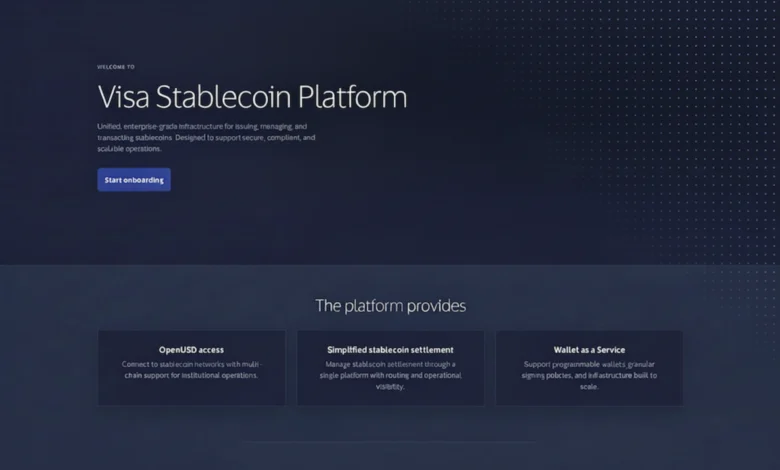
In the high-stakes race to modernize the plumbing of global finance, Visa is moving to cement its role as the primary bridge between traditional banking and the burgeoning world of digital assets. The payments giant on Thursday unveiled the Visa Stablecoin Platform, a sophisticated internal system designed to allow banks and fintech firms to integrate stablecoins directly into their existing treasury and payment workflows.
The move represents a significant scaling of Visa’s digital asset strategy. While the company already settles approximately $15 trillion in total payments annually, it has quietly built a multibillion-dollar pipeline for stablecoin settlements. By launching this dedicated platform, Visa aims to simplify the transition for its massive network, which includes roughly 15,000 financial institutions and more than 200 million merchants worldwide.
Stablecoins—digital currencies typically backed 1-to-1 by dollar reserves—have emerged as a critical tool for institutional finance because they combine the speed and transparency of blockchain technology with the price stability of fiat currency. However, for many legacy institutions, the technical hurdle of managing private keys and interacting with decentralized ledgers remains a barrier to entry.
“It’s less about accessing stablecoins and more about how… this interoperate[s] with their treasury settlement, their money movement workflows, [and] their existing bank setups,” Rubail Birwadker, Visa’s global head of growth, told Fortune.
For the modern merchant, the value proposition of a blockchain-based settlement layer is clear: the ability to bypass the traditional multi-day settlement cycles of the legacy banking system in favor of near-instant transactions at a fraction of the cost. Because these transfers occur on a blockchain, they provide a permanent, tamper-proof record that simplifies auditing and reconciliation.
The platform’s inaugural asset will be OUSD, a stablecoin introduced just two weeks ago by Open Standard, a newly formed consortium of major financial players. Visa, a founding partner of Open Standard, views OUSD as a strategic anchor for its new infrastructure. The asset joins a growing stable of supported tokens on Visa’s network, including Circle’s USDC and Paxos’ USDG.
The push into stablecoins is not a sudden pivot but the culmination of a half-decade of experimentation. Visa’s history with the technology dates back to March 2020, when it became the first major payments network to settle transactions in USDC. Last December, the company further signaled its intent by rolling out a dedicated stablecoin settlement program. According to Birwadker, the new Visa Stablecoin Platform will act as an umbrella, unifying these disparate services into a single, cohesive offering.
Birwadker noted that the ultimate goal is to abstract away the underlying technical complexity, allowing clients to reap the benefits of blockchain without needing to overhaul their entire technological stack. “We want to bring them along on this journey… and we’ve been doing that for the better part of half a decade, and this is just the next iteration,” he said.
Visa is far from alone in its pursuit of the stablecoin market. Its primary competitors, American Express and Mastercard, are also members of the Open Standard consortium. Mastercard has been particularly aggressive in its own right, recently introducing a program for banks to settle card transactions using six regulated dollar-backed assets. Mastercard’s strategy has focused heavily on external partnerships, including tie-ups with MoonPay and the Paxos Global Dollar network, to allow consumers to spend digital assets via traditional plastic.
As the regulatory environment for digital assets begins to stabilize globally, the competition between these payment titans is shifting from experimental pilots to the construction of permanent, industrial-scale infrastructure. By integrating stablecoins into the core of its treasury settlement operations, Visa is betting that the future of money movement will be defined by the seamless blending of the old world and the new.