Naver Bets on Sovereign AI and Custom Chips to Challenge Google and OpenAI
South Korean tech leader defends 59% search share with HyperCLOVA X and non-English model exports
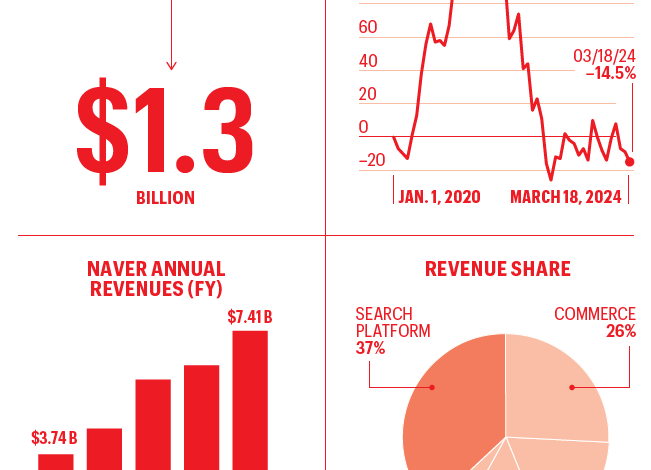
South Korean internet firm Naver Corp. is pivoting to customized non-English “sovereign AI” platforms and hardware partnerships to defend its regional dominance against global technology giants Google and OpenAI. As generative artificial intelligence platforms built primarily on English-language data expand globally, Naver is deploying localized large language models as a central defense for its core search engine, commerce services, and growing enterprise cloud computing business.
Naver has maintained a dominant search presence in South Korea, making the country one of the few global markets where a homegrown platform successfully outpaces U.S. internet search engines without government intervention or regulatory market barriers. As of September 2023, Naver controlled 59% of South Korea’s search market compared to Google’s 31%. Originally launched in 1999 when founder Lee Hae-jin spun out an internal Samsung project into an independent entity, Naver surpassed domestic web portal Daum in the mid-2000s by designing a feature-dense homepage packed with icons, links, and direct community answers tailored specifically to South Korean consumer preferences.
The firm reported record operational results in 2023, earning 9.6 trillion won ($7.41 billion) in revenue, driven by search operations that generated 37% of sales and e-commerce services that contributed 26%. Operating profit also reached a record $1.3 billion. However, Naver shares have traded roughly 60% below their peak during the COVID-19 pandemic, reflecting market concerns over slowing core search revenue growth, which rose 0.6% in 2023, and a 10% decline in display advertising revenue, alongside mounting artificial intelligence development costs.
Naver has a chatbot, CLOVA X, and an AI-powered search engine, Cue. Both are built on its Korean-language large-language model, HyperCLOVA X, which outperforms OpenAI’s GPT in Korean, recent studies say. Naver has claimed that HyperCLOVA, an earlier version of its model, was trained on 6,500 times as much Korean data as GPT-3.0, which underpins OpenAI’s ChatGPT. Naver is also partnering with Saudi Aramco on an Arabic large-language model.
Choi is especially interested in what she calls “sovereign AI,” or a model that’s tailored to an individual user. “We focus on what companies and governments that want to use AI would want, and what needs Big Tech can’t fulfill,” she says. As AI becomes more common, “each group will need an AI model that best understands” its unique traits.
To commercialize its sovereign AI capabilities internationally, Naver has targeted public sector clients in the Middle East seeking tailored cloud and data systems. In late 2023, Naver signed a $100 million contract with Saudi Arabia’s Ministry of Municipal and Rural Affairs and Housing to construct cloud-based 3D digital twin mapping systems across five Saudi cities, as reported by Reuters. The project serves as an export model for Naver’s sovereign technology stack, allowing sovereign entities to retain administrative control over their local data infrastructure rather than transferring hosting to U.S.-based hyperscalers.
Sources: Bloomberg; Naver
Chief Executive Officer Choi Soo-yeon, a Harvard-educated lawyer who took leadership of Naver in 2022, noted that integrating generative AI into consumer search requires rigorous management of false outputs, known as AI hallucinations. “People need accurate information through search,” Choi said, stating that she expects hallucination rates in enterprise and consumer tools to drop significantly in near-term model releases.
Choi also emphasized that generative artificial intelligence products will not completely replace standard search formats that list hyperlinked sources. “Not all questions in the world have a single correct answer,” Choi stated, explaining that user demand for comparative exploration across multiple web sources remains vital alongside conversational AI summaries.
To reduce computing hardware expenses associated with running HyperCLOVA X, Naver is building custom semiconductor partnerships with global hardware providers. According to Samsung Electronics, Naver collaborated with the chipmaker to co-develop a specialized low-power AI inference chip known as Mach-1, designed to accelerate processing efficiency and cut energy consumption for large language model workloads. In addition, Naver partnered with Intel to launch a joint AI software laboratory in South Korea, enabling engineering teams to optimize enterprise AI software frameworks specifically for Intel’s Gaudi AI accelerators.
Choi cited South Korea’s advanced domestic chipmaking ecosystem as an advantage in deploying localized models using hardware tailored for non-English character sets. Addressing the industry-wide dependency on dominant graphics processor supplier Nvidia, Choi noted in English that “it’s not healthy to rely on just one company,” confirming Naver’s long-term plan to diversify its AI chip architecture across multiple hardware platforms.